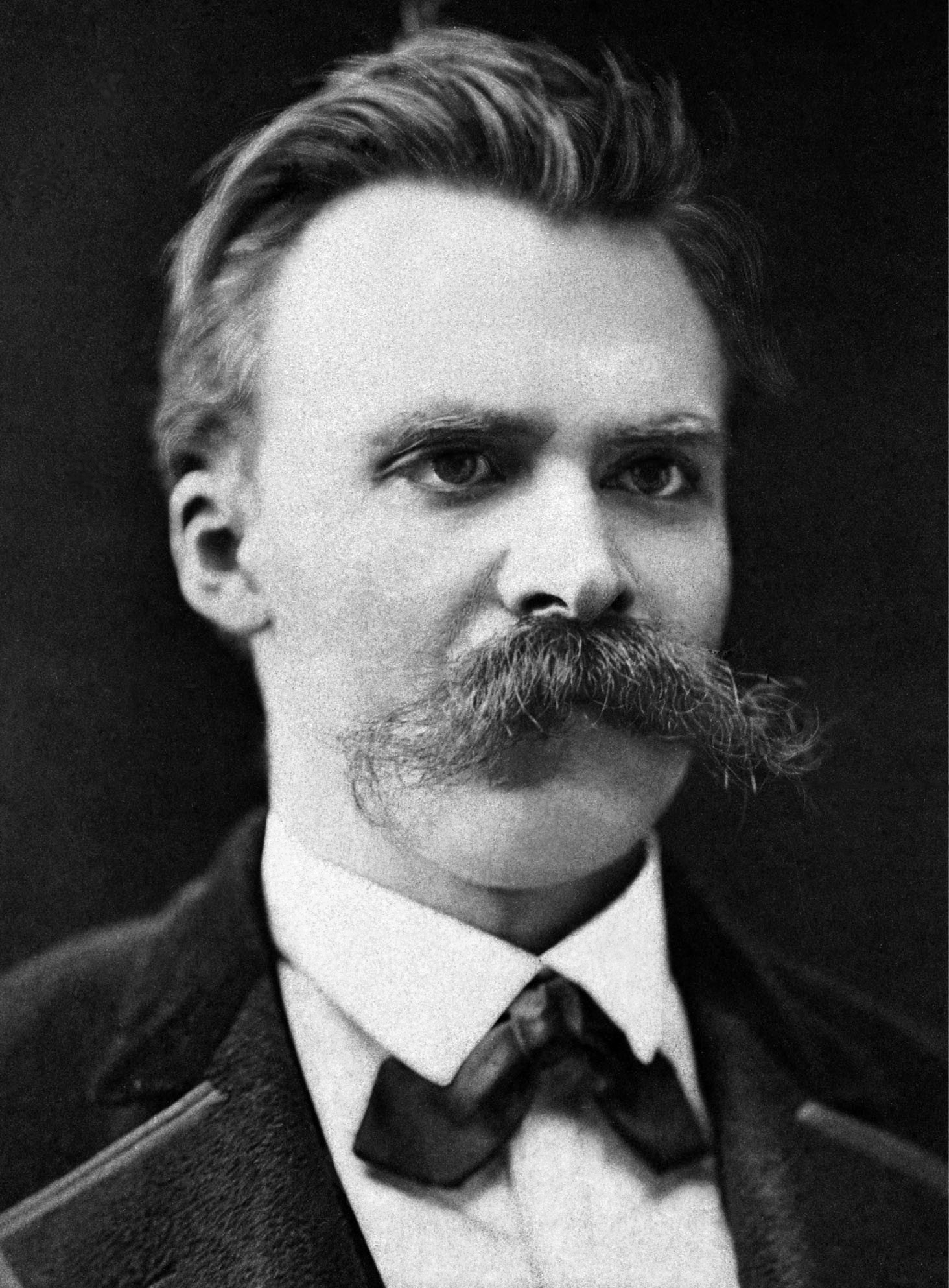
The first fact about Friedrich Nietzsche in a public catalog is a chair and then a book that betrayed the chair’s method. Basel appointed him in 1869 (https://www.unibas.ch/en.html (opens in a new tab); life-works at https://plato.stanford.edu/entries/nietzsche-life-works/ (opens in a new tab)). In 1872 Die Geburt der Tragödie used Wagner and Schopenhauer as keys to Attic drama. Nietzsche Source’s eKGWB (https://doc.nietzschesource.org/en/ekgwb (opens in a new tab)) and Stanford (https://plato.stanford.edu/entries/nietzsche/ (opens in a new tab)) independently date that break with source philology. The Wilamowitz quarrel is a contemporary reception; it is not stored here as his deed. The 1872 Cosima preface-cluster includes a Greek-State argument that culture needs a labouring class held down. Human, All Too Human (1878), Zarathustra (1883), Beyond Good and Evil (1886; English at https://www.gutenberg.org/ebooks/4363 (opens in a new tab)), and On the Genealogy of Morality (1887; https://www.gutenberg.org/ebooks/52319 (opens in a new tab)) teach rank, anti-levelling, anti-pity, woman as a type, and the blond beast. Stanford’s moral-political entry (https://plato.stanford.edu/entries/nietzsche-moral-political/ (opens in a new tab)) does not let a later slogan erase those pages. The Case of Wagner (1888) sickens a festival public. Twilight appears in January 1889 as he collapses. The Antichrist is his 1888 text issued in 1895. Ecce Homo becomes a public self-file in 1908. Then the heading is stolen. The 1901 Wille zur Macht is Elisabeth Förster-Nietzsche’s compilation (Weimar Archiv: https://www.klassik-stiftung.de/en/nietzsche-archiv/ (opens in a new tab)). The 1930s honour at that house is National Socialist reception, not his invitation. Britannica (https://www.britannica.com/biography/Friedrich-Nietzsche (opens in a new tab)) and Stanford independently require that split. He wrote against Förster’s antisemitic politics; those letters are an improving minority-rights row, not a rebate that deletes blond beast. The offsets are URLs with dates. 1870 medical orderly service is in the life-works record. The same 1878–1887 books are also method and vernacular access. Colli–Montinari from 1967 (https://www.degruyter.com/serial/nietzkw-b/html (opens in a new tab)) and eKGWB replace the fake spine. SEP and IEP (https://iep.utm.edu/nietzsch/ (opens in a new tab)) flag the sister problem. Cambridge’s companion (https://www.cambridge.org/core/books/cambridge-companion-to-nietzsche/ (opens in a new tab)) is a classroom file. Gutenberg Zarathustra (https://www.gutenberg.org/ebooks/1998 (opens in a new tab)) is cheap English with translation risk. Sils (https://www.nietzschehaus.ch/ (opens in a new tab)) is a later door. What the score must not say: that he legislated 1935; that 1901 is his summa; that 1870 orderly work cancels 1887 anti-pity; that ‘God is dead’ is a lab result; that Übermensch is a racial statute he signed; that a 1997 encyclopedia undid 1886 woman-aphorisms. Complex contribution is the honest type for Archiv, KGW, and museums. Direct is honest for Basel and for books he issued before 3 January 1889. Confidence is high on those imprints, medium on unique modern indicator coefficients. 1869 is not 1872. 1887 is not 1901. 1901 is not 1934. Off-family indicator padding — a health series nailed to Turin without a mechanism — is refused. Related people are Wagner, Schopenhauer, Goethe, Luther as Genealogy object, Voltaire as 1878 dedicatee, Rousseau as a frequent opponent, Overbeck who fetched him from Turin, Elisabeth who ran the Archiv, Lou Salomé as 1882 interlocutor, and Machiavelli as a rank-politics counterpart in later reading. The useful question is which public pages still move knowledge, rank, and minority-rights drivers under this name without inventing a Nazi party card.
His attacks on equality were not a Nazi party program
Nietzsche's political vocabulary is deliberately anti-egalitarian, and Beyond Good and Evil in 1886 is one of the clearest places where he criticizes democratic leveling, mass morality and the ideal of equal worth. The Stanford Encyclopedia of Philosophy (opens in a new tab) emphasizes that his moral and political thought attacks egalitarian morality and celebrates forms of rank, excellence and self-overcoming. Those positions are real and cannot be sanitized into modern liberalism. They also do not map neatly onto later German nationalism. Nietzsche repeatedly attacked German chauvinism, mass politics and antisemitism, and in the late 1880s he broke with people in his circle who promoted antisemitic causes. The distinction matters because his sister Elisabeth Förster-Nietzsche later became deeply involved in nationalist and antisemitic politics and helped shape the posthumous archive. Reading Nietzsche's hostility to equality alongside his explicit hostility to antisemitism is necessary to avoid both whitewashing the hierarchical parts of his philosophy and falsely treating him as the author of twentieth-century Nazi racial ideology.
The 1888 rupture with Wagner sharpened his late critique
Nietzsche's final productive year, 1888, concentrated several of his most polemical works. The Case of Wagner turned his earlier admiration for Richard Wagner into an attack on what Nietzsche saw as cultural decadence, theatrical manipulation and German nationalist taste. In the same year he wrote The Antichrist, a frontal assault on Christianity that was not published until 1895. The Stanford life-and-works entry (opens in a new tab) places these texts immediately before his mental collapse in Turin in January 1889. After that collapse Nietzsche never returned to sustained philosophical work; his mother and then his sister controlled access to his manuscripts and reputation. The Nietzsche Archive (opens in a new tab) is inseparable from that afterlife because editorial decisions made around the archive helped construct later images of Nietzsche. The result is a record in which the chronology of 1886–1888 matters: anti-egalitarian philosophy, anti-antisemitic statements, the break with Wagner and anti-Christian polemic belong to the same late period and should be judged together rather than selectively.