
Karl A. Lamers
Karl Alfred Lamers (born 12 February 1951 in Duisburg-Hamborn), recorded in parliamentary and library files as Karl A. Lamers…
- Facts0
- Drivers0
- Indicators0
Karl Alfred Lamers (born 12 February 1951 in Duisburg-Hamborn), recorded in parliamentary and library files as Karl A. Lamers…
Karl Alfred Lamers (born 12 February 1951 in Duisburg-Hamborn), recorded in parliamentary and library files as Karl A. Lamers, is a German lawyer and politician of the Christian Democratic Union. The German National Library authority file lists him as a member of the Bundestag from 10 November 1994 to 26 October 2021, covering the 13th through 19th electoral terms. In the 19th term the Bundestag recorded a directly elected mandate for constituency 274, Heidelberg. A different CDU member of the same surname, Karl Lamers, was born in Königswinter, sat in the Bundestag from 1980 to 2002 as the CDU/CSU group's foreign-policy spokesman, and died on 27 August 2022.
Lamers passed the Abitur in 1969, studied law at the University of Münster, took the first state examination there, received a doctorate in law, and passed the second state examination in Stuttgart. His dissertation, accepted by the Münster law faculty in 1976 and published in 1977 by Duncker & Humblot, examined the representation and integration of foreigners in the Federal Republic of Germany, with particular attention to voting rights and a comparison of municipal franchises in the European Communities. He then worked as a research associate and Referent at the Max Planck Institute for Comparative Public Law and International Law in Heidelberg, and as a Ministerialrat in the Landtag of Baden-Württemberg, where he headed the personal office of the Landtag president and handled the parliament's international relations. The Bundestag's register of outside activities during the 19th term listed him as a lawyer with the Mannheim firm Hengerer & Niemeier.
He joined the Junge Union and the CDU in 1975, served as deputy state chairman of the Junge Union in Baden-Württemberg from 1981 to 1986, chaired the CDU district association in Heidelberg from 1985 to 2003, and was its honorary chairman from 2003. From 1987 to 1995 he was a member of the Heidelberg city council. In the Bundestag he belonged to the Defence Committee, chaired its subcommittee on the further development of Innere Führung from 2003 to 2007, and was deputy chairman of the Defence Committee from 2006, while also sitting as a substitute member of the Foreign Affairs Committee.
He was a member of the NATO Parliamentary Assembly from 1998, head of the German delegation from 2006, and chairman of its Political Committee from 2008 until his election as president. On 16 November 2010 the Assembly elected him president by acclamation at its 56th annual session in Warsaw, in succession to John Tanner of the United States; he told the session that dialogue, cooperation and communication would guide the presidency, and he was due to represent the Assembly at the NATO Lisbon summit. The Assembly's list of presidents gives his term as 2010–2012, followed by Hugh Bayley of the United Kingdom. He was president of the Atlantic Treaty Association from 2008 to 2014, and the 19th-term disclosure listed him as its vice-president and as vice-president of the Deutsche Atlantische Gesellschaft. Mykolas Romeris University in Vilnius named him an honorary doctor in 2011. The Estonian foreign ministry lists him as honorary consul in Heidelberg, with Baden-Württemberg as his consular district.
Karl Alfred Lamers, the fuller form recorded by the German National Library for the preferred name Karl A. Lamers, was born on 12 February 1951 in Duisburg-Hamborn, in West Germany. The Bundestag biography, drawn from his own information, states that he is Catholic and that he passed the Abitur in 1969, without naming the school. The dissertation he later published is dedicated "Meinen Eltern" ("To my parents") and does not name them.
He studied law and political science (Rechts- und Staatswissenschaften) at the Westfälische Wilhelms-Universität in Münster. The biography for the 19th Bundestag shortens that course to the study of law. He passed the first state examination in law in Münster, received the doctorate—styled Dr. der Rechte in the earlier biography and Dr. jur. in the later—and passed the second state examination in Stuttgart. Neither text dates the second examination.
The thesis was finished in the autumn of 1976 and, the preface says, submitted to Münster's law faculty in February 1977; the Deutsche Nationalbibliothek catalogues it as a 1976 dissertation of that faculty. Writing from Heidelberg in May 1977, Lamers thanked his teacher, Professor Werner Hoppe, for his support; Hoppe held Münster's chair of spatial planning and public law from 1972 to 1995. He also thanked Hermann Mosler and Rudolf Bernhardt, directors of the Max Planck Institute for Comparative Public Law and International Law, for supporting his research and recommending a doctoral scholarship of the Max Planck Society, and the Commission of the European Communities for information and suggestions.
Duncker & Humblot in Berlin published the dissertation in 1977 as volume 328 of Schriften zum Öffentlichen Recht, a book of 164 pages: Repräsentation und Integration der Ausländer in der Bundesrepublik Deutschland unter besonderer Berücksichtigung des Wahlrechts. Zugleich eine rechtsvergleichende Studie über das Kommunalwahlrecht in den Staaten der Europäischen Gemeinschaften (ISBN 3-428-04006-6).
The introduction placed the subject against the foreign population of the Federal Republic, which Lamers, citing the statistical yearbooks, put at 2.381 million in September 1969 and 4.127 million at the end of September 1974, many of them resident for more than five years and some for more than ten. He wrote that the Council of Europe, the European Communities and the Council of European Municipalities (Rat der Gemeinden Europas) had turned from economic and social status toward political rights, and that the Paris summit of 9–10 December 1974 had charged the Commission with examining "special rights" for Community nationals, chiefly political rights. Debate, in his account, had shifted from national and regional parliaments to the municipal franchise.
The first part asked whether foreigners could vote, and stand, for the Bundestag, the Landtage and municipal councils under the Basic Law as it stood (de constitutione lata) and by amendment (de constitutione ferenda), working through Articles 20, 28, 38 and 79. Treating the constitution then in force as a barrier to that franchise, it surveyed participation already lawful—foreigners' parliaments, coordination circles, advisory councils (Ausländerbeiräte), expert citizens, and roles in universities, the public service, social insurance, works councils, trade unions and parties. Lamers concluded that only municipal elections could give foreigners real local influence and integrate them into the host state's political and social system, so that such a vote would be a further stage of integration rather than an isolated right. He took "foreigner" from section 1(2) of the Ausländergesetz.
The second part compared the municipal franchise, including nationality, residence and compulsory voting, in Belgium, Denmark, France, the United Kingdom, Ireland, Italy, Luxembourg and the Netherlands. It weighed a European indigenat, dropping the nationality requirement, naturalization and a "small naturalization" (kleine Einbürgerung) as routes to a local vote for citizens of the Communities.
Lamers's documented connection with the Max Planck Institute for Comparative Public Law and International Law (Max-Planck-Institut für ausländisches öffentliches Recht und Völkerrecht) in Heidelberg began while his doctorate was still before the faculty. The dissertation, completed in the autumn of 1976 and submitted in February 1977 to the law faculty of the University of Münster, was published in 1977 by Duncker & Humblot as Repräsentation und Integration der Ausländer in der Bundesrepublik Deutschland unter besonderer Berücksichtigung des Wahlrechts, with a comparative study of municipal voting rights in the member states of the European Communities. In a preface dated Heidelberg, May 1977, he thanked the institute's directors, Hermann Mosler and Rudolf Bernhardt, for supporting that work and for recommending a doctoral scholarship from the Max Planck Society.
The institute describes itself as having been founded in 1924 at the Berlin Palace and established anew in Heidelberg in 1949, with basic research in public international law, European Union law, and comparative constitutional and administrative law. A separate staff appointment is recorded only after the second state examination in law, which the biographical notes place in Stuttgart. The archived biography for the 19th Bundestag, drawn from the member's own information, calls him a wissenschaftlicher Assistent and Referent at the institute. A biography from the 17th Bundestag uses the shorter title wissenschaftlicher Referent, and a curriculum issued for his October 2011 address to the NATO Parliamentary Assembly describes him as a fellow there. None of these accounts dates the start or the end of the appointment.
From the institute, the same biographies move him into the higher civil service of the Landtag of Baden-Württemberg. They record him as a Ministerialrat in the state parliament, head of the personal office of the Landtag president (Leiter des Persönlichen Büros des Landtagspräsidenten), and the official responsible for maintaining the parliament's international relations. The 2011 curriculum renders that post in English as senior civil servant and head of the office of the president of the state parliament. The published accounts do not name the president he served, and they give no dates for when he entered or left the Landtag administration. They present the office as the post he held before membership of the Bundestag, which those biographies date from 1994.
Bundestag profiles list his occupation as Rechtsanwalt. The 2011 biographical note states that he had been a practising lawyer since 2000, so the practice is recorded as running alongside the parliamentary mandate rather than as the career that preceded it. In the Bundestag's register of members' outside interests he declared a paid activity as a lawyer with the partnership Anwaltssozietät Hengerer & Niemeier in Mannheim. Abgeordnetenwatch, compiling those filings, records the entry as covering the 2013–2017 and 2017–2021 terms, first captured on 29 May 2017 and last changed on 19 November 2018, with the income and interval fields left blank. The disclosures name the Mannheim partnership; they do not describe a firm under his own name or the areas of law in which he worked.
Lamers joined the Junge Union and the Christian Democratic Union (CDU) in 1975. The Junge Union is the independent youth association of the CDU and the Christian Social Union in Bavaria, divided into state, district and local associations whose boards are elected at congresses. From 1981 to 1986 he was a deputy state chairman of the Junge Union in Baden-Württemberg.
For the later years of that term the state chairman was Günther Oettinger. The Baden-Württemberg government biography issued during Oettinger's time as minister-president records him as Landesvorsitzender of the Junge Union Baden-Württemberg from 1983 to 1989, and as a member of the Landtag of Baden-Württemberg from 12 April 1984. Lamers's office as deputy therefore overlapped Oettinger's chairmanship from 1983 to 1986. The same biography dates Oettinger's appointment as minister-president to 21 April 2005.
In 1985, while he was still a deputy state chairman of the Junge Union, Lamers became Kreisvorsitzender of the CDU in Heidelberg. He led the district association, the party's organisation for the city, until 2003. Since 2003 he has been an honorary chairman. The Kreisverband keeps branches across Heidelberg's districts and counts the Junge Union Heidelberg among its associations, together with the Frauen Union, the Senioren Union and the student group RCDS. Its board list still names him Ehrenvorsitzender, a title held alongside other honorary chairmen and distinct from the office of chairman.
From 1987 to 1995 Lamers was a city councillor (Stadtrat) on Heidelberg's Gemeinderat, the municipal council. He joined during the term chosen on 28 October 1984, when the CDU received 35.8 percent of the vote and 15 of the 40 seats.
The two council elections held while he was a member left the CDU the largest group but short of a majority. On 22 October 1989 its share fell to 27.8 percent and 12 seats, ahead of the Social Democratic Party of Germany (SPD) with 26.4 percent and 11 seats and the Grün-Alternative Liste with 19.0 percent and eight. The Freie Wähler Vereinigung took five seats, the Free Democratic Party two, and smaller lists the remaining two. On 12 June 1994 the CDU rose to 30.9 percent and 14 seats; the SPD won 10 and the Grün-Alternative Liste seven, with three seats for the Freie Wähler Vereinigung, two for the independent list Die Heidelberger, one for the FDP and three for smaller lists.
Reinhold Zundel was Oberbürgermeister when Lamers entered the council, having been re-elected on 6 May 1984 with 54.9 percent of the vote. On 21 October 1990 Beate Weber, a member of the SPD since 1970 and a Heidelberg councillor from 1975 to 1985, was elected mayor with 55.5 percent; she was returned on 8 November 1998. Lamers stayed on the Gemeinderat until 1995, after he had entered the Bundestag in 1994.
Lamers, standing for the Christian Democratic Union (CDU), entered the Bundestag at the election of 16 October 1994 by winning the direct mandate in constituency 178, Heidelberg, in Baden-Württemberg. The archived biography for the 19th electoral term lists him as a member since 1994 and, for that term, as directly elected in constituency 274, Heidelberg, with the term running to 26 October 2021. He sat from the 13th Bundestag through the 19th.
The direct seat was not his route in every election. In 1998 and 2002 the first-vote plurality went to the Social Democratic Party (SPD), and the elected constituency member was Lothar Binding. The same Federal Statistical Office volumes list Lamers among candidates finally elected from state lists, second on the Baden-Württemberg CDU list in 1998 and first in 2002. He later counted five direct mandates—1994, then 2005, 2009, 2013 and 2017—and called the 1993 district Heidelberg/Schwetzingen and the later seat Heidelberg/Weinheim.
Returning Officer files number the constituency 178 in 1994 and 1998, 275 in 2002 and 2005, and 274 from 2009.
In 1994, with 189,835 people eligible and turnout of 82.1 per cent, the CDU received 66,359 of 153,760 valid first votes (43.2 per cent) and the SPD 61,945 (40.3 per cent), a margin of 4,414. In 1998 turnout was 84.7 per cent (160,708 of 189,654). Binding and the SPD took 70,603 of 158,507 valid first votes (44.5 per cent); the CDU had 62,516 (39.4 per cent). In constituency 275 in 2002, 174,246 of 208,183 eligible voters took part (83.7 per cent), and the SPD won with 73,918 of 172,289 valid first votes (42.9 per cent) against the CDU's 65,695 (38.1 per cent).
In 2005 Lamers regained constituency 275 by 550 votes. Of 168,437 valid first votes he received 65,242 (38.7 per cent) and the SPD 64,692 (38.4 per cent); turnout was 81.8 per cent of 208,852 eligible voters. In constituency 274 in 2009 he took 57,963 first votes (36.1 per cent) to the SPD's 47,683 (29.7 per cent), with Alliance 90/The Greens on 24,985 (15.6 per cent) and the FDP on 19,314 (12.0 per cent). Turnout was 76.9 per cent.
In 2013 the CDU received 68,061 of 166,319 valid first votes (40.9 per cent), ahead of the SPD on 50,850 (30.6 per cent) and the Greens on 20,392 (12.3 per cent); turnout was 77.9 per cent (168,177 of 215,943). In 2017 the CDU polled 58,019 of 177,570 valid first votes (32.7 per cent), ahead of the SPD on 46,219 (26.0 per cent) and the Greens on 29,664 (16.7 per cent). Turnout was 82.2 per cent (179,138 of 217,934), and the 19th-term biography records that result as his direct mandate. For 2021 constituency 274 was the city of Heidelberg plus eleven municipalities of the Rhein-Neckar-Kreis: Dossenheim, Edingen-Neckarhausen, Eppelheim, Heddesheim, Hemsbach, Hirschberg an der Bergstraße, Ilvesheim, Ladenburg, Laudenbach, Schriesheim and Weinheim.
At a CDU chairs' conference in Edingen-Neckarhausen on 5 March 2020, Lamers said he would not seek renomination and would sit until the new Bundestag met. The Rhein-Neckar-Zeitung reported the decision the next day, quoting his wish to hand over the baton "selbstbestimmt und frei" (of his own accord and freely).
Alexander Föhr, the 39-year-old Heidelberg CDU district chairman and city councillor, said on 27 April 2020 that he would seek the candidacy. CDU delegates meeting in Dossenheim in July 2020 nominated him. Lamers was not a candidate on 26 September 2021. Franziska Brantner of the Greens won constituency 274 with 53,288 first votes (30.2 per cent). Föhr, for the CDU, was second with 42,582 (24.1 per cent), and the SPD received 35,602 (20.2 per cent). Turnout was 81.4 per cent (177,868 of 218,431 eligible voters). The constituency electoral committee adopted that result on 30 September 2021, and Lamers's membership ended with the 19th Bundestag on 26 October 2021.
Karl A. Lamers of the Christian Democratic Union, the member for Heidelberg, sat on the Defence Committee (Verteidigungsausschuss) of the Bundestag from his first term. The biography for the 13th legislative period (1994–1998) lists him as an ordinary member, and a 15th-period list (2002–2005) does so again.
On 8 November 2006 he became deputy chairman, succeeding Thomas Kossendey, who had been appointed parliamentary state secretary in the Federal Ministry of Defence; Ulrike Merten (SPD) chaired. The biography for the 19th period (2017–2021) still lists him as deputy chairman and as an ordinary member, and as a substitute member of the Committee on Foreign Affairs, and states that the deputy chairmanship dated from 2006. Article 45a of the Basic Law requires the committee and lets it constitute itself as a committee of inquiry.
From May 2003 Lamers chaired the subcommittee “Weiterentwicklung der Inneren Führung”. The 16th-period balance gives it a longer formal title, covering political education and the social responsibility of service personnel as tasks changed, and records that the body, begun in the 15th period, handed the Defence Committee a 93-page report on 7 November 2007. Its question was whether the Bundeswehr leadership concept still fitted a force used increasingly abroad. On 6 March 2008 Lamers told the plenary it had met 32 times over four and a half years.
He argued that principles traced to the Bundeswehr’s formation in 1955, and to Wolf Graf von Baudissin and Ulrich de Maizière, still held: the primacy of politics, human dignity, the citizen in uniform, and the rule of law. He called Innere Führung “unique in the whole world” and “dynamic enough to serve in future as an ethical compass and a modern instrument of leadership”, and welcomed a revised service regulation that, he said, took up much of that work. Winfried Nachtwei of the Greens thanked him for the chairmanship and objected that the report had not been published as a Bundestag paper.
On 25 October 2006, on a CDU/CSU and SPD motion, the committee decided to constitute itself under Article 45a(2) as an inquiry into allegations by Murat Kurnaz. Kurnaz had alleged in Stern of 5 October 2006 that two German soldiers mistreated him while he was in United States custody at Kandahar, Afghanistan; the mandate also covered Kommando Spezialkräfte operations there from about November 2001 to November 2002. Lamers chaired the constitutive sitting on 8 November 2006 in Merten’s absence and, the report states, exercised the chair thereafter without a break. He signed the report of 18 September 2008, printed paper 16/10650, as deputy chairman, after 24 sittings and 49 witnesses in 17 evidence sessions.
The CDU/CSU and SPD majority left open whether German soldiers had mistreated Kurnaz: neither his account nor the contrary was proved, and most of the evidence did not support mistreatment. It treated KSK identities and current operations as strictly secret, but held that parliament still needed the essential facts of completed armed deployments. The FDP, The Left and the Greens dissented. The Greens credited Lamers with leaving questioners room, then said the coalition had dropped a shared interest in clarification at the end.
On 30 January 2019 the committee constituted itself again, at the request of the FDP, The Left and the Greens, to examine external consulting in the defence ministry after reports by the Bundesrechnungshof. The coalition abstained, partly from doubt that an inquiry was necessary. A nine-member subcommittee did the work, the first use by this committee of section 34(3) of the committees-of-inquiry act. Wolfgang Hellmich (SPD) chaired both bodies; Lamers was deputy chairman of both and a substitute member of the subcommittee, and the report notes that he never took the chair. Between 21 March 2019 and 13 February 2020 the subcommittee held 17 public sessions, heard one expert and 41 witnesses — the last, former defence minister Ursula von der Leyen — and drew more than 4,700 files. It adopted its report on 10 September 2020; the Defence Committee adopted it on 16 September 2020 as printed paper 19/22400. The assessment says the evidence confirmed errors and omissions already known from the audit office and largely conceded by the ministry. The Alternative for Germany dissented that this did not adequately address von der Leyen’s responsibility.
In the budget debate of 4 July 2018 he defended higher spending after post-Cold War savings, citing modernisation and changes since 2014, including Russia’s annexation of Crimea, which he called contrary to international law, the conflict in eastern Ukraine, and Daesh terrorism. He said the 2014 NATO summit in Wales had pledged 2 per cent of gross domestic product within ten years, that Germany was far short of it, and that a ministerial aim of 1.5 per cent by 2024 was realistic while 2 per cent should remain the target; soldiers on operations, he added, were owed the best equipment. In a reply of 14 July 2015 he described the 2011 suspension of conscription as a ministry judgement that further call-ups were no longer required, and said a volunteer force had to recruit, through an attractiveness programme under von der Leyen, from a shrinking pool of young people. He wrote that equipment was in principle fit for operations — a view he said Afghanistan had confirmed — while helicopter shortcomings could not be fixed quickly.
Karl A. Lamers was a member of the NATO Parliamentary Assembly from 1998, in the delegation of the German Bundestag. His archived biography for the 19th electoral period, which the Bundestag says rests on members’ own statements, lists the posts he reported before the presidency: head of the CDU/CSU group in the delegation from 2003; deputy chair of the Political Committee in 2003–2004; chair of the subcommittee on NATO partnerships from 2004 to 2008; and, from May 2005, chair of the Assembly’s group of Conservatives, Christian Democrats and Associates.
The Assembly’s notice of his election as president confirms the offices at the end of that period. It described him as a member of the Bundestag’s Defence Committee who had served since 1998, had chaired the Political Committee since 2008, had led the German delegation since 2006, and had been a vice-president from 2006 to 2008. The Bundestag biography dates the delegation leadership from May 2006 and records the same vice-presidency. Assembly records consulted for these years do not list him as chair of a Defence and Security Committee.
On 16 November 2010, at the 56th annual session in Warsaw, Lamers was elected president by acclamation, succeeding Congressman John Tanner of the United States. He told the plenary, of about 260 parliamentarians, that “Dialogue, Co-operation and communication” would guide the presidency, and the Assembly said he would represent it at the NATO summit in Lisbon later that week. Its list of presidents gives the term as 2010–2012. He was the first German in the office since Karsten Voigt, listed for 1994–1996.
He was the only candidate when the Bucharest plenary re-elected him on 10 October 2011, during the 57th annual session of 7–10 October, for a further year. In the draft of his address to the Prague plenary on 12 November 2012 he said he had tried to apply the three Warsaw principles, and he handed the office on. Hugh Bayley of the United Kingdom is listed as president for 2012–2014.
On dialogue, the Prague text centres on partnerships after the Arab Spring. He described a September 2011 visit to Tunisia, including a meeting with Rached Ghannouchi, a 2012 gathering in Marseille, and an offer to assist transitions if asked. In September 2012 he said he was the first Assembly president to visit Kyrgyzstan, and he also went to Kazakhstan in connection with the transition in Afghanistan. On Russia he rejected isolation after the 2008 war in Georgia, which he said the Assembly had condemned, while the dispute over Abkhazia and South Ossetia remained. He reported a revived NATO–Russia Parliamentary Committee, what he called the first Bureau visit to Moscow since 1989 and the first committee visit since 2006, and he criticised limits on speech and assembly.
He said he addressed heads of state and government at Lisbon in November 2010 and at Chicago in May 2012, and the Euro-Atlantic Partnership Council in Brussels that September. A week after Chicago, in Tallinn, Estonia, he called the summit’s pledges unfinished business, invoked the Lisbon Strategic Concept’s description of NATO as the cornerstone of allied security, and argued for “Smart Defence” after sharp European defence cuts. The Prague text adds limited political coordination between NATO and the European Union, cyber visits to SHAPE, Estonia’s Cooperative Cyber Defence Centre of Excellence and US Cyber Command, and an account of Afghanistan as a mission against the export of terrorism, with Chicago’s commitments on transition and training. He called for an end to violence in Syria and for solidarity with Turkey, and he criticised developments in Ukraine, including a meeting with imprisoned former prime minister Yulia Tymoshenko and the October 2012 elections, from which she and other opposition figures were excluded.
The Bundestag biography records another vice-presidency in 2012–2014, continued leadership of the German delegation from May 2006, the conservative-group chair from May 2005, and a return from 2014 to the chair of the subcommittee on NATO partnerships. Assembly minutes show the partnerships chair was not continuous. In March 2017 he led that subcommittee to Lithuania, Latvia and Estonia on implementation of the 2016 Warsaw summit. At Bucharest that October he still presented its programme as chair; the Political Committee then elected Metin Lufti Baydar of Turkey as partnerships chair and Lamers as chair of the Sub-Committee on Transatlantic Relations.
An interview dated 13 May 2020 introduced him again as vice-president and head of the German delegation; the byline calls him acting vice-president. He discussed German medical help sent through NATO during the COVID-19 pandemic and pressure the crisis could place on defence spending. At the online annual session on 23 November 2020 he questioned Secretary General Jens Stoltenberg. The five vice-presidents elected that day did not include him.
The 67th annual session, in Lisbon from 8 to 11 October 2021, was his last. The Bundestag’s report lists him as head of the German delegation; the agenda covered Russia, the Mediterranean, revision of the Strategic Concept, China and Afghanistan. In the Political Committee the chair thanked him and he presented the partnerships subcommittee’s programme, including visits tied to Ukraine and the Mediterranean and a planned report on NATO in the Indo-Pacific; Marcos Perestrello de Vasconcellos of Portugal was then elected partnerships chair. In plenary the president paid tribute to Lamers, Lord Jopling and Ulla Schmidt as departing members. Lamers addressed the Assembly and, described as a former vice-president, temporarily took the chair for the election of the Bureau.
The Bundestag biography for the 19th electoral period (2017–2021) records that Karl A. Lamers, of the Christian Democratic Union, was president of the Atlantic Treaty Association from 2008 to 2014, and notes that such entries rest on members’ own disclosures. The Deutsche Atlantische Gesellschaft (German Atlantic Association) gives the same dates. Chancellor Angela Merkel confirmed the succession at the time: on 10 November 2008, addressing the association’s general assembly near the Brandenburg Gate in Berlin—its fourth meeting in Germany—she thanked the outgoing president, Hunter, and wished Lamers well as his successor. For the 19th term the Bundestag also listed him as unpaid vice-president, with the office given as Brussels. The German Atlantic Association and Lamers’s own curriculum vitae date that vice-presidency to 2017–2020. His presidency of the NATO Parliamentary Assembly in 2010–2012 overlapped the association term but was a separate office.
After the assembly’s Lisbon session in October 2021 he described NATO as indispensable to German and allied security and as a community of values—democracy, human rights, the rule of law and individual freedom—as well as a regional defence alliance for the Euro-Atlantic area. He said the alliance was under pressure from China’s armament and conduct in the Indo-Pacific and from Russia, including what he called the illegal annexation of Crimea. The Strategic Concept then in force, he argued, still called Russia a partner and said too little about China, cyber attacks, hybrid threats and climate change, and should be revised while reaffirming the transatlantic bond. On Afghanistan he separated the post-2001 aim, after the United States invoked Article 5 of the North Atlantic Treaty, of stopping groups such as al-Qaeda from planning further attacks—which he said had been met—from nation-building, which he said had overwhelmed NATO and largely failed. A stronger European defence would help, in his view, only if it avoided costly structures parallel to NATO. He treated the AUKUS dispute with France as real, but as one the alliance was strong enough to absorb.
In Germany his base was the Deutsche Atlantische Gesellschaft in Berlin. The 19th-term Bundestag disclosure lists him as its unpaid vice-president. His curriculum vitae dates that office from 2009 to 2022 and honorary membership from 2022. The association’s members’ assembly of 5 November 2025 named him among the existing honorary members, with Klaus Naumann, Werner Dornisch and Jörg van Essen, and its personnel page lists him as leader of the regional forum for Heidelberg and Mannheim.
On burden-sharing and Russia he spoke in parliamentary settings. In a July 2016 interview with Das Parlament, before the Warsaw summit, he said NATO’s policy was twofold: to show Russia and any other state that the alliance was able and willing to defend a member if attacked—“everyone stands for everyone”—and to remain open to dialogue. Rotational battalions of about 1,000 soldiers each in the Baltic states and Poland from 2017 stayed, he said, inside the 1997 NATO–Russia Founding Act; Russia, not NATO, had broken agreements by annexing Crimea. European allies had to do more, because the United States could not do everything. On 19 January 2018, opposing a Left Party motion against the 2 percent goal, he told the Bundestag that the Wales commitment of September 2014—to move defence spending toward 2 percent of gross domestic product by 2024—was a target for security, not an immediate armament drive, and that allies had duties as well as rights in sharing burdens. The demand, he said, long predated Donald Trump and had been pressed by Barack Obama and others. Higher European spending, including through Permanent Structured Cooperation, would strengthen NATO’s European pillar and equip the Bundeswehr. Russia, he added in reply to an intervention, had used its forces aggressively, and the annexation of Crimea was a breach of international law that could not be accepted.
The City of Heidelberg records Dr. Karl A. Lamers, dated 25 March 2009, among people connected with the city who received the Order of Merit of the Federal Republic of Germany. A biography published by the NATO Parliamentary Assembly describes the decoration as the Cross of the Order of Merit, conferred in March 2009.
On 6 July 2011, Lithuania’s State Day, President Dalia Grybauskaitė awarded Karl Alfred Lamers the Grand Cross of the Order for Merits to Lithuania. He was then president of the NATO Parliamentary Assembly and a member of the Bundestag. The decree cited his support for Lithuania’s transatlantic integration and for Lithuanian–German relations. The nomination came from Seimas speaker Irena Degutienė, and Lamers was expected at the Presidential Palace ceremony.
On 15 May 2015 President János Áder presented the Commander’s Cross, civilian division, of the Hungarian Order of Merit at Sándor Palace in Budapest. The Hungarian news agency MTI reported that it recognised his work for Hungarian–German relations and for Hungary’s membership of NATO. E. Szilveszter Vizi, president of the Hungarian Atlantic Council, called him a true friend of Hungary; Lamers said he had backed accession from the start. Speaker László Kövér and former foreign minister János Martonyi were present.
By a decree of 6 June 2016, President François Hollande named him a knight of the Legion of Honour, the lowest of that order’s five grades. Ambassador Philippe Étienne presented the insignia on 14 October 2016 in Heidelberg town hall; first mayor Jürgen Odszuck conveyed the city’s congratulations.
On 20 October 2011 the senate of Mykolas Romeris University in Vilnius decided to make Lamers an honorary doctor. It cited his support for Lithuania’s Euro-Atlantic integration, the promotion of Lithuania abroad, Lithuanian–German relations, and international study and research. He appears on the university’s roll of honorary doctors for 2011.
The Rhein-Neckar-Zeitung reported on 1 September 2016 that the university had, the day before, conferred an honorary professorship for services to democracy and peace on the Christian Democratic Union member for Heidelberg/Weinheim. The style “Prof. h. c. Dr.”, used in a Bundestag interview in October 2021, marks that honorary title together with his earned law doctorate; it is not a salaried chair. In May 2016, before the professorship, Bundestag copy still styled him “Dr. Dr. h. c.”
His Bundestag biography also listed membership of the International Institute for Strategic Studies in London and of Lions Club Heidelberg-Palatina, a club of Lions Clubs International. Those entries are part of the member’s published biography, not a separate notice from either body.
Later statements on security policy survive mainly as Bundestag interviews. In May 2012, as president of the NATO Parliamentary Assembly, he said withdrawal from Afghanistan had to be responsible, and that allies should not bring contingents home unilaterally in 2013, ahead of the planned end of the operation in 2014.
Before the assembly’s session in Tirana from 27 to 30 May 2016, he argued for dialogue with Moscow together with deterrence. A settlement in Ukraine, he said, could not bypass Russia, while alliance measures and European Union sanctions remained necessary so long as Russia disregarded the international legal order.
After the assembly met in Lisbon from 8 to 11 October 2021, he described NATO as under pressure from China’s military build-up and from Russian actions, including the annexation of Crimea. He called it both a defence alliance and a community of values, and said Germany’s security depended on remaining anchored in it.
The Dr. Karl A. Lamers Friedens-Stiftung (Dr. Karl A. Lamers Peace Foundation) was founded in Heidelberg in December 2018, while Lamers was still a member of the Bundestag. It is entered in the Stiftungsverzeichnis of the Regierungspräsidium Karlsruhe, the register of foundations with legal capacity under civil and public law in that district. The list gives Heidelberg as the seat and Schwetzinger Straße 133 as the office, with the purpose categories education, upbringing, science, international understanding and other purposes. In its notice of a joint essay prize, the Deutsche Atlantische Gesellschaft says the foundation seeks to encourage young people to think about peace and freedom.
At Mykolas Romeris University in Vilnius, an annual English essay contest—the eighth edition was announced in April 2026—offers €1,000, €600 and €400. On 1 September 2025 Lamers handed over the certificates; first prize went to the law student Hayrünnisa Çelik. A further contest, with the Deutsche Atlantische Gesellschaft and the Youth Atlantic Treaty Association, is open to students aged 20 to 30 from NATO countries; the 2025 question was what was meant by saying that NATO was becoming more European. At Heidelberg University, a €5,000 prize for work on peace, freedom and security was awarded on 8 December 2022 to Kerstin Zettl-Schabath for a dissertation on proxy actors in state cyber conflict. In December 2025 Verena Meier, honoured for a dissertation on the National Socialist persecution of Sinti and Roma, and the political scientist Carmen Wintergest shared the prize. For schools in the former Heidelberg/Weinheim constituency, the Weinheimer Nachrichten reported in August 2025 seven prizes totalling €2,500 on how allies with shared values can hold together; first prize (€600) went to Moritz Prosper Horber of the St.-Raphael-Gymnasium.
Lamers’s Bundestag mandate ended at 11:00 on 26 October 2021, at the constitutive sitting of the new parliament. At 14:30 the same day, Estonia’s ambassador in Berlin, Alar Streimann, delivered the certificate by which Foreign Minister Eva-Maria Liimets appointed him honorary consul for Baden-Württemberg. The federal government had just granted the exequatur for that district.
The Estonian foreign ministry lists Prof. h. c. Dr. Karl Alfred Lamers at Vangerowstraße 18/1, 69115 Heidelberg, for the whole of Baden-Württemberg, and states that the honorary consul may issue Estonian passports and identity cards. The city said the Bergheim office had, from the beginning of 2022, dealt with personal documents, assistance and certificates in cooperation with the Berlin embassy, and that it was Heidelberg’s first consulate. On 24 October 2022 he took the oath at a city-hall reception with Mayor Eckart Würzner, deputy minister-president and interior minister Thomas Strobl, Ambassador Streimann, and Andres Sutt, chair of the Estonian–German parliamentary friendship group. He described the task as linking Estonia and Baden-Württemberg in science, research, culture and personal contact.
From 13 December 2022 Lamers has been registered with the Bundestag lobby register as a natural person (R005532), classed as a consulting firm or self-employed adviser. The 2025 return gives spending on interest representation of €20,001 to €30,000, a 0.5 full-time equivalent, membership of the CDU in Baden-Württemberg, and the areas of foreign and defence policy, international relations, trade, development, and science and technology. He states that he acts alone, for himself and for clients, and names one client, io-consultants GmbH & Co. KG of Heidelberg, which paid between €1 and €50,000 in 2025 for advice and contacts rather than for work on a particular law; the return lists no public grant above €10,000. His own site calls the practice “Dr. Lamers Consulting”; the register does not.
On 8 March 2022 the Wochenblatt reported a digital “Heidelberg Talks Online” of the Rhine-Neckar friends of the German Academic Exchange Service, at which he spoke on “Russia’s war of aggression against Ukraine — quo vadis, Europe?”, called the attack a breach of international law, and described Vladimir Putin as “a case for The Hague.” In summer 2025 Nussbaum.de reported a Schriesheim evening for the Junge Union Rhein-Neckar and Junge Union Heidelberg on security and defence challenges for Germany and NATO “between Ukraine and the Middle East.”
Two members of the Christian Democratic Union sat in the Bundestag as Karl Lamers. The parliamentary biography lists the younger as Prof. h. c. Dr. Karl A. Lamers, a lawyer born on 12 February 1951 in Duisburg-Hamborn; an earlier official entry styles him Dr. Karl A. Lamers (Heidelberg). He was a member from 1994 to 2021, served on the defence committee and was president of the NATO Parliamentary Assembly from 2010 to 2012. In the 19th electoral term the Bundestag recorded him as directly elected in the Heidelberg constituency.
The other Karl Lamers was born on 11 November 1935 in Königswinter and died on 27 August 2022, aged 86. He belonged to the Bundestag from 1980 to 2002 and, in the 14th electoral term, was returned on the state list of North Rhine-Westphalia. For twelve of those years he was foreign-policy spokesman of the CDU/CSU parliamentary group. In 1994 he and Wolfgang Schäuble wrote a paper on European policy; Die Welt later described the pair as having coined the term "Kerneuropa" that year. The two deputies overlapped from 1994 until the older man left in 2002. The Bundestag keeps separate biographies, with different dates and places of birth, and neither entry records a family relationship between them.
The Bundestag biography states that Karl A. Lamers is Catholic. It gives no marital status and does not mention children.
The shared surname produced mix-ups in the press. On 31 August 2001 Der Tagesspiegel reported that correspondents had first taken the line "Lamers, Karl" on a list of votes against a Bundeswehr deployment to Macedonia, now North Macedonia, for a misprint. The Lamers who was foreign-policy spokesman, then in his twenty-first year in parliament, had pressed the Union to vote in favour. The other, also in the CDU and then in his seventh year, had voted no. The column said that this no vote brought the less noticed member out of his namesake's shadow for the first time, and compared the confusion to Erich Kästner's Das doppelte Lottchen.
The distinction was still being drawn in interviews a decade later. In February 2012 Die Welt asked Karl A. Lamers about "Kerneuropa" by referring to "your namesake", the foreign-policy spokesman until 2002, and to Schäuble. The same article, by Christian Gehrke, called the Heidelberg member "the shadow of the chancellor": at roll-call votes he was repeatedly standing immediately behind Angela Merkel. Lamers said that place in the queue was not chosen on purpose, while adding that he also supported her politically.
Ranked by shared high-impact facts, then explicit ties, then shared drivers.
 Ursula von der LeyenUrsula von der Leyen is a German CDU politician and…Affiliated
 Ulrich de MaizièreKarl Ernst Ulrich de Maizière (24 February 1912Affiliated
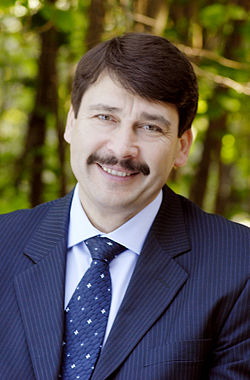 János ÁderJános Áder is a Hungarian politician and lawyer who served…Affiliated
 Yulia TymoshenkoYulia Volodymyrivna Tymoshenko is a Ukrainian politicianAffiliated
 Angela MerkelAngela Merkel is a German physicist and CDU politician who…Affiliated
How the record is sourced and how the score is derived.
The score is formula-derived (Factrail formula v1, version 1.0.0), not an editorial verdict. Read the methodology.
By the Factrail desk · Method: how we source and score · Last reviewed
Dispute a fact on this pageNamed here, or represent someone who is? Request a right of reply.
People and organizations as listed in the Related section of this page; facts, drivers and the pages that name it as listed in the blocks here. Counts, not a rating.