
Marc Jongen
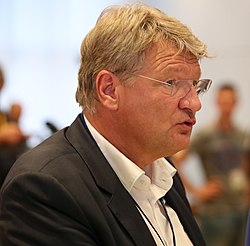
Marc Stephan Jongen (born 23 May 1968 in Merano, South Tyrol, Italy) is a German philosopher and a politician of the Alternative for Germany (AfD).
- Facts0
- Drivers0
- Indicators0
Marc Stephan Jongen (born 23 May 1968 in Merano, South Tyrol, Italy) is a German philosopher and a politician of the Alternative for Germany (AfD).
Marc Stephan Jongen (born 23 May 1968 in Merano, South Tyrol, Italy) is a German philosopher and a politician of the Alternative for Germany (AfD). He was a member of the Bundestag from October 2017 until 15 July 2024, serving as the AfD parliamentary group's spokesman on cultural policy, and has been a Member of the European Parliament since July 2024. In the 2024 European election he was returned from sixth place on the AfD's common list for all Länder; the party took 15.9 percent of the vote and 15 of Germany's seats.
He was born to an Italian mother and a Dutch father, completed the Abitur in Merano in 1987, and has described German as his mother tongue. After a year of economics at the Vienna University of Economics and Business (1987–1988), he studied philosophy at the University of Vienna and received a Magister in 1995. From 1996 to 1999 he was a cultural editor at the Neue Südtiroler Tageszeitung in Bolzano. He was naturalised as a German citizen in 2011.
In 1999 he began a doctorate at the Karlsruhe University of Arts and Design. From 2003 he was academic assistant to the rector, the philosopher Peter Sloterdijk, and a lecturer in philosophy; the doctorate followed in 2009. He joined the AfD in April 2013, sat on the Baden-Württemberg state executive from 2013 to 2024 (as its chairman from 2017 to 2019), and has been a member of the federal executive since 2022. He is also a member of the board of trustees of the Desiderius Erasmus Foundation.
German press coverage has called him the AfD's "party philosopher," "leading thinker" (Vordenker) or "chief ideologue," labels he told Handelsblatt in 2016 that he disliked, preferring to call himself an intellectual representative of the party. Sloterdijk, asked about him for a 2018 New Yorker profile, said there was no common ground between them and called Jongen "a complete impostor," adding that Jongen had given up the academic work for which he had come to the university and that a political career was his way out.
Marc Jongen was born on 23 May 1968 in Merano (German: Meran), in South Tyrol, Italy. He grew up in Lana, in the Adige valley between Merano and Bolzano, and South Tyrolean reporting identifies him as coming from that town. Munzinger’s biography describes the upbringing as German-speaking inside an Italian province, and a 2017 Südwest Presse profile noted that an Austrian colour was still audible in his speech.
His father was from the Netherlands and his mother from South Tyrol. He held Italian citizenship from birth and also Dutch citizenship through his father. In 2011 he was naturalized in Germany. UnserTirol24, citing an interview with him, reported that his mother was born a Zuegg and that one branch of the family runs the fruit-juice and jam firm of that name. A Staatsanzeiger profile adds that, growing up between Merano and Bolzano, he heard stories of the years in which South Tyroleans had to choose between becoming Italian and leaving for the German Reich.
He went through compulsory school and the Oberschule in Merano. In 1987 he took the Matura at the Realgymnasium there; German parliamentary biographies record the same qualification as the Abitur.
After school he studied in Vienna. The curriculum vitae he supplied for the 20th Bundestag states that he read economics at the Vienna University of Economics and Business in 1987–88 and philosophy at the University of Vienna from 1988 to 1995, completing a Magister. The biography from the previous electoral term lists the Vienna subjects as philosophy, economics, history and Indology, with the degree Mag. phil. A 2017 profile in the South Tyrolean magazine Barfuss repeats that range and adds German studies. Other reference accounts shorten the span: Munzinger places philosophy, history and economics in Vienna in 1987–1994, ending with the Magister, and a September 2017 Salto profile gives the same years, with economics first and philosophy and history afterwards.
Munzinger records that, after a journey of several months in India, he published in 1998 the monograph Das Wesen spiritueller Erkenntnis. It appeared in Munich with Eugen Diederichs as volume 141 of the Diederichs Gelbe Reihe, subtitled Eine Reise ins Innere des Geistes (ISBN 3-424-01392-7). The publisher’s description presents a spiritual view of the world and the person as the core of major wisdom teachings of East and West, naming Vedanta and Buddhism together with Taoism, Sufism, Neoplatonism, alchemy and Hermeticism. The taz later described the roughly 300-page book as a concentrated esoteric text whose stated aim was “the mystical” and an “archetypal original language in things themselves,” together with the world of “magic, alchemy, astrology.”
In the later 1990s Jongen worked as a journalist in Vienna and in Bolzano. The 20th-term Bundestag biography states that from 1996 to 1999 he was cultural editor of the Neue Südtiroler Tageszeitung in Bolzano. Salto, whose author wrote of having crossed professional paths with him about twenty years before a 2017 profile, describes those years as freelance cultural editing for the paper and recalls “sensitive, clever and thoroughly worth reading” articles; the same profile says that a return to university was already his aim. Munzinger dates journalistic work in Vienna and Bolzano to 1995–1999 and includes an editorship at the paper, while Barfuss notes that in the 1990s he also wrote for Die Zeit, among other outlets. In 1999 he began doctoral studies in philosophy at the Karlsruhe University of Arts and Design.
In the biography he supplied to the Bundestag, Marc Jongen states that he undertook doctoral study at the Staatliche Hochschule für Gestaltung Karlsruhe—the Karlsruhe University of Arts and Design, or HfG—from 1999 to 2003, and that from 2003 he was academic assistant to the rector and a lecturer in philosophy, taking his doctorate in 2009. The rector for most of that period was Peter Sloterdijk, who had succeeded the school's founder, Heinrich Klotz, in 2001. Sloterdijk's term ended on 30 June 2015, when he reached the statutory age limit of 68; he remained a professor of philosophy and aesthetics.
The HfG opened in 1992 together with the ZKM Center for Art and Media Karlsruhe, combining art and design with media theory and philosophy. Handelsblatt reported in July 2016 that Jongen had been a wissenschaftlicher Mitarbeiter since 2003, working in the administration and teaching philosophy—his seminar the previous term was "Klassiker der Ästhetik"—and that for many years he had also been Sloterdijk's assistant, with whom he held dozens of courses. The taz described joint seminars from 2003 to 2013. In December 2015 he was still a lecturer and the editor of the series HfG Forschung. Nine authors of that series, and the art historian Beat Wyss, asked that he be removed as editor because of his offices in the Alternative for Germany; the rectorate replied that membership in a party treated as constitutional was a private matter so long as it did not affect university work.
In a March 2016 Neue Zürcher Zeitung interview, Jongen said he had to separate politics from academic life, that the new rector did not want him as an assistant, and that he would no longer make an academic career in Germany. A biographical note on a 2024 posting of that interview quotes Sloterdijk as preferring that Jongen finish a Habilitationsschrift Sloterdijk called long overdue. No such second dissertation appeared. Jongen's pre-mandate Bundestag disclosures list the HfG post as wissenschaftlicher Mitarbeiter with a right of return and protection against dismissal.
The dissertation accepted by the HfG is Nichtvergessenheit. Tradition und Wahrheit im transhistorischen Äon. Umrisse einer hermetischen Gegenwartsdeutung im Anschluss an zentrale Motive bei Leopold Ziegler und Peter Sloterdijk. The title page names Sloterdijk as rector and first examiner and Boris Groys as second examiner, and dates the oral examination to 18 July 2009. The taz, describing an unpublished typescript of 237 pages, reported that Sloterdijk awarded it summa cum laude. The contents treat "Nichtvergessenheit," equated there with truth, as a method for a shift from "hypermodernity" to a "transhistorical aeon," in sections on time (Gestaltwandel) and space (Unus Mundus) drawn from Ziegler and Sloterdijk. The thesis was not issued as a book.
Jongen also edited volumes around the HfG and the ZKM. Der göttliche Kapitalismus (Wilhelm Fink, 2007), the first number of a joint research series, records a conversation with Groys, Jochen Hörisch, Thomas Macho, Sloterdijk and Peter Weibel on money, consumption, art and destruction. In 2008 he edited Philosophie des Raumes: Standortbestimmungen ästhetischer und politischer Theorie (Fink). With Sjoerd van Tuinen and Koenraad Hemelsoet he edited Die Vermessung des Ungeheuren: Philosophie nach Peter Sloterdijk (Wilhelm Fink, Munich, 2009). For a 2007 Festschrift on Sloterdijk's sixtieth birthday he wrote an essay the taz quoted as "Sloterdijk Essenz," likening Sloterdijk's seminar manner to an Indian satsang.
The tie was that of assistant, co-teacher and doctoral student. After Jongen joined the AfD in 2013 and was discussed in the press as a theorist of the party, Sloterdijk rejected the association. In a Tages-Anzeiger interview of 16 April 2016, as quoted by the taz, he said Jongen might call himself a student had he written at least one presentable book as an assistant—"so aber bleibt es nur bei falschen Zitaten"—and accused him of distorting thymos, from Zorn und Zeit (Rage and Time), by confusing pride with resentment.
In a July 2016 Handelsblatt essay, after Sigmar Gabriel had called Sloterdijk a supplier of right-wing ideology and pointed to Jongen, Sloterdijk wrote of "mein akademisch bislang unauffälliger 'Schüler'" styling himself a Vordenker of the AfD against advice to leave the party at once. He called the AfD an "Unmöglichkeitspartei" for the frustrated and denied supplying its ideas. Jongen said he could follow the rejection of the party, that the personal relationship was burdened, and that a philosophical break was impossible: "Dafür habe ich zu viel von ihm gelernt." In a February 2018 New Yorker profile, asked if any common ground remained, Sloterdijk said no and called Jongen "a complete impostor," adding that Jongen had come to study Sanskrit classics such as the Upanishads and then given that up, with politics as "the way out for him."
Jongen joined the Alternative für Deutschland in April 2013. The Baden-Württemberg association was founded on 22 April 2013 in Karlsruhe, about two months after the federal party. At that meeting he was elected one of three assessors on the first state executive, with Lars Patrick Berg and Bernd Winkler, under co-speakers who included Bernd Kölmel. A Cicero author note of 22 January 2014 already described him as deputy speaker and programme coordinator of the state association. In July 2016, still outside parliament, he was reported as holding that deputy speakership and sitting on the federal programme commission.
At the state congress in Sulz am Neckar on 4 March 2017, delegates elected a new dual leadership before that year’s Bundestag campaign. Ralf Özkara, who had run the Landtag office of federal co-chair Jörg Meuthen and was treated as close to him, narrowly defeated Alice Weidel, the state’s lead candidate. Jongen was elected the other, equal-ranking state speaker, defeating Landtag member Bernd Gögel. The congress opened onto a dispute over whether Thuringia chair Björn Höcke should be expelled after a speech on historical memory; Meuthen argued against expulsion.
Özkara resigned as co-speaker on 20 November 2018, citing work and family, after saying that Weidel should leave her offices if her Bodensee district association had taken an illegal donation. Jongen, by then a member of the Bundestag, remained sole state speaker until the next regular congress. He did not stand again for the chair. At the congress in Heidenheim on 23 February 2019, Bernd Gögel and Dirk Spaniel were elected co-speakers, and Jongen took a deputy post with 351 votes to 221 for Christina Baum.
The association then dropped the dual chair. On 15 February 2020 in Böblingen, Weidel was elected sole state speaker with 547 votes (54 percent) against Spaniel’s 419 (41 percent); Jongen, Martin Hess and Markus Frohnmaier became the deputies. Weidel did not run in 2022, after she and Tino Chrupalla had become federal co-chairs. At the state congress in Stuttgart on the weekend of 16–17 July, Frohnmaier and Emil Sänze won a new dual leadership, and Jongen was returned as a deputy paired with Frohnmaier, beside Rüdiger Klos and Udo Stein. His archived Bundestag biography, drawn from his own disclosures, records membership of the state executive from 2013 to 2024, and the chairmanship as 2017–2019.
The federal programme commission met for the first time in Kassel on 28 February 2015, to draft proposals for the party programme, specialist programmes and election manifestos. Jongen was a member by July 2016, when he was described as sharing responsibility for the federal party’s programmatic guidelines. The commission’s page, updated on 24 September 2026, lists him as a representative of the federal executive; the same page names Sänze as the Baden-Württemberg representative.
On 18 June 2022, at the 13th federal congress in Riesa, delegates who had that morning elected Chrupalla and Weidel as co-speakers chose Jongen as first assessor (Beisitzer) on the federal executive. The leading offices run for two years. At the congress in Essen on 29 June 2024, where Weidel and Chrupalla were confirmed, Jongen, nominated by Chrupalla, kept an assessor’s seat with just under 55 percent of the vote against Baum, whom n-tv described as a representative of the party’s far-right wing. On 4 July 2026 in Erfurt the co-chairs were re-elected, Weidel with 81.3 percent and Chrupalla with 70.05 percent; the party’s account of the new executive again placed Jongen among the six assessors.
The Augsburg congress of 30 June 2018 separately recognised the Desiderius Erasmus Foundation, chaired by former CDU politician Erika Steinbach, as the party’s associated foundation, a choice pressed in particular by the camp around Weidel. Jongen’s archived Bundestag biography lists him as a member of that foundation’s board of trustees. The same class of disclosures, recorded from February 2018, includes a board seat on the Johann-Gottfried-Herder-Verein für Demokratie in Bonn, which Abgeordnetenwatch files under political life and parties; the association drew little later public reporting.
Jongen stood for the Alternative for Germany in Baden-Württemberg constituency 266, Neckar-Zaber, at the federal elections of 24 September 2017 and 26 September 2021, and both times entered the Bundestag on the state list rather than with a constituency seat. He was third on the AfD list in 2017 and fifth in 2021. He sat from the constitution of the 19th Bundestag on 24 October 2017 until the end of 15 July 2024, when he resigned the seat and Volker Münz succeeded him; from July 2024 the biography records him as a member of the European Parliament.
In Neckar-Zaber in 2017 he received 23,215 first votes, 12.6 percent of the valid total. The Christian Democratic Union led the constituency with 73,689 first votes (40.0 percent), and turnout was 81.3 percent. AfD second votes there were 24,212 (13.1 percent); across Baden-Württemberg the party took 12.2 percent of second votes, enough for his list place. In 2021 his first-vote share fell to 18,478 (10.0 percent), 2.6 points below 2017, while the CDU candidate won the seat with 56,249 votes (30.4 percent). AfD second votes in the constituency were 18,702 (10.1 percent), and 9.6 percent statewide; turnout was 80.9 percent.
From October 2017 until he left the Bundestag he was the AfD group's cultural-policy spokesman, a role recorded in his parliamentary biography. In the 19th term he was a full member and the group's Obmann on the Committee on Culture and Media. After the 2017 election he was discussed as a possible AfD nominee to chair that committee, which also deals with remembrance policy. The German Cultural Council and other cultural figures warned that an AfD chair would be a damaging signal; in January 2018 the groups left the post with the Social Democratic Party, while the AfD received the chairs of the budget, legal-affairs and tourism committees. Katrin Budde of the SPD was elected chair when the committee constituted itself. In a Spiegel interview reported then, Jongen said the group wanted to re-examine funding criteria, cut support for what he called politically correct projects, and promote "genuine quality and talent."
In the 20th term he and Martin Erwin Renner were the AfD's ordinary members of the culture committee. When it constituted itself in December 2021, Budde was re-elected with the votes of all 19 ordinary members; the groups' Obleute were to be named the following January. A 2022 Bundestag brochure on the committee lists Jongen as the AfD Obmann. The 19th-term register also names him a deputy member of the board of trustees of the Federal Agency for Civic Education. Disclosures for both terms list a seat on the foundation council of the Humboldt Forum in the Berlin Palace, and the 20th-term disclosure adds membership of the German National Committee for Monument Protection.
The disputes over exhibitions and restitution are taken up under Reception. On 16 February 2022 he was the lead signatory of an AfD motion, printed paper 20/705, to stop the planned return of the Benin Bronzes to Nigeria. On 6 July 2022 he was the lead signatory of printed paper 20/2598, which called for consequences from antisemitic imagery at documenta fifteen in Kassel, criticised Culture Minister Claudia Roth for the timing of her response, and demanded an end to public funding of postcolonial approaches.
In both the 19th and 20th terms he was an ordinary member of the Committee on Education, Research and Technology Assessment, which covers schools and higher education, research funding and parliamentary technology assessment. A motion he introduced on 16 December 2020, printed paper 19/25312, called for public funding of gender studies to be ended and described that research as ideology rather than scholarship.
He was an ordinary member, not the group's spokesperson, of the study commission "Artificial Intelligence – Societal Responsibility and Economic, Social and Ecological Potential." Set up on 28 June 2018, it constituted itself on 27 September 2018 with 19 members of parliament and 19 outside experts. Chaired by Daniela Kolbe of the SPD, it worked in project groups on the economy, the state, health, work, education and research, mobility and the media, and on 28 October 2020 handed over a report of more than 800 pages, later printed as paper 19/23700, framed as "human-centred" artificial intelligence as distinct from Chinese and US approaches. The commission adopted the text by a large majority: the two members from the Left, with one expert, voted against the ethics and economy chapters, and those two members and one expert abstained on the rest, while the other members, including the AfD members, voted in favour.
The same printed paper records minority opinions signed by Jongen with Joana Cotar and Peter Felser. On bias and discrimination they wrote that the majority's fairness measures were impractical and could slow the development of AI systems so long as there were no agreed normative standards for what counts as discriminatory. On ethics they argued that the report underplayed Germany's lack of technological sovereignty and tied a values-based policy to mathematics teaching and the supply of IT specialists, quoting the line that artificial intelligence is applied mathematics. On society they disputed treating aims such as combating climate change as settled collective interests that would justify subsidising technologies unlikely to succeed in the market. Further opinions under the same names cover research, ecological sustainability, start-up policy, and smart-city and open-data questions.
The European Union election in Germany was held on 9 June 2024. Alternative for Germany received 15.9 percent of the vote and 15 of Germany's 96 seats in the European Parliament, up from 11.0 percent and 11 seats in 2019; the federal electoral committee confirmed the result on 3 July 2024. Marc Jongen was elected from sixth place on the AfD's nationwide list, a place covered by the 15 seats the list won. Twelve of those 15 members were new to the Parliament, including the sitting Bundestag members Petr Bystron and Jongen, while Maximilian Krah, Christine Anderson and Markus Buchheit were re-elected. The Bundestag's account of the new delegation also noted a decision by the newly elected AfD members that lead candidate Krah would not belong to it.
Jongen resigned his Bundestag seat with effect at the close of 15 July 2024, and Volker Münz (AfD) succeeded him. Münz, a former member from the Göppingen area in Baden-Württemberg, had said after the election that he would accept the mandate because Jongen was moving to the European Parliament. In the Parliament's open data, Jongen's membership of the tenth term begins on 16 July 2024, the day the new Parliament was constituted.
The seat was not taken in the group that had included the AfD before the election. On 23 May 2024 the bureau of Identity and Democracy excluded the AfD delegation with immediate effect, pointing to incidents involving Krah. After Krah told an Italian newspaper that members of the Nazi SS were not necessarily criminals, Marine Le Pen said her National Rally would no longer sit with the AfD, and the Identity and Democracy leadership then voted to expel the party. Days after the election, National Rally and Fidesz formed Patriots for Europe, which replaced Identity and Democracy and did not include the AfD. On 10 July 2024 in Brussels, AfD members and MEPs from Confederation Liberty and Independence in Poland, Bulgaria's Revival, France's Reconquête, Slovakia's Republic Movement, Hungary's Our Homeland Movement, Lithuania's People and Justice Union and the Czech Freedom and Direct Democracy party constituted the Europe of Sovereign Nations group. It began with 25 MEPs, then the Parliament's smallest group. René Aust of the AfD and Stanisław Tyszka were its co-presidents, Anderson was chosen as chief whip, and Krah remained non-attached. Jongen joined the group; the Parliament's data records him as a member of its bureau from 16 July 2024, and the group lists that post as deputy whip. The group's membership page in 2026 listed 27 MEPs in nine national delegations, 15 of them in the German AfD delegation.
From 19 July 2024 the same record lists Jongen as a full member of the Committee on Development and as a substitute on the Committee on Culture and Education and on the Subcommittee on Human Rights. He sat as a full member of the Committee on the Environment, Public Health and Food Safety from 19 July 2024 until 19 January 2025, and from 20 January 2025 on the renamed Committee on the Environment, Climate and Food Safety. On 19 September 2024 he became a member of the delegation to the EU–United Kingdom Parliamentary Partnership Assembly and of the delegation to the joint parliamentary assembly with the Organisation of African, Caribbean and Pacific States. From the same date he was a substitute on the Cariforum–EU parliamentary committee, the Caribbean–EU parliamentary assembly, and the delegation for relations with Southeast Asia and the Association of Southeast Asian Nations (ASEAN). Apart from the January 2025 change of environment committee, those memberships have no end date in the open-data record for MEP 256942.
Jongen set out a cultural line for the Alternative for Germany in “Das Märchen vom Gespenst der AfD” (Cicero, 22 January 2014). Then deputy spokesman in Baden-Württemberg, he wrote that the party would last only if it was liberal and conservative, “at times even reactionary.” Language and the family were “essential building blocks of cultural transmission”; where programmes said Gleichstellung, Gleichschaltung was “not far.” Openness required a “healed self-confidence,” not a “repressed bad conscience.”
In the Bundestag he made this a claim on public culture. Die Zeit (14 February 2018) led with his remark that it would be “a pleasure” to begin the Entsiffung—a cleaning-out—of the cultural sector. A motion of 16 December 2020 in his name sought to end federal funding of gender research, treating the claim that biological sex is “socially constructed” as a “blank slate” theory shielded, in Hans Albert’s sense, by “immunizing mechanisms.”
He separates remembrance of Nazi crimes from what he calls a politics of guilt. On 23 February 2018, answering the charge that the AfD was trampling commemoration of the Holocaust, he said a “worthy remembrance” of Nazi atrocities “cannot be equivalent to cultivating a guilt complex that leaves the country defenseless.” He called Stolpersteine dignified, rejected the antisemitism accusation, and said migration policy was importing “Arab antisemitism,” including the chant “Hamas, Hamas, Jews to the gas.” Some party voices, he conceded, had “oversteered into the red”; Katrin Göring-Eckardt interjected that Björn Höcke was not a single voice. On 5 April 2019, on the programme “Jugend erinnert,” he set research into “how it really was” against “memory politics” that would teach “guilt and shame about their being German” and the thought that Germany had “no historical right to exist.” Linking the crimes to “hostility to Islam,” he said, placed critics under “the threatening shadow of Nazi terror.” In Sezession (February 2017) he used Schuldkult and called Höcke’s Dresden picture of a “totally defeated people” selective perception: postwar Germany, he wrote, lived in American-protected “subdominance,” not submission.
He extended the point to objects. On 21 February 2019 he called colonial-collection policy a “guilt complex” serving as a “psychopolitical basis” for mass migration. A motion of 16 February 2022 sought to block return of the Benin Bronzes and to deny any legal claim to restitution. After antisemitic imagery at documenta fifteen, a motion of 6 July 2022 blamed what it called inherently antisemitic postcolonialism and asked that this “rhetoric of guilt” stop guiding federal memory policy.
In NZZ am Sonntag (12 March 2016) Jongen called Angela Merkel’s border opening an “act of self-empowerment” that set the law aside. Arrivals via safe third countries were “illegal immigrants” who should have been turned back. People “too many and too foreign” to integrate would destabilize the country; parallel societies and “no-go areas” were, he said, already visible in the Ruhr and parts of Berlin. He located the argument in thymos, which, following Plato, he defined as the soul’s third faculty, beside eros and logos. The nation-state was the last “thymotically charged” large body; the European Union was already “post-thymotic.”
In Die Zeit (25 May 2016) he called loss of the German language and state the “logical consequence” of asylum policy, and mass integration the government’s “great life-lie.” Citing Francis Fukuyama, he preferred isothymia, recognition among equals, to megalothymia, the will to dominate—yet Germans were making themselves “the servant of immigrants.” He would not join the European Identitarian movement, citing its “shortened understanding of culture,” but he viewed with sympathy an attempt to correct Europe “from the side of identity.” Identity mixed descent, culture and law; “the passport alone does not yet make a German,” and he wanted the descent principle restored so that assimilation, a “becoming-similar,” would hold.
In February 2017 the lecture “Migration und Thymostraining” opened the Institut für Staatspolitik academy at Schnellroda, associated with Götz Kubitschek. The Ludwigsburger Kreiszeitung reported that he appeared with Identitarian activist Martin Sellner and Jack Donovan, whose apology of violence he called “a kind of bodybuilder philosophy,” and that he would not distance himself from guests whose views he did not share. It attributed to him the description of the “migrant invasion” as an “act of violence” and a “historical crime” by a “Merkel regime” pursuing “abolition of one’s own culture, of one’s own people.” Thymos, taken from Peter Sloterdijk, was “the real realm of the political”; “lowered thymos” could mean disappearing “as a nation.” The Sezession printing, “Migration und Streßtraining,” calls August 2015 a “social experiment of historic scale”: “unlawful entry” of “culturally alien” people, “largely young Muslim men.” Islam, “above all” the Islamic State, figures as resentment of a humiliated culture; the stress of migration is “stress training” for “civil defensiveness,” not a summons to war.
The Cicero essay already fixed the European line: private bank debts turned public, the European Stability Mechanism and the European Central Bank as a “bad bank,” and a “bank socialism.” He wanted a return to the Maastricht Treaty, to the Basic Law, and if necessary to a national currency. The European Union, “central monster of structural corruption,” had to be freed from forcing states “into a federal state”; the party should become an “Alternative for Europe.” In Die Zeit the ESM’s passage was an “enabling act” that suspended Bundestag budget rights—the shock, he said, that led him into the AfD—and the Union an undemocratic “superstate,” an “EUdSSR.”
On 15 March 2019, debating pupil climate strikes, he said Merkel’s support taught “the rule of illegality in the name of a sentimental hypermorality.” He described Greta Thunberg as a child “abused in a professionally staged campaign” and as “a sick child” with “Asperger’s syndrome, a form of autism.” “The case of Greta” symbolized a “delusional climate-rescue policy” that “resembles a civil religion, with Greta Thunberg as child prophet”; “Asperger patients,” he said, “cultivate an extreme black-and-white thinking.” Her call, at Davos, for panic was a “religion of guilt and fear.” Putting atmospheric CO2 at 0.038 percent and Germany’s share of the human part at 3.1 percent, he said an energy transition of 50 billion euros a year meant one need no longer ask whether CO2 drove warming. SPD deputy Matthias Miersch called the speech “despicable.”
A minority opinion in the Bundestag’s artificial-intelligence inquiry, signed by Jongen with Joana Cotar and Peter Felser and included in the report of 28 October 2020, judged strategies for detecting discrimination through bias “not practicable” and liable to “inhibit the development of AI systems,” for want of agreed scientific “fairness measures.”
The largest of the Wilhelm Fink volumes Jongen edited at the Karlsruhe University of Arts and Design is Die Vermessung des Ungeheuren: Philosophie nach Peter Sloterdijk (Paderborn and Munich: Fink, 2009; 501 pages), co-edited with Sjoerd van Tuinen and Koenraad Hemelsoet.
It collects essays on Sloterdijk's books from Kritik der zynischen Vernunft (1983) through the Sphären trilogy, Zorn und Zeit (2006) and the then forthcoming Du mußt dein Leben ändern. Jongen's chapter is "Wir sind nie zur Welt gekommen: Peter Sloterdijks Maieutik der Eksistenz"; other contributors include Boris Groys, Peter Weibel, Rüdiger Safranski, Slavoj Žižek and Bruno Latour.
Der göttliche Kapitalismus (Fink, 2007; 61 pages), edited by Jongen, opened a new sequence of the school's Schriftenreihe: a conversation with Groys, Jochen Hörisch, Thomas Macho, Sloterdijk and Weibel on capitalism as a religious cult in which money replaces God. Philosophie des Raumes: Standortbestimmungen ästhetischer und politischer Theorie (Fink, 2008), also edited by Jongen, starts from Michel Foucault's 1967 "epoch of space" and surveys work from the Karlsruhe school, including Jongen's "Sein und Raum" and Sloterdijk's "Die Akademie als Heterotopie."
In HfG Forschung, a Fink series the school has issued since 2011 for philosophical, media-theoretical and cultural studies from its research institute, Jongen edited Was wird Denken heißen? Kognition und Psyche im posthumanen Zeitalter (Fink, 2012; 240 pages). The publisher's note says the volume restates Martin Heidegger's "Was heißt Denken?" for a "posthuman age" of poststructuralism, neuroscience and biotechnology, in a colloquium that includes Annette Bitsch, Martin Kurthen, Heiner Mühlmann and Jongen.
Das Wesen spiritueller Erkenntnis: eine Reise ins Innere des Geistes (Munich: Diederichs, 1998; Diederichs gelbe Reihe, vol. 141; 298 pages) is classed by the German National Library under philosophy, comparative religion and esotericism. A note for his 2017 Bard College appearance calls it a study of Indian Vedanta. The dissertation Nichtvergessenheit: Tradition und Wahrheit im transhistorischen Äon; Umrisse einer hermetischen Gegenwartsdeutung im Anschluss an zentrale Motive bei Leopold Ziegler und Peter Sloterdijk is catalogued as a 2009 Karlsruhe thesis of 237 leaves and was not published as a book. In Humana.Mente (2011, vol. 18, pp. 199–219), "On Anthropospheres and Aphrogrammes. Peter Sloterdijk's Thought Images of the Monstrous" argues that Sloterdijk, unlike Heidegger, uses spherology to picture a world that can no longer be conceived as pictureless.
On 22 January 2014 Cicero published "Das Märchen vom Gespenst der AfD," with a note identifying Jongen as a Karlsruhe lecturer, assistant to rector Sloterdijk, and deputy speaker and programme coordinator of the Alternative for Germany in Baden-Württemberg. Rewriting the opening of the Communist Manifesto, the essay argues that the party would have to be liberal and conservative, and at times reactionary, if it was to outlast the euro dispute.
Sezession, issue 76 (February 2017), carried "Migration und Streßtraining." Jongen calls the 2015 border opening an irreversible social experiment and, using Mühlmann's Die Natur der Kulturen (1996), treats conflict around migration as stress that might revive cultural self-assertion. A page on his site, headed as a Sezession item, records a lecture at the Institut für Staatspolitik titled "Migration und Thymostraining."
In October 2017 the Hannah Arendt Center at Bard held "Crises of Democracy: Thinking in Dark Times," where Jongen spoke opposite Ian Buruma in the session "Does Democracy Need to be More Populist?," later posted on the Center's YouTube channel.
The main newspaper interviews date from 2016. Die Zeit, no. 23/2016, ran "Man macht sich zum Knecht," on AfD voters, cultural identity and asylum policy. A Frankfurter Allgemeine Zeitung profile reported that he was drafting a philosophical foundation for the party aimed, in the article's words, at preventing the "deconstruction of family and Volk." Martin Helg's "Wir müssen wehrhafter werden" appeared in the NZZ am Sonntag on 12 March 2016 and was republished by the Neue Zürcher Zeitung on 10 February 2024. There Jongen invokes Plato's tripartite soul and argues that Germany had neglected thymos, the spirited part he links with anger, while keeping its borders open.
Before Marc Jongen entered the Bundestag, German reporting called him the Parteiphilosoph, Vordenker or Chefideologe of the Alternative for Germany. A July 2016 Handelsblatt profile recorded that he rejected those titles for “intellektuellen Vertreter meiner Partei.” It quoted his former supervisor Peter Sloterdijk on an “academically hitherto inconspicuous ‘student’” posing as an AfD Vordenker against advice to leave the party. In a Handelsblatt essay reported by Der Spiegel, Sloterdijk called the AfD an “Unmöglichkeitspartei” for “countless frustrated people,” after Sigmar Gabriel had called Sloterdijk a “rechter Ideologielieferant” and cited Jongen. Jongen told the Handelsblatt he had to accept that rejection and could understand it given the party’s image. The Neue Zürcher Zeitung reported that he called Parteiphilosoph “vergiftetes Lob.”
In February 2018 Thomas Meaney asked Sloterdijk, for The New Yorker, whether he shared any ground with Jongen, whom Meaney called the party’s “party philosopher.” Sloterdijk said no and called him “a complete impostor,” who had come to study Sanskrit classics such as the Upanishads and for whom “a political career is the way out,” a dismissal Meaney heard as professional disdain rather than moral abhorrence. An open letter in the Chronicle of Higher Education reused “party philosopher,” and Masha Gessen called him the party’s “intellectual face.”
The 15 January 2019 report of the Federal Office for the Protection of the Constitution, published by netzpolitik.org, called him a Vordenker and tied him to the Neue Rechte. It recorded two talks at the Institut für Staatspolitik, a Facebook advertisement for one, republication in the magazine Sezession, and a published exchange with Götz Kubitschek. From the February 2017 lecture it quoted him on “genetic foundations of culture” and on a supposed desire for revenge against Europe, “above all” from Islam. The report said he could not understand why the Identitarian Movement Germany was observed, since on his account it shielded people from the government’s “Kamikaze policy”; it recorded no break with that milieu. “Der Flügel,” around Björn Höcke, was listed separately as a Verdachtsfall. On the rule of law the office grouped Höcke and Jongen as showing a particular radicalism in attacking the democratic system itself, yet found leading functionaries’ statements on that point still too diffuse to be consolidated evidence of an anti-constitutional endeavour.
On 12–13 October 2017 the Hannah Arendt Center at Bard College held “Crises of Democracy: Thinking in Dark Times.” Jongen’s talk, “Does Democracy Need to Be More Populist?”, was followed by questions from Ian Buruma. Director Roger Berkowitz wrote that he had invited a voice for “democratic nationalism and democratic authoritarianism,” because on his reading of Hannah Arendt opposing views were a condition of plurality. Gessen, also a speaker, reported that Jongen complained of a Nazi smear, tied immigrants to crime and terrorism, and called immigration “an act of violence,” and that he later posted the centre’s recording with thanks to Berkowitz.
A 23 October 2017 open letter in the Chronicle, to Berkowitz and president Leon Botstein, was signed by more than fifty scholars, including Judith Butler, Wendy Brown, Andrew Arato, Richard J. Bernstein and Rainer Forst. It said the invitation “enabled him to leverage Hannah Arendt’s legacy to legitimize and normalize the AfD’s far-right ideology,” troubling because Arendt was a German-Jewish refugee who wrote on statelessness and race thinking. The letter quoted centre tweets on immigrant crime, on mass immigration as “traumatic” and “an act of violence,” and on Jews leaving France “because they are being attacked by Muslims,” and it linked his thymos to a defence of Pegida.
Botstein replied that an academic invitation “does not constitute either legitimation or endorsement,” that such parties had to be heard to be challenged, and that the letter’s “self-righteous stance” resembled Soviet-era denunciations. Gessen answered that the invitation lent legitimacy, that the speech could have been discussed without him, and that Arendt had treated the “preposterous” ideas under evil as matter for judgement, citing her 1948 protest against manifestations for Menachem Begin. Francine Prose wrote in The Guardian that Bard students who attended thought Buruma had exposed Jongen—some said “a Nazi”—and that his physical presence made the politics more concrete than a text or a video.
On 16 January 2018 the German Cultural Council urged other Bundestag groups to deny the AfD the culture and media committee chair. Managing director Olaf Zimmermann called an AfD chair “a fatal signal”: the committee answered for artistic and media freedom and for remembrance, and the faction questioned remembrance “especially” of “the crimes of National Socialism.” The council said the Frankfurter Allgemeine Zeitung had named Jongen and Martin Renner as nominees. Der Spiegel quoted his plan to review subsidies, cut “politically correct” projects he called propaganda for diversity or multiculturalism, and fund “echte Qualität und Talent,” so as to “die Stimmung im Land insgesamt drehen.” He said critics were reacting to the AfD, “deren Aura auf mich projiziert wird.” The Tagesspiegel reported that the Social Democrats took the chair. The taz gave as his best-known line “Es wird mir eine Freude sein, die Entsiffung des Kulturbetriebs in Angriff zu nehmen”; Deutschlandfunk cited that “Entsiffung” in an account of a Kulturkampf from the right.
The Bundestag record of the 7 July 2022 debate on antisemitic imagery at documenta 15 lists Jongen among the speakers, beside an AfD motion to draw consequences and to end public funding of postcolonialism. In an Aktuelle Stunde the AfD requested on the Benin Bronzes, the Frankfurter Allgemeine Zeitung reported that he accused Culture Minister Claudia Roth and the foreign minister of having “blamiert und der Demütigung preisgegeben” Germany and of indulging “moralische Größenphantasien” in their “kulturellen Selbsthass.”
The January 2019 report quoted his description of a “Migranteninvasion” as a blow to the “psychische, die psychopolitische Integrität” of the “sozialen Großkörper” he called people or nation, and as “ein Akt der Gewalt” otherwise seen on that scale only in war. It noted the comparison of “Aggressoren” to a traumatic break-in and the word “Wirtsgesellschaft,” read as ascribing parasitic qualities to migrants. The office called the remarks “eindeutig krass abwertend”: refugees were equated with intruders into the psyche and, by implication, with parasites, in a manner “zur Auslösung von körperlichem Ekel geeignet,” in part clearly and in part at least arguably against the human dignity of refugees or Muslims. The same text classed the whole AfD as a Prüffall and the Young Alternative for Germany and “Der Flügel” as Verdachtsfälle. It also quoted his September 2018 line “Wir müssen die Einwanderung aus islamischen Ländern stoppen,” attached to a warning that Muslims would otherwise become the majority and, with what he called the corrupt and degenerate left, legislate for themselves.
Ranked by shared high-impact facts, then explicit ties, then shared drivers.
 Ian BurumaIan Buruma (born December 28Affiliated
 Christine AndersonChristine Margarete Anderson (born 1968) is a German…Affiliated
 Alice WeidelAlice Weidel is a German politician and co-leader of the…Affiliated
 Sigmar GabrielSigmar Hartmut Gabriel is a German politician who was the…Affiliated
 Jörg MeuthenJörg Hubert Meuthen (born 29 June 1961) is a German…Affiliated
 Björn HöckeBjörn Uwe Höcke is a German politician of the far-right…Affiliated
How the record is sourced and how the score is derived.
The score is formula-derived (Factrail formula v1, version 1.0.0), not an editorial verdict. Read the methodology.
By the Factrail desk · Method: how we source and score · Last reviewed
Dispute a fact on this pageNamed here, or represent someone who is? Request a right of reply.
Linked because the text names them, not because anything was measured.
People and organizations as listed in the Related section of this page; facts, drivers and the pages that name it as listed in the blocks here. Counts, not a rating.