
Nadine Schön
Nadine Schön (née Müller; born 5 June 1983 in Lebach) is a German politician of the Christian Democratic Union (CDU) from Saarland.
- Facts0
- Drivers0
- Indicators0
Nadine Schön (née Müller; born 5 June 1983 in Lebach) is a German politician of the Christian Democratic Union (CDU) from Saarland.
Nadine Schön (née Müller; born 5 June 1983 in Lebach) is a German politician of the Christian Democratic Union (CDU) from Saarland. She sat in the Landtag of Saarland from 2004 to 2009 and in the Bundestag from 2009 to 2025, winning the St. Wendel constituency by a direct mandate in 2009, 2013 and 2017. From 2014 until she left parliament she was a deputy chair of the CDU/CSU group, a post first arranged for family and youth policy and, from December 2021, recorded by the Bundestag as covering digital affairs, education and research.
She passed the Abitur in 2002 at the Arnold-Janssen-Gymnasium in St. Wendel and studied law from 2002 to 2007 at Heidelberg University and Saarland University, taking the first state examination in law in 2007. From 2002 to 2008 she also completed a journalistic training course on a scholarship from the Konrad Adenauer Foundation. She entered the Landtag in 2004, while still a student, in the CDU sole-party government of Minister-President Peter Müller, and was 21 at the time.
In 2017 she received 57,987 first votes in St. Wendel (41.8 percent), ahead of the Social Democratic Party candidate on 42,129 (30.4 percent). In 2013 the CDU share of first votes in the constituency was 45.4 percent. At the 2021 election she lost the seat to Christian Petry of the SPD, who led with 35.1 percent to her 32.1 percent, and her place on the state list was not at first enough for a seat. She said she would leave active politics, then entered the 20th Bundestag after Annegret Kramp-Karrenbauer and Peter Altmaier declined the mandates they had won on the Saarland CDU list.
On 8 July 2024 she told party colleagues that she would not stand in the 2025 federal election. She said that politics lives by rotation and that after four terms it was time for a change, and that she would serve out the legislative period and stay active in the CDU. She lives in Tholey, is married and has two children. After the mandate ended she co-chaired a federal commission on child and youth protection in the digital world and, from the summer of 2026, became geschäftsführende Vorständin of GovTech Deutschland in Berlin.
Nadine Schön was born Nadine Müller on 5 June 1983 in Lebach, Saarland. A Bundestag biography for the 19th electoral period, compiled from her own information, records her as Roman Catholic. She grew up in Hasborn-Dautweiler, a locality of about 2,800 people that the municipality of Tholey describes as its geographic centre, and she has continued to live in Tholey. Tholey is one of eight municipalities in the Sankt Wendel district, in northern Saarland. In its St. Wendel year-in-review of 30 December 2010, the Saarbrücker Zeitung referred to her as Nadine Schön, née Müller, from Tholey, and noted that she had married Peter Schön that year.
From 1989 to 1993 she attended the primary school in Hasborn-Dautweiler. She then entered the Arnold-Janssen-Gymnasium in the district town of Sankt Wendel and passed the Abitur there in 2002. The gymnasium stood at the Missionshaus of the Society of the Divine Word (Steyler Missionare), the Catholic missionary congregation founded by Arnold Janssen. The order states that the school admitted external pupils from 1 September 1969, at first only boys, and girls from 1984, and that enrolment passed 800 in 1995. After the congregation failed to find another sponsor, the school took no new classes from the 2016/17 school year; the Rheinpfalz reported in January 2020 that teaching would end that summer, and the order marked the formal closure on 31 July 2023.
Schön studied law from 2002 to 2007 at the universities of Heidelberg and Saarbrücken, Heidelberg University and Saarland University. In 2003 and 2004 she worked as a student assistant at the Forschungsstelle Bundessteuergesetzbuch directed by Paul Kirchhof. Kirchhof, a former justice of the Federal Constitutional Court and director of Heidelberg’s Institute for Finance and Tax Law, had founded that centre on 1 January 2000 to draft one federal tax code in place of rules then spread across more than a hundred statutes. She passed the first state examination in law in 2007. The curricula vitae she has published do not record a Referendariat or a second state examination.
In parallel she held a scholarship from the Konrad Adenauer Foundation for journalistic training. Bundestag biographies for the 19th and 20th electoral periods, and a Saarbrücker Zeitung profile of 1 November 2026, date that training from 2002 to 2008. Her own curriculum vitae, also carried on regional CDU websites, describes it more narrowly as a study-accompanying journalistic course from 2002 to 2006. The foundation’s Journalistische Nachwuchsförderung (JONA) is a scholarship for students of any subject who share its Christian-democratic orientation; working journalists teach research and reporting, and the foundation presents the course as lasting about three years and taken mainly during semester breaks.
Nadine Müller, as she was then known, joined the Junge Union and the local branch of the Christian Democratic Union (CDU) in Hasborn-Dautweiler, part of Tholey in the Sankt Wendel district, in 1998. She later said she had entered the youth organization at 15 not in order to become a professional politician but to improve what was available for young people where she lived. In the same interview she recalled that, at 20 and still a law student at Heidelberg University, she was asked by her CDU district chair to stand for the state parliament, and that she agreed because the chance to take part in decisions would not come twice.
The Frauen Union is the CDU's women's organization. Under its statute, a woman acquires membership when she joins the CDU unless she expressly declares that she does not wish to belong. The party biographies that date Müller's Junge Union and CDU membership do not record a separate Frauen Union entry. She was later elected to the organization's federal executive: its report on the 34th federal delegate conference lists her as a Beisitzerin, with the postal ballot counted on 8 September 2021. A Bundestag biography published in 2010 also described her as deputy state chair of the Junge Union in Saarland, without giving the year she took that post.
At the Saarland state election of 5 September 2004 the CDU won 209,690 votes, 47.5 percent, and 27 of the 51 seats in the Landtag of Saarland, an absolute majority. The Social Democratic Party took 18 seats, and Alliance 90/The Greens and the Free Democratic Party three each; turnout was 55.5 percent, then the lowest since the first postwar state election in 1947. In the constitutive sitting in Saarbrücken on 29 September 2004 the Landtag re-elected Peter Müller as minister-president by 27 votes to 23, with one abstention, and he presented a reshuffled CDU-only cabinet that morning.
Müller was not among the members initially returned. Gabriele Klara Schäfer was elected in seventh place on the CDU list in the Neunkirchen constituency and then renounced the mandate; the statistical office's account of the election, dated 31 December 2004, records Nadine Müller as her successor. She was 21 and continued her law studies while holding the seat, a combination she later described as a hard period because she wanted both to finish the degree and to do justice to the mandate. The Bundestag biography that preserves her Landtag roles lists her as the CDU group's spokesperson for higher-education and science policy. It names four committees: economic affairs, science and mine safety; the interior, data protection and sport; justice, constitutional and legal questions, and electoral scrutiny; and European affairs together with questions of the interregional parliamentary council.
The constitution of Saarland provides that a Landtag's electoral period ends when the newly elected Landtag convenes. The parliament chosen on 30 August 2009 held its first sitting on 23 September 2009, which also ended Peter Müller's term as minister-president, though he continued in a caretaker capacity until a successor took office. The statistical office's preliminary list of those elected on 30 August does not include Nadine Müller, and the Bundestag's later biography dates her membership of the Saarland Landtag to 2004–2009, with membership of the Bundestag from September 2009.
Schön's constituency for the Bundestag was St. Wendel (Wahlkreis 298), in northeastern Saarland. From the 2009 election through 2021 the federal returning officer defined it as the whole district of St. Wendel; the municipalities of Eppelborn, Illingen, Merchweiler, Ottweiler and Schiffweiler in the district of Neunkirchen; Lebach and Schmelz in the district of Saarlouis; and Heusweiler in the Regionalverband Saarbrücken.
At the election of 27 September 2009 she stood as Nadine Müller. The Bundestag biography published at the start of the term gives that name and a birth date of 5 June 1983, so she was 26 on polling day, and lists the seat as a direct mandate. In the final result the Christian Democratic Union (CDU) took 55,727 first votes (40.1 percent) and the Social Democratic Party (SPD) 42,910 (30.9 percent). Die Linke received 22,965 (16.5 percent), the Free Democratic Party (FDP) 9,486 (6.8 percent) and Alliance 90/The Greens 6,058 (4.4 percent). Of 184,896 people eligible to vote, 142,795 cast ballots, a turnout of 77.2 percent, and 138,981 first votes were valid. Second votes in the constituency divided 34.6 percent for the CDU and 25.4 percent for the SPD.
She defended the seat on 22 September 2013. The final count gave the CDU 60,865 first votes (45.4 percent, 5.3 points above 2009) and the SPD 44,868 (33.5 percent). Turnout was 76.1 percent: 138,097 voters from an electorate of 181,521. The Saarbrücker Zeitung reported that the SPD candidate was Christian Petry and that Schön's lead was about 16,000 votes; the official totals differ by 15,997.
In the 2017 election the CDU stayed ahead, with 57,987 first votes (41.8 percent, down 3.6 points) to the SPD's 42,129 (30.4 percent). Die Linke was third on 13,584 (9.8 percent) and the Alternative for Germany fourth on 11,646 (8.4 percent). The electorate was 177,468, 141,387 people voted, turnout was 79.7 percent, and 138,769 first votes were valid. For the 19th Bundestag the parliament again listed her mandate as a direct election in Wahlkreis 298.
On 26 September 2021 Petry won St. Wendel for the SPD with 48,135 first votes (35.1 percent). Schön's CDU vote fell to 43,928 (32.1 percent), 9.7 points below 2017, and the AfD placed third with 12,346 (9.0 percent). Turnout was 80.8 percent: 139,808 voters out of 173,074 eligible, and 136,980 valid first votes. Second votes in the constituency went 37.4 percent to the SPD and 26.5 percent to the CDU. The SPD took all four Saarland direct seats. On the preliminary result, Saarländischer Rundfunk named Josephine Ortleb in Saarbrücken, Heiko Maas in Saarlouis, Petry in St. Wendel and Esra Limbacher in Homburg, and reported that the only CDU members returned from the state were Annegret Kramp-Karrenbauer and Peter Altmaier, both by state list.
The CDU Saar had fixed that list on 19 June 2021, with Kramp-Karrenbauer first, Altmaier second, Schön third and Markus Uhl fourth; all four were also the party's direct candidates. On 1 October 2021, with no seat in prospect, Schön told the Saarbrücker Zeitung that she would not stand for the Landtag of Saarland at the election of 27 March 2022 and would, for the time being, leave the front rank of politics. She said twelve years in the Bundestag and five in the Landtag had left too little time for her family, and that she would use the interval as a pause for thought.
On 9 October 2021 in Saarbrücken, Kramp-Karrenbauer, then defence minister, and Altmaier, then economics minister, said they would not take up the mandates, so that Schön and Uhl could enter from the list. Altmaier called the step a generational change; Kramp-Karrenbauer said she wanted to show how such a change could be arranged by agreement. Schön accepted. In a statement carried by the CDU district association of St. Wendel she said she was taking the mandate with a particular responsibility toward her voters, and that the district would again have a voice in the Bundestag. The archived biography for the 20th Bundestag records her as elected on the Saarland state list. In July 2024 she told her local CDU association in Tholey that she would not stand for the Bundestag again in 2025.
Schön had been a member of the Bundestag since September 2009. By December 2013 the Süddeutsche Zeitung recorded that she had sat on the Committee on Economic Affairs and Technology and on the Committee on Family Affairs, Senior Citizens, Women and Youth. In the 17th electoral term she was also a substitute member of the Enquete Commission on the Internet and Digital Society, created by a unanimous decision of 4 March 2010. Its interim report of 19 April 2011 places her among the CDU/CSU deputy members; the ordinary Union members included the chair, Axel E. Fischer, with Reinhard Brandl, Thomas Jarzombek and Peter Tauber.
From the 18th term the Bundestag biographies list only substitute seats, the usual pattern for a member of a parliamentary-group leadership. For 2013–2017 those were the Digital Agenda Committee, the family committee and the Wahlausschuss. For 2017–2021 they were the Digital Agenda Committee, the Committee on Education, Research and Technology Assessment, the family committee, and the enquete commission on artificial intelligence.
That commission, “Künstliche Intelligenz – Gesellschaftliche Verantwortung und wirtschaftliche, soziale und ökologische Potenziale”, constituted itself on 27 September 2018 with 19 members of the Bundestag and 19 outside experts. Daniela Kolbe (SPD) chaired it and Stefan Sauer (CDU) was deputy chair; Bundestag president Wolfgang Schäuble opened the sitting. Schön was a CDU/CSU substitute, not a full member. The body was to report after the 2020 summer recess.
In the 20th term the substitute seats tracked her new group brief: the Committee on Education, Research and Technology Assessment, the Committee on Digital Affairs and the Defence Committee, plus the Mediation Committee. The family committee no longer appears. She sat for Saarland on the state list, constituency 298, St. Wendel.
On 3 December 2009, still named Nadine Müller, she was elected a deputy chair of the Gruppe der Frauen, the women members’ group the CDU/CSU parliamentary party had kept since 1980 and that then had 48 members. Rita Pawelski became chair in place of Ingrid Fischbach, who had just been made a deputy chair of the full group. The other deputies were Katharina Landgraf, Daniela Raab and Elisabeth Winkelmeier-Becker.
In December 2013, after the cabinet had been filled, Der Spiegel reported that the 30-year-old was to take a deputy chair for family and youth, succeeding Fischbach as Fischbach became a parliamentary state secretary in the Health Ministry. Philipp Mißfelder and Jens Spahn were not promoted. The same preview lined up Ralph Brinkhaus for finance, Sabine Weiss for labour and social affairs, and Thomas Strobl for a new European portfolio, with Michael Kretschmer keeping education and research. The ballots were still to come in January.
The CDU section elected her on 13 January 2014 with 205 votes, 92 percent. The faction’s notice gave her family, senior citizens, women and youth, and the digital agenda — wider than the family-and-youth line Spiegel had described. Elected the same day were Brinkhaus for the budget, finance and local government (221 votes), Kretschmer for education and research with arts, culture and media (222 votes), Weiss for labour and social affairs (209 votes) and Arnold Vaatz for transport and digital infrastructure (219 votes). Two CSU deputies, Thomas Silberhorn and Georg Nüßlein, had been chosen on 7 January. The Süddeutsche Zeitung treated the choice as unexpected: Schön, little noticed beyond the economics and family committees and the women’s group, would be one of several deputies under Volker Kauder.
The 18th- and 19th-term biographies keep that split: deputy chair from January 2014 for “Familie, Senioren, Frauen und Jugend” and “Digitale Agenda”. On 29 January 2018 the group confirmed her with 93.5 percent; she said she remained responsible for digitalisation and family policy, and pointed to both in the coalition talks then under way. CDU deputies are elected first for one year and then for the rest of the term. On 25 September 2018 she was confirmed again, with 91 percent, for the same fields; the notice called her chair of the Saarland Landesgruppe. That Landesgruppe lists her as chair from 2017 to 2025, between Peter Altmaier (2004–2017) and Roland Theis, chosen on 25 March 2025.
The brief changed after the 2021 election. On 13 December 2021 the group, still under Brinkhaus, elected eleven deputy chairs. Spiegel gave Schön education and research, and digital affairs. Family and culture went to Dorothee Bär of the CSU; Spahn took the economy, climate and energy, small business and tourism, and Hermann Gröhe labour, social affairs and development. The 20th-term biography states the same cut: deputy chair of the CDU/CSU group since 2014, and from December 2021 responsible for digital affairs, education and research.
In February 2014, as a deputy chair of the Christian Democratic Union and Christian Social Union group in the Bundestag, Nadine Schön said the new digital-agenda committee should pool the groups' expertise. By 2017 the Bundestag's weekly called her the deputy responsible for digital policy, a brief she still held in opposition after 2021.
When Justice Minister Heiko Maas (Social Democratic Party) published the draft Network Enforcement Act in March 2017, Schön welcomed a bill she said had come "finally," after months of hesitation and "not least under pressure from the CDU/CSU Bundestag group." In May she told Das Parlament that the draft did not say clearly who decides whether a post is criminal. She proposed "regulated self-regulation," like film-industry self-control: not operators such as Facebook, but "an authority controlled by the state and financed by the companies." Fines of up to €50 million should, she argued, punish a refusal to build complaints machinery, not a missed deadline on one post, so that firms would not delete early out of fear. "We want to protect freedom of expression and not hollow it out."
On 30 June 2017 she told the Bundestag the draft had arrived too late and been "really poorly crafted," but that regulated self-regulation—a neutral body for doubtful cases—was the fix, and recommended the revised text even if it was "perhaps not the last word of wisdom." The governing parties passed it that day. In March 2018 she said the 24-hour rule was not fixed and that self-regulation should be compulsory. Amending the Act on 6 May 2021, she called online hate "a poison" and the 2017 law a "success model" on which the European Commission's draft Digital Services Act drew. She backed complaints over wrongly removed posts and researcher access to platform data, and endorsed Carsten Müller, who had said feared "overblocking" had not occurred.
On 27 March 2019, the day after the European Parliament adopted the Directive on Copyright in the Digital Single Market, she told Deutschlandfunk the CDU wanted a national law without upload filters. Filters, she said, were not explicitly required. Platforms would share advertising income through blanket or individual licences; users could upload first, and a check would follow. Parody, quotation and borderline cases would sit under a blanket licence, a model she said was covered by the directive and could serve other European Union states. Asked if she guaranteed Germany would have no upload filters, she replied: "That is our proposal. With that we are now also approaching the coalition partner." She dismissed "death notices for the free internet" and asked for a calmer debate.
The 2017 Online Access Act required the main services of the Federation, Länder and municipalities to be available digitally by the end of 2022. A Bundesrechnungshof report reaching the Bundestag in April 2022, as reported by Der Spiegel, found that of 1,532 federal processes only 58—3.8 percent—were fully online nationwide by September 2021, about 20 percent partly so, and that the Interior Ministry's dashboard gave "positively distorted" to "falsified" figures. On 22 September 2022 Schön said Chancellor Olaf Scholz's digital strategy added little on the state and risked going backwards. She asked where funding was for the Act's next stage—"otherwise the project rests"—and said gigabit construction then under way rested on the previous government's laws, not on steps by Digital Minister Volker Wissing.
In the 21 February 2019 debate on the federal digitalization strategy she called the school DigitalPakt the priority in "digital education." After a mediation-committee deal the day before, SPD deputy Sören Bartol described a €5 billion pact as ready; Schön said the delay was not the Union's fault, federal money could now reach the Länder, and the Länder had to "make something of the money." She wanted the horizon pushed past 2021, including artificial intelligence in federal administration, and objected when the finance minister proposed cutting a digital fund first. With Thomas Jarzombek and Tankred Schipanski she co-wrote a CDU "digital charter," adopted on 30 September 2019, that would move "away from the principle of data minimization and towards data sovereignty." Heise reported that data-protection specialists heard in that phrase a fighting term of the data economy, set against the General Data Protection Regulation.
Reporters Without Borders said only independent courts should restrict expression, and that networks must not police speech. Bitkom warned of a "deletion orgy" of lawful posts; Digitale Gesellschaft objected to private enforcement and to a definition wide enough to cover messengers and email. On 1 June 2017 David Kaye, then United Nations Special Rapporteur on the promotion and protection of the right to freedom of opinion and expression, wrote that vague offences such as "insult" and "defamation" conflicted with Article 19 of the International Covenant on Civil and Political Rights, that platforms were "in no position to assess" context, and that "censorship measures should not be delegated to private entities." Fines up to €50 million and deadlines of 24 hours and seven days, he argued, invited precautionary removal. Green deputy Renate Künast warned that non-democratic states would copy Germany, and that Schön's self-regulation was optional and unfinished.
On 23 March 2019, netzpolitik.org's tally of police and organizer figures put European protests against the directive at 170,000 to 200,000 people, after marches in more than 50 German cities. Parliament adopted it anyway. Schön's response was the licensing plan and a plea for a less emotional argument. The same audit that found federal online services far short of the 2022 legal deadline was also a judgment on governments in which the CDU/CSU had shared responsibility.
In opposition she aimed the charge at Scholz's coalition. On 22 September 2022 she said Wissing offered a strategy while rejecting "visions of the future," and that fiber for 50 percent of households by 2025 was so unambitious it could be reached at once. Other goals, she said, promised only to "improve," without a date or a number. FDP deputy Carina Konrad asked why such easy targets were still unmet after years in which Schön's group had, Konrad said, helped administer digitalization rather than shape it. Greens answered that rural mobile "white spots" remained because spectrum awards under the previous Union-led government had not required full coverage.
In the 17th Bundestag (2009–2013) Schön was a full member of the Committee on Family Affairs, Senior Citizens, Women and Youth and a deputy member of the Kinderkommission. After the 2013 election the CDU/CSU group increased its deputy chairs from nine to eleven and in January 2014 elected her deputy chair for family, senior citizens, women and youth and for the digital agenda. She kept that double portfolio through the 19th Bundestag. From December 2021 the biography for the 20th term lists her brief as digital policy, education and research; she was no longer on the family committee and sat instead as a deputy on education and research, digital affairs, and defence.
The file was shared with the group's family spokesman, Marcus Weinberg, and with the minister. On 7 November 2014 the Bundestag passed Elterngeld Plus, extending parental allowance for parents in part-time work and adding a partnership bonus. The coalition and Alliance 90/The Greens backed it; Family Minister Manuela Schwesig (SPD) called it a new chapter, and Weinberg said it met parents' wish for more time. In February 2018 she and SPD deputy Katja Mast called the scheme a success story. At the October 2018 first reading of the Gute-Kita-Gesetz she backed more federal childcare money but said the Länder should decide on fees and that the funds had to improve quality. SPD speaker Sönke Rix wanted the fees abolished.
On 7 April 2022, debating the Third Gender Equality Report, Schön called it "alarming" (erschreckend) that 84 per cent of IT employees were men. She called the shortage of women an economic problem in a tight labour market and a task for society, not only for statute.
In August 2012 Schön was one of 13 CDU members of the Bundestag who called for income-tax equality, including splitting, between marriage and registered life partnerships. They argued that the Federal Constitutional Court should not have to keep ending unequal treatment, and that splitting followed because registered partners already owed each other maintenance. Deputy group chair Ingrid Fischbach and health spokesman Jens Spahn were among them. Family Minister Kristina Schröder welcomed the appeal; FDP leader Philipp Rösler was open to it. The Finance Ministry saw no need to change the rules, and CSU chair Gerda Hasselfeldt defended a special status for marriage between a man and a woman.
On 30 June 2017 the Bundestag voted by roll call on a Bundesrat bill opening marriage to persons of the same sex (Drucksachen 18/6665 and 18/12989). Chancellor Angela Merkel had declared it a question of conscience, Union discipline was lifted, and the SPD, with the Greens and Die Linke, had forced the bill onto the agenda. It passed by 393 votes to 226, with four abstentions and seven members not voting. In the CDU/CSU the official count was 75 yes, 225 no, four abstentions and five not voting. Schön, entered as Nadine Schön (St. Wendel), voted yes; Merkel voted no. Merkel said that for her the Basic Law meant marriage between a man and a woman; the statute also opened joint adoption to same-sex couples.
On 3 September 2025 Education and Family Minister Karin Prien presented a commission on child and youth protection in the digital world, co-chaired by Schön and the education researcher Olaf Köller, to carry out a coalition-agreement mandate.
Sixteen specialists and the two chairs were to advise the federation, the Länder and civil society on a safe digital environment, health effects of media use and media literacy, with Länder, observers and young people involved.
An April 2026 stocktaking of 128 pages described risks and where help might start. netzpolitik.org argued that it leaned toward strict age checks without weighing privacy and participation costs, despite an open letter from more than 400 researchers. On 11 June 2026 the German Ethics Council, asked by Bundestag President Julia Klöckner, rejected a statutory social-media age and urged risk-based rules under the Digital Services Act.
On 24 June 2026 the commission gave Prien 56 recommendations built around protection, empowerment and participation. She backed a proposed age of 13 for independent social-media use, with checks and graduated safeguards to 18, and a permission rule under 13 for only low-risk, child-appropriate services — preferably by European law, with national rules if that lagged — and writing parental media education into the Civil Code. Schön said safe defaults and workable reporting should take weight off families, and that services had to fit children rather than the reverse. The closing report, including workshops with more than 100 young people, followed on 11 September 2026 and ended the mandate. Schön said responsibility had to be shared and must not rest on children and parents alone.
In 2020 Schön and Thomas Heilmann, both CDU members of the Bundestag, published NEUSTAAT: Politik und Staat müssen sich ändern. 64 Abgeordnete & Experten fangen bei sich selbst an – mit 103 Vorschlägen (FinanzBuch Verlag, Munich; ISBN 978-3-95972-376-3, ISBN-10 3-95972-376-8), a 315-page volume of which socialnet lists them as editors. It grew out of the CDU/CSU group's Projektgruppe Zukunft und Innovation. Press counts of the circle differed slightly from the subtitle's 64: Focus reported 28 further colleagues and 35 outside experts, the Handelsblatt 30 Union members and 35 administrative specialists.
Presented in Berlin on 2 June 2020, the book said institutions were, for the great challenges of the time, "too bureaucratic, too complex, too slow". The opening chapter calls that condition a "complexity trap". The authors name digitalisation, international competition, climate change, pandemic preparedness and social change as underestimated trends, and ask for post-war-scale reform, a "Mutanfall". Schön and her co-authors called the COVID-19 crisis the moment to "tidy up the shop". The guiding image was a "learning state" (lernender Staat): decisions taken on data, action reviewed and adapted, laws given measurable indicators of success, so that the state would act "in an evidence-based way, beyond opinions and political taste". Proposals included open data and artificial intelligence, a mixed pension, new public-service career rules and a digital ministry. Heilmann wanted them in the Union election programme and then in coalition talks. Group chair Ralph Brinkhaus wrote a foreword praising concrete proposals to think, regulate and act differently. The Rheinische Post said some of the analysis already sounded familiar, and that the gain was in bundling it.
Later notices questioned both the authors' record and the book's method. A Handelsblatt note of 1 October 2020, in its Deutscher Wirtschaftsbuchpreis coverage, quoted the line that state processes were "organised in a way that is too bureaucratic, too complex and too protracted". In August 2021 Martin Roos, writing for the Initiative Neue Soziale Marktwirtschaft, called the book at first sight "a kick against one's own shin": politicians from the parties then in government were proposing to sweep clean a state whose rules they had made. He thought the catalogue constructive, and asked whether whoever governed in the next ten years would have the will. Gernot Weißhuhn, reviewing for socialnet on 30 December 2020, found trivial passages and an undefined "functioning state", no costing of tax breaks for venture capital, and a welfare-ratio series for 1725–1900 that did not securely show that reforms produce prosperity.
In the taz on 15 June 2020 Schön said the state had to change more in the next ten years than in the previous seventy. Planning times for ordinary buildings were, she said, "beyond good and evil", and ministerial budgets split infrastructure and family policy until citizens lost the thread. A senior official interviewed for the book had said: "We coordinate, but we do not work together." Her learning state would set goals with data, judge laws by results as well as by legal form, and change a failed measure without handing the decision to artificial intelligence.
On 9 June 2020 the Union Stiftung streamed a Saarland discussion with Schön, Markus Uhl and Ammar Alkassar, the state's commissioner for innovation and strategy, moderated by Peter Stefan Herbst of the Saarbrücker Zeitung. Schön called the 103 proposals the start of a "reform decade". In December she and Uhl told Der Jungreporter that the project, begun inside the parliamentary party, kept meeting the same bottleneck — "ourselves, politics and administration" — and that they wanted a more effective state to become a promise of the Union.
On the evening of Monday, 8 July 2024, Nadine Schön told the board of the CDU municipal association in Tholey that she would not stand again for the Bundestag and would leave federal politics after 16 years. In a statement that evening the then 41-year-old said she had decided after careful thought and discussion with her family and close friends. She had held the mandate gladly and with conviction, she said, but "politics lives on change," and after four terms she believed the next election was the time for a change. She would serve out the legislative period with full commitment and would remain active in the CDU.
It was not the first such announcement. On 1 October 2021, after losing her seat, she told the Saarbrücker Zeitung that she was stepping back for the time being from front-line politics to concentrate on her family; she later accepted a list seat after Annegret Kramp-Karrenbauer and Peter Altmaier declined mandates, an episode covered in the elections section. In a February 2025 Tagesschau survey of members leaving of their own accord, she was reported, like others, to have described a harsher climate facing politicians, including handwritten letters in 2021, after she entered via the state list, that abused her as a "Rabenmutter."
She was not a candidate at the federal election on 23 February 2025. In the constituency of St. Wendel, Roland Theis of the CDU won the direct mandate. The Lobbyregister later recorded her membership as ending in March 2025; the 21st Bundestag convened on 25 March. In a Saarbrücker Zeitung interview in Tholey on 1 November 2026 she said one does not retire as a member of the Bundestag after starting as early as she had, and that in her early forties, after four terms, it had been time for something new.
After the mandate she became co-chair, with Olaf Köller, managing scientific director of the Leibniz Institute for Science and Mathematics Education in Kiel, of the federal expert commission on child and youth protection in the digital world. On 3 September 2025 Federal Minister Karin Prien presented the commission at the Federal Press Conference; it was to start that autumn and to recommend a strategy to the federation, the Länder and civil society.
In November 2026 she said Prien had asked her to take the co-chair. She had wanted a pause and was at first reluctant, but the task matched the family and digital policy she had followed in parliament. The interviewer described it as a one-year role before the move to GovTech.
Since the summer of 2026 she has been a managing board member (geschäftsführende Vorständin) of GovTech Deutschland e.V. in Berlin. The association has been in the Bundestag Lobbyregister since 7 March 2022. For 2025 the register gives membership contributions of 4,070,001 to 4,080,000 euro as the main income, records no public grants above 10,000 euro, and counts 149 organisational members at year-end. It calls the association a joint institution of the federal government, the Länder and the technology community for digital tools in the public sector, and names Ammar Alkassar, Marcus Kirchner and Schön as authorised representatives. Its governance page limits ordinary membership to public-law bodies, including the federation through the digital ministry, several Länder including Saarland, FITKO, GovTech Kommunal and PD. Alkassar, a former Saarland innovation commissioner and state chief information officer, Kirchner and Schön form the managing board, with Achim Berg and Christian Pfromm as associate members; the association says it is non-partisan and charitable and does not award grants to third parties. Schön told the Saarbrücker Zeitung that it trains public employees and, through a subsidiary, runs platforms supplying software to authorities—implementation, she said, rather than the political framework of her old brief. The Think Tank of the Technical University of Munich also lists her as a Fellow of Practice, on strategic foresight in policy and regulation.
Schön's archived biography for the 20th Bundestag, drawn from her own information, calls her a co-founder of Initiative Sicherer Landkreis St. Wendel e.V. and its chair since 2016; the term's disclosure records that chairmanship as unpaid. A commercial extract of the register of associations dates the club to 26 May 2006 (VR 1351, Amtsgericht St. Wendel). In February 2016 the Saarbrücker Zeitung reported the year's programme in the Sankt Wendel district: Konrad Adenauer Foundation brochures on German law for refugees; graffiti removal; a seniors' day on safety at home and trick theft; and events on the Schloßplatz in Sankt Wendel for motorcyclists and on safety in the dark season, with the Verkehrswacht, ADAC Saarland and the fire service.
At the 33rd Hungermarsch in 2009, under the name Nadine Müller, she was deputy chair of the Jochen-Rausch-Zentrum St. Wendel. The centre holds the walk with the Aktion Hungermarsch and the Steyler Missionaries after a service at the Missionshauskirche; the newspaper reported that donations went in full to projects in southern India, including surgery for children and houses for widows. The 20th-term disclosure lists only an unpaid Beisitzerin role, ended in June 2023.
The same disclosure lists unpaid national seats. She was a member of the advisory board of the Federal Network Agency, a statutory body of 16 Bundestag members and 16 Bundesrat representatives appointed by the federal government on the chambers' proposal. The board proposes the agency's president and two vice-presidents and is consulted on specified telecommunications, postal and energy decisions.
From 8 April 2024 she was an honorary adviser to HateAid in Berlin, which counsels people affected by digital violence and arranges legal support; its site lists her as a former member of the Bundestag. From 19 September 2023 the disclosure records honorary membership of the Rat of Agora Digitale Transformation gGmbH in Essen, a nonprofit think tank owned by the Stiftung Mercator. Agora describes the Rat as advisory rather than a decision-making body, and Schön is not on its published list. From May 2023 she was an honorary trustee of the Max Planck Institute for Informatics in Saarbrücken, which does foundational computer-science research; the institute's trustee list still names her. She is also on the Kuratorium of the Stefan-Morsch-Stiftung in Birkenfeld, which calls itself Germany's first stem-cell donor registry.
In July 2020 the Bundestag committee for family affairs, senior citizens, women and youth elected her to the board of the new Deutsche Stiftung für Engagement und Ehrenamt, which funds and trains volunteers; the disclosure ends that honorary role, placed in Neustrelitz, on 31 March 2022. An advisory seat at the KI-Campus, the Stifterverband's free courses on artificial intelligence, ended in November 2022. Still listed, without end dates, were the steering circle of Bitkom's #SheTransformsIT, run with the Federation of German Industries on women in digital occupations; trusteeships at the Bielefeld Kompetenzzentrum Technik-Diversity-Chancengleichheit and at EAF Berlin, both working on equal opportunity; the advisory boards of the network-policy association cnetz and of EPICO, a Berlin and Brussels think tank oriented to the Paris Agreement; the Hauptausschuss of the Deutscher Verein für öffentliche und private Fürsorge; the general assembly of the Konrad-Adenauer-Stiftung; and the innovation council of heal.capital, a Berlin digital-health investor.
Nadine Schön was born Nadine Müller on 5 June 1983 in Lebach, in Saarland. The archived biography for the 20th Bundestag states that its personal details come from the member herself, and it records her as married with two children. That entry does not name her husband or the children.
The wedding was reported by the Saarbrücker Zeitung on 2 August 2010, under the headline "Nadine Müller heißt jetzt Schön". The paper wrote that Müller, then 27 and described by it as the youngest Christian Democratic Union member of the Bundestag, had married and taken the surname Schön. It said the church wedding had taken place the previous Saturday, 31 July 2010, at the Missionskirche in St. Wendel. Her husband was Peter Schön, then 34, from Nohfelden-Bosen, a locality in Nohfelden. Among the guests was Saarland minister-president Peter Müller, also of the CDU. The same report said Peter Schön had been Müller's office manager in the state chancellery in Saarbrücken until the end of April 2010, and that on 1 May he had moved into the management of Lebenshilfe in St. Wendel.
A biographical note in the Saarbrücker Zeitung on 1 November 2026, which gave Schön's age as 43, again described her as married and as having two children. That age agrees with the birth date of 5 June 1983 in the Bundestag biography. The 2026 note, like the parliamentary biography, did not name the children.
The Bundestag biography lists her religious affiliation as Roman Catholic. The 2010 newspaper account of the marriage describes the ceremony it reported as a church wedding at the Missionskirche in St. Wendel.
In that 2010 article she was identified as a 27-year-old from Tholey-Hasborn. On 1 November 2026 the Saarbrücker Zeitung stated that she lived in Tholey. The profile was datelined Tholey and ran in the paper's coverage of the Sankt Wendel district; its opening sentence described her as known in that district and beyond.
Ranked by shared high-impact facts, then explicit ties, then shared drivers.
 Heiko MaasHeiko Josef Maas is a German lawyer and former politician…Affiliated
 Olaf ScholzOlaf Scholz was Chancellor of Germany from December 2021…Affiliated
 Julia KlöcknerJulia Klöckner (born 16 December 1972 in Bad Kreuznach) is…Affiliated
 Thomas JarzombekThomas Jarzombek (born 28 April 1973 in Düsseldorf) is a…Affiliated
 Volker KauderVolker Kauder is a German lawyer and politician of the…Affiliated
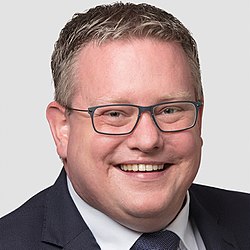 Markus UhlMarkus Alexander Uhl (born 31 October 1979 in Cologne) is…Affiliated
How the record is sourced and how the score is derived.
The score is formula-derived (Factrail formula v1, version 1.0.0), not an editorial verdict. Read the methodology.
By the Factrail desk · Method: how we source and score · Last reviewed
Dispute a fact on this pageNamed here, or represent someone who is? Request a right of reply.
Linked because the text names them, not because anything was measured.
People and organizations as listed in the Related section of this page; facts, drivers and the pages that name it as listed in the blocks here. Counts, not a rating.