
Katharina Landgraf
Katharina Landgraf (born 24 February 1954 in Kirchengel, Thuringia) is a German politician of the Christian Democratic Union (CDU) and a qualified…
- Facts0
- Drivers0
- Indicators0
Katharina Landgraf (born 24 February 1954 in Kirchengel, Thuringia) is a German politician of the Christian Democratic Union (CDU) and a qualified…
Katharina Landgraf (born 24 February 1954 in Kirchengel, Thuringia) is a German politician of the Christian Democratic Union (CDU) and a qualified land-improvement engineer. She was a member of the first freely elected Volkskammer of the German Democratic Republic from March to October 1990 and of the Bundestag from October to December 1990, then again from 2005 until the end of the 19th electoral term in 2021, sitting for the Leipzig-Land constituency in Saxony.
She passed the Abitur in Borna in 1972, studied Meliorationswesen at the University of Rostock from 1972 to 1976 and graduated as a Diplom-Ingenieurin. From 1976 to 1979 she worked as an engineer for water management and environmental protection in the Borna lignite combine, and from 1980 to 1990 in the crop-production cooperative at Wiederau-Zwenkau. After German reunification she was a scientific staff member of the Konrad Adenauer Foundation at its Leipzig education centre from 1991 to 1999 and at the Dresden centre in 2004–05.
Landgraf joined the Christian Democratic Union of East Germany in 1988 and later sat in the Landtag of Saxony from 1999 to 2004. In the 19th Bundestag she was a full member of the Committee on Food and Agriculture, the Committee on Family Affairs, Senior Citizens, Women and Youth, and the board of trustees of the Federal Agency for Civic Education. She won Leipzig-Land with 51.3 percent of the constituency vote in 2013 and held it in 2017 with 34.1 percent, when the Alternative for Germany finished second on 28.7 percent of the first votes.
On 11 June 2020 the Leipziger Volkszeitung reported that she would not stand at the 2021 federal election, closing a continuous Bundestag membership that had begun in 2005. The Bundestag biography, drawn from her own disclosure, lists her as evangelical Lutheran, married and the mother of four children.
Katharina Landgraf was born on 24 February 1954 in Kirchengel in Thuringia, then part of the German Democratic Republic. The archived biography for the Bundestag’s 19th electoral term gives that date and place and notes that the biographical details rest on the member’s own information.
Kirchengel is a street village about five kilometres north of Greußen and about 500 metres east of Westerengel. The town of Greußen, which lists it as an Ortsteil, records a first documentary mention in 1220 and a population of 234 in December 2020. The German National Library’s Integrated Authority File lists Katharina Mühlbach as an earlier name. The Bundestag biography, issued under the name Katharina Landgraf, does not name her parents; it describes her as evangelical Lutheran.
In 1972 she passed the Abitur in Borna, a town about 30 kilometres south of Leipzig, now in the Free State of Saxony. In the GDR the Abitur was the general qualification for university entry. Only about a tenth of each age group was admitted to the Erweiterte Oberschule, the school that led directly to it. Until 1984 pupils transferred there after the eighth school year, and a place depended on marks and on the political conformity of both the pupil and the parents. A three-year vocational course combined with the Abitur was another route to the same certificate. The Bundestag entry records the year and the town, not the school.
From 1972 to 1976 Landgraf studied Meliorationswesen at the University of Rostock and in 1976 graduated as a Diplom-Ingenieurin. The authority file gives the degree as Diplom-Ingenieurin für Meliorationswesen.
Meliorationswesen was the engineering of land improvement. West German handbooks on the GDR defined Meliorationen as technical and biological measures to change the biological, chemical and physical properties of agricultural and forest land, so as to raise soil fertility, ease the use of machinery and make production less dependent on weather. The works they listed included drainage and irrigation or sprinkling, deep loosening and the removal of stones, the cultivation of moor, wasteland and mining spoil, protection against wind and water erosion, and the building of farm roads. The 1985 DDR-Handbuch, published for the Federal Ministry for Intra-German Relations, treated these usually large projects as part of the effort by the Socialist Unity Party of Germany to raise self-sufficiency in food, and it noted a specialised course for managerial tasks in the field, ending in the Diplom-Ingenieur, at Rostock, alongside an engineering school in Fürstenwalde.
At Rostock the third higher-education reform of 1969 replaced the agricultural faculty with sections, among them Meliorationswesen und Pflanzenproduktion, based at Justus-von-Liebig-Weg. Teaching was recast as a “scientifically productive” programme of basic, subject and specialised study. After changes in the prescribed length, training lasted four years, the span of Landgraf’s enrolment. The faculty history records 122 students enrolled in Meliorationswesen and 98 in crop production in 1970, and 47 and 83 respectively in 1989. Water works had priority in practice: the 1985 handbook treated about 38 per cent of the GDR’s agricultural land, some 2.4 million hectares, as needing drainage, and about 60 per cent, some 3.78 million hectares, as needing irrigation in dry years.
From 1976 to 1979, after qualifying as a Diplom-Ingenieurin in land improvement (Meliorationswesen) at the University of Rostock, Katharina Landgraf worked as an engineer for water management and environmental protection at the Braunkohlekombinat Borna, a state-owned lignite combine in the Central German mining district south of Leipzig. The dates and title are from the curriculum vitae she supplied to the Bundestag, which publishes members' biographies from their own information. The Saxon State Archives record that the Braunkohlenwerk Borna, a branch of Braunkohlenwerke Salzdetfurth AG before 1945 and a Volkseigener Betrieb from 1952, became a combine on 1 July 1968, absorbing the works at Thräna, Neukirchen, Großzössen, Lobstädt and Witznitz.
Aerial view of the Speicherbecken Borna, a reservoir in the former Borna-Süd lignite pit, with the town of Borna on the far shore.
Open-pit mining there required continuous dewatering and left residual pits whose water balance had to be rebuilt. One project still being finished while Landgraf was at the combine was the Speicherbecken Borna. Tagebau Borna-Süd, worked from 1939 to 1970 and a supplier of the Borna works, was reshaped between 1964 and 1980 into a reservoir commissioned in 1977, after Hartmannsdorf, Görnitz and Altdeutzen had been cleared and the Pleiße diverted. The Saxon reservoir authority gives it a water surface of about 250 hectares and a capacity of nearly 100 million cubic metres, for flood retention and for raising low flows in the Pleiße, as the largest reservoir in the Wyhra–Pleiße system. Her biography does not identify which plants, pits or reservoirs were assigned to her.
On 1 October 1980 the Borna enterprise became a constituent works of the VEB Braunkohlenkombinat Bitterfeld. From 1980 to 1990 Landgraf was on the staff of the LPG Pflanzenproduktion Wiederau-Zwenkau, a crop-production collective. In the German Democratic Republic, Type III agricultural production cooperatives were, during the 1960s and 1970s, concentrated into large units specialized either in crops, LPG (P), or in livestock, LPG (T); land brought into a cooperative remained formally the property of the farmers, who could no longer dispose of it freely. Wiederau, now part of Pegau, and Zwenkau lie on the plain of the White Elster south of Leipzig, beside that mining landscape. After German reunification, cooperatives were converted into market-economy legal forms under agricultural-adjustment legislation. The Federal Agency for Civic Education records that, of those employed in agriculture and forestry, four in five had lost their jobs by 1993, and that agricultural employment fell from 923,000 to 179,100 within four years. Landgraf's biography places the end of her own employment at the cooperative in 1990.
From 1991 to 1999 Landgraf was a scientific staff member of the Konrad Adenauer Foundation at its Bildungswerk, a civic-education centre, in Leipzig, and in 2004/05 at the Bildungswerk in Dresden. The foundation is the Christian-democratic political foundation associated with the Christian Democratic Union. A 1977 survey in Aus Politik und Zeitgeschichte grouped it with the other party-near foundations: their domestic work was civic education, and their budgets came predominantly from public funds.
In a statement printed in the federal government's December 1991 report to the Bundestag on political education, the foundation's Institute for Political Education said that between March and October 1990 it had opened regional Bildungswerke in Leipzig and Rostock and had begun events in the GDR on parliamentarism, the rule of law and the social market economy. After unification the same statement named party democracy, federalism and what it called an ecologically obliged social market economy as themes, and office-holders and people in education, science, the media and culture as audiences. It reported 2,015 events and 93,557 participants in 1990, about 23,000 of them, roughly a quarter, from the new Länder. Landgraf joined the Leipzig staff in 1991, after that opening phase; the report does not describe her own programme.
In February 2004 the foundation announced that its Bildungswerk for Saxony was moving from Leipzig to Dresden, to Königstraße 23, and scheduled an opening on 24 February. Her return to the scientific staff in Dresden in 2004/05 falls between the end of her term in the Saxon Landtag and her later return to the Bundestag. The notice describes the regional centres as venues for seminars and workshops; that states the institution's remit and does not record what she did there.
Katharina Landgraf joined the East German Christian Democratic Union in 1988, while it was still a bloc party in the German Democratic Republic. With the LDPD, the NDPD and the DBD, and with the mass organisations, the CDU belonged to the Democratic Bloc. The Federal Agency for Civic Education describes these parties as having had little room for independent policy: unlike the Socialist Unity Party, they were barred from organising in workplaces and from recruiting in public, and they were popularly called the SED’s “Blockflöten”. The CDU had existed in the Soviet zone since 26 June 1945, and in 1989 it still had about 134,000 members.
In the upheaval of late 1989 the East CDU and the LDPD declared that they were leaving the Democratic Bloc. A special party congress then confirmed Lothar de Maizière, elected chairman on 12 November, as party leader. On 5 February 1990, in the federal government’s guest house in West Berlin, de Maizière, Hans-Wilhelm Ebeling of the German Social Union and Wolfgang Schnur of Democratic Awakening agreed to form the Alliance for Germany for the Volkskammer election of 18 March. The three parties stayed organisationally separate and put up their own candidates. Their stated aims were the restoration of the Länder that the GDR had abolished, German unity, and, as a step toward it, a currency and economic union with the Federal Republic. Chancellor Helmut Kohl promised the support of the West German CDU and of himself. In the campaign the alliance argued for rapid reunification, the D-Mark and a social market economy.
The poll on 18 March 1990 was the first competitive election to the Volkskammer. The Alliance for Germany took about 48 per cent of the vote. Inside that total the CDU received 4,710,598 votes (40.8 per cent) and 163 of 400 seats, the DSU 727,730 votes (6.3 per cent) and 25 seats, and Democratic Awakening 106,146 votes (0.9 per cent) and four seats. The SPD followed with 21.9 per cent and the PDS, the SED’s successor, with 16.4 per cent. Mandates were filled from lists in the 15 Bezirke. In the Leipzig district, with 33 seats and 936,715 valid votes, the CDU won 371,346 votes (39.6 per cent) and 13 seats; the DSU won three and Democratic Awakening none.
Landgraf was elected on the CDU list for the Leipzig district. The Bundestag’s biographical register lists her as a member of the tenth Volkskammer with the affiliation “CDU → CDU/DA”, and distinguishes her by the place-name suffix Großstorkwitz from the other deputy named Landgraf. The same handbook describes that chamber as freely elected on 18 March 1990 and constituted on 5 April 1990. Her Bundestag biography, drawn from her own information, dates the mandate from March to October 1990. A documentation project of the Commission for the History of Parliamentarism and Political Parties records that she sat in the joint CDU/DA group and on the Committee for Press and Media.
The freely elected chamber used the Palace of the Republic. Meeting there, it voted for the GDR to accede, under Article 23 of the Basic Law, to the territory in which the Basic Law applied, and on 18 May 1990 it ratified the treaty on monetary, economic and social union. On 19 September 1990 the Council of Ministers closed the building because of asbestos, so the chamber’s last sittings were held elsewhere. In 37 working sessions the chamber, most of whose members were new to parliament, passed the laws that prepared unity.
Article 42 of the Unification Treaty required the Volkskammer, before accession took effect, to choose 144 of its members, according to its composition, for dispatch to the 11th German Bundestag, plus substitutes. Membership was to begin only with accession, and only after a declaration of acceptance to the Volkskammer’s president. On 28 September 1990, in a sitting of more than 16 hours, the chamber selected those 144 deputies to represent the GDR’s population from reunification until a new all-German parliament was elected. The Volkskammer sat for the last time on 2 October.
Landgraf was one of the deputies sent across. The Bundestag register lists her as a member of the 11th Bundestag from 3 October 1990, for the CDU, and not again until the 16th to 19th electoral periods. Her official biography likewise gives Bundestag membership for October to December 1990 and then only from 2005, rather than a continuous term from 1990 to 1994. The seat was not a directly elected federal constituency. The 144 were chosen by the Volkskammer itself. On 4 October 1990 the enlarged house met for the first time as an all-German parliament in the Reichstag building in Berlin: 519 members of the existing Bundestag and the 144 from the Volkskammer. That bridge ended when the 12th Bundestag, elected on 2 December 1990, held its constituent sitting on 20 December 1990.
Landgraf joined the Christian Democratic Union of East Germany in 1988. In the CDU in Saxony she was deputy state chair from 1991 to 1993 and, in parallel, state chair of the Frauen-Union in Saxony from 1991 to 1995. Both spans are given in the biography the Bundestag published for her 18th electoral term.
The same biography names her district chair of the CDU Borna from 1995 to 2000, and it does not record a chairmanship of a Kreisverband Leipziger Land continuing until 2002. In Pegau the Leipziger Volkszeitung reported in 2020 that she had again been elected chair of the CDU local association, succeeding her son Albrecht Landgraf, after an earlier tenure the paper put at 17 years.
From 1995 she sat on the Pegau city council. The Bundestag biography for the 18th term still listed that seat as current, and abgeordnetenwatch recorded membership of the council of the Stadt Pegau among the side activities declared for her 2013–2017 Bundestag mandate. A curriculum vitae on the website of the Bildungswerk Sachsen der Deutschen Gesellschaft, an association she chairs, additionally describes her as deputy mayor of Pegau from 1995, a title the Bundestag text does not use.
The side-activity register lists the Pegau council only against the 2013–2017 mandate, not against 2017–2021, although other offices she continued to hold were entered for both terms. From 2004 the Bundestag biography also lists her as a district councillor, without naming the district. Abgeordnetenwatch attaches that office, again only for 2013–2017, to the Kreistag of Landkreis Leipzig. The Bildungswerk vita instead names the Kreistag of Landkreis Leipziger Land and, like its wording on the deputy mayoralty, leaves the office open with “since 2004.” None of these accounts gives 2014 as the year the district mandate ended.
The third Landtag of Saxony was elected on 19 September 1999. Turnout statewide was 61.1 percent. The CDU took 56.9 percent of the list vote, ahead of the PDS (recorded in later tables as the Linke) on 22.2 percent and the SPD on 10.7 percent, and received 76 of 120 seats; the PDS received 30 and the SPD 14. The CDU also won the direct seat in nearly every constituency.
In constituency 24, Leipziger Land 2, the CDU direct seat went with a list share of 55.7 percent and turnout of 59.0 percent. On the list vote there the PDS took 20.8 percent, the SPD 14.8 percent, the Greens 2.6 percent and the FDP 1.1 percent, with the Republicans at 0.9 percent and the NPD at 0.7 percent. That constituency table identifies the direct winner only as “CDU” and does not publish a personal share of the first votes. A documentation of the preliminary official result issued by the Konrad-Adenauer-Stiftung names Katharina Barbara Landgraf as the CDU candidate elected in the constituency.
The Landtag’s historical register does not list her on 18 September 1999, the day before the election. The new Landtag opened in Dresden on 13 October 1999, with the senior member, Cornelius Weiss of the SPD, presiding. The register lists Landgraf that day as a CDU deputy, with no chamber office recorded beside her name. She is still listed on 13 October 2004 and is absent from the register on 19 October 2004.
Committee assignments do not appear in that register. The Bildungswerk vita states that she was deputy chair of the Verfassungs- und Rechtsausschuss and a member of a committee for agriculture and the environment. On 1 January 2000 the Landtag’s own list of standing committees comprised a Verfassungs- und Rechtsausschuss, an Ausschuss für Landwirtschaft, Ernährung und Forsten, and a separate Ausschuss für Umwelt und Landesentwicklung. The public member register does not show her as chair or deputy chair of any of them.
Katharina Landgraf was directly elected to the Bundestag for the rural area around Leipzig in Saxony, not for the separate constituency of Nordsachsen. From 2013 through 2021 the Federal Returning Officer numbered the seat 154 and named it Leipzig-Land, and defined it as the Landkreis Leipzig alone. The city of Leipzig formed its own constituencies.
The Returning Officer's maps for the 2013, 2017 and 2021 elections, drawn to administrative boundaries of 31 December 2012, 13 August 2017 and 15 April 2020, mark Borna, Grimma, Markkleeberg and Wurzen inside the seat, with Markranstädt, Pegau, Colditz, Frohburg, Geithain, Groitzsch, Zwenkau and the other municipalities of the Landkreis. The outer line is the district boundary. Municipal mergers inside it did not move that line: Deutzen, Espenhain and Narsdorf are labeled separately on the 2012 boundary but not in 2017, and Kohren-Sahlis is still separate in 2017 but not on the 2020 map. The same sheets show Landkreis Nordsachsen and the city of Leipzig to the north, Mittelsachsen to the southeast, and Burgenlandkreis, the Saalekreis and Altenburger Land along the borders with Saxony-Anhalt and Thuringia.
In 2005 the seat was number 155 and was named Leipziger Land – Muldentalkreis. A bill introduced on 11 December 2007 by the CDU/CSU and SPD groups, for the redistribution used in 2009, treated constituency 155 as territorially unchanged, described it as the districts of Leipziger Land and Muldentalkreis, and renamed it Leipzig-Land in line with the planned district reform. The Returning Officer's final 2009 results use that name and the number 155. From 2013 the Landkreis Leipzig area was numbered 154. Eligible voters fell from 235,291 in 2005 to 231,084 in 2009, 220,400 in 2013, 215,616 in 2017 and 212,853 in 2021.
On 18 September 2005 Landgraf, for the Christian Democratic Union (CDU), won the direct mandate. The Returning Officer's final table names her as elected with 61,178 first votes, 34.9 percent of 175,499 valid first votes, ahead of the Social Democratic Party (SPD) on 51,962 (29.6 percent) and the Left, tabulated as Die Linke., on 37,850 (21.6 percent). The margin over the SPD was 9,216 votes, and turnout was 76.0 percent. The Free Democratic Party (FDP) took 9,710 first votes (5.5 percent), the National Democratic Party 7,966 (4.5 percent) and the Greens 4,025 (2.3 percent); an independent, Blaßkiewitz, received 1,442 (0.8 percent). Second votes were 30.9 percent for the CDU, 26.5 percent for the SPD and 22.7 percent for the Left.
On 27 September 2009 the Returning Officer's register of elected constituency candidates lists Barbara Katharina Landgraf of the CDU for Wahlkreis 155 Leipzig-Land, with 41.7 percent. The final file gives 60,969 of 146,106 valid first votes. Die Linke followed with 33,044 (22.6 percent), the SPD with 23,471 (16.1 percent) and the FDP with 14,799 (10.1 percent); the lead over the Left was 27,925 votes. Turnout was 64.2 percent. Second votes were 36.7 percent for the CDU (53,735) and 23.8 percent for the Left (34,826).
On 22 September 2013, with the seat numbered 154, the Bundestag biography for the 18th electoral term records Landgraf as directly elected in Wahlkreis 154. The Returning Officer's party table, which does not print candidate names, gives the CDU 76,273 first votes, 51.3 percent of 148,740 and 9.6 points above 2009. The Left was second with 31,865 (21.4 percent) and the SPD third with 23,542 (15.8 percent); the NPD received 6,066 (4.1 percent). Turnout was 68.8 percent, and the CDU's second-vote share was 45.8 percent (68,348).
On 24 September 2017 her biography for the 19th term again records a direct mandate in Wahlkreis 154. The CDU's 54,152 first votes were 34.1 percent, 17.2 points below 2013, and the Alternative for Germany (AfD) took 45,563 (28.7 percent), a CDU lead of 8,589 votes. The Left had 24,801 (15.6 percent), the SPD 18,221 (11.5 percent), the FDP 10,048 (6.3 percent) and Alliance 90/The Greens 6,219 (3.9 percent). Turnout was 74.8 percent. On second votes the CDU fell to 30.1 percent (47,944), down 15.7 points, and the AfD rose to 26.9 percent (42,823), up 20.5 points.
On 11 June 2020 the Leipziger Volkszeitung reported that Landgraf, the member for the Landkreis Leipzig, would not stand again at the end of the term. She was quoted as saying "Ich höre auf," and the paper reported that the decision had already been clear to her during the previous campaign. It noted that by the next election she would have sat in the Bundestag for 16 years and had already reached retirement age, and it compared that timetable with Chancellor Angela Merkel's plan to stop in 2021.
She did not contest the election of 26 September 2021. The CDU direct candidate was Georg-Ludwig von Breitenbuch. The Returning Officer's final count gave the AfD 39,348 first votes (24.6 percent) and the CDU 39,066 (24.4 percent), 282 votes apart, with the SPD on 31,989 (20.0 percent). Reporting the preliminary final figures, MDR named Edgar Naujok of the AfD as the winner and von Breitenbuch as runner-up on those shares. Naujok's biography for the 20th term records him as directly elected in Wahlkreis 154, Leipzig-Land. Second votes were 24.0 percent for the AfD (38,458), 21.3 percent for the SPD (34,104) and 20.4 percent for the CDU (32,711), and turnout was 76.2 percent.
Landgraf trained as a Diplom-Ingenieurin in Meliorationswesen (land improvement) at the University of Rostock, graduating in 1976, and from 1980 to 1990 worked in the LPG Pflanzenproduktion at Wiederau-Zwenkau. In the 18th Bundestag (2013–2017) her archived biography lists her as an ordinary member and as Obfrau of the Ausschuss für Ernährung und Landwirtschaft. The Obleute are the spokespersons of the parliamentary groups, not the committee chair: the 19th-term committee page describes them as planning the committee’s work under the chair.
In the 19th Bundestag (2017–2021) she remained an ordinary member of that committee and was also an ordinary member of the Committee for Family Affairs, Senior Citizens, Women and Youth. She was not an Obfrau. The chair was Alois Gerig (CDU/CSU) and the CDU/CSU Obmann was Johannes Röring, alongside Obleute from the other groups. The committee’s brief tracked the Federal Ministry of Food and Agriculture: nutrition and nutrition education, food trade, safety, quality and labelling, plant protection, national farm policy and the European Union’s Common Agricultural Policy, and rural development.
On 15 January 2015, debating the CDU/CSU–SPD motion “Gesunde Ernährung stärken – Lebensmittel wertschätzen” (Drucksache 18/3726), Landgraf said diet was a personal responsibility that the state should support but not take over. The family, “in its diversity”, was normally where nutritional competence was formed, through parents and grandparents, before school; good school meals, school nutrition education, education for parents and public information were supplements. She noted Bundestag support since 2008 for the national action plan IN FORM, on healthy eating and physical activity, and said carrying it to 2020 needed a wider reach. Diet-related illness, she said, was a “societal dilemma” that would not be solved “mit Brechstange und Paragrafen” — with a crowbar and statutes.
The same debate set her next to the minister and the opposition. Food and agriculture minister Christian Schmidt (CSU) said people could not be told what to eat and that consumer information had to stay understandable, while promising help for a school-catering network. Karin Binder (Die Linke) called the coalition text a showcase motion and asked for binding rules, including a mandatory traffic-light label and sweet-free checkouts. Ute Vogt (SPD) likewise rejected prescribing a lifestyle, but stressed the duty to keep food safe; Nicole Maisch (Alliance 90/The Greens) said the motion was silent on working conditions in meat plants. The motions were referred to committee.
On 10 November 2016 she spoke on the Greens’ motion for a transparent regional food label (Drucksache 18/9544). She favoured regional labelling, but said “regional” first had to be defined and that a seal should show the main ingredients, their origin and where the product was packed. The voluntary Regionalfenster was useful but needed development; she preferred a voluntary scheme that could be certified, controlled and read, and that did not mislead, to wide statutory duties. The Greens wanted a 70 percent minimum of regional ingredients for the Regionalfenster and a nationwide positive label binding voluntary origin claims to a defined region. The Bundestag referred the motion to the agriculture committee.
On plant protection she voted with the Union in the dispute over glyphosate. In March 2015 the International Agency for Research on Cancer, the cancer agency of the World Health Organization, classified the herbicide as probably carcinogenic to humans (Group 2A), citing limited evidence for non-Hodgkin lymphoma in people and sufficient evidence in experimental animals. In November 2015 the European Food Safety Authority, after peer review with member-state bodies, concluded that glyphosate was unlikely to pose a carcinogenic hazard to humans. The Federal Institute for Risk Assessment (BfR), author of the EU rapporteur report, later described the split as hazard identification versus a risk assessment that includes exposure: the majority EU view, it said, was that no carcinogenic risk to humans could be derived from intended and proper use.
On 25 February 2016 the Bundestag rejected the Greens’ motion “Voreilige Neuzulassung von Glyphosat stoppen” (Drucksache 18/7675) by 446 votes to 117, with three abstentions. Landgraf voted no, as did 276 of 310 CDU/CSU members; two Union members voted yes. On 27 April 2016 she wrote on Abgeordnetenwatch that she had followed the BfR report and the EFSA conclusions, which after consultation with experts from all member states had, she said, confirmed glyphosate’s “gesundheitliche Unbedenklichkeit”, and that she expected proper and responsible use.
During the 19th term the question shifted from an early European stop to a national reduction. On 16 January 2019 the agriculture committee, with the votes of CDU/CSU and SPD members, recommended rejecting motions from the Free Democratic Party (Germany), the Left and the Greens. The Left and the Greens sought a national ban or a rapid exit, including private use and public land; the FDP wanted authorisations kept strictly scientific. The Union called a total ban excessive and legally unavailable, citing limits near water and on public land and a one-third cut in use over five years, while the government said the agriculture and environment ministries would table a joint proposal that year.
On 4 September 2019 the cabinet adopted the Action Programme on Insect Protection, presented by environment minister Svenja Schulze (SPD) and agriculture minister Julia Klöckner (CDU). It was to restrict glyphosate-containing and equivalent products sharply from 2020 and to end glyphosate use in Germany at the end of 2023, in farming, home gardens and public green space, with alternatives developed with farming in an arable strategy. Her recorded position on an early stop to re-approval remained that 2016 vote and the BfR and EFSA assessments she cited for it.
Landgraf's recorded work on family, women and social policy sat partly outside the family committee. The Bundestag biography for the 18th electoral term (2013–2017) does not list her as a member of the Committee on Family Affairs, Senior Citizens, Women and Youth. On 18 December 2013 the Gruppe der Frauen of the CDU/CSU parliamentary group confirmed her as a deputy chair when Karin Maag was elected chair in succession to Rita Pawelski. Daniela Ludwig was confirmed as first deputy; Elisabeth Winkelmeier-Becker and Nadine Schön were confirmed with Landgraf, and Claudia Lücking-Michel and Barbara Lanzinger were newly elected deputies. A newsletter of the group dated 10 September 2015 still described her as a member of its board.
In the 19th electoral term (2017–2021) she was an ordinary member of the Committee on Family Affairs, Senior Citizens, Women and Youth. The same biography lists her as a deputy member of that committee's Subcommittee on Civic Engagement and of the Parliamentary Accompanying Body on the COVID-19 pandemic. The health committee had set up the accompanying body, with 21 members drawn from the health committee and from other committees, to look at pandemic control, at vaccination—including development, licensing, access, and the ethical, social and legal questions attached to it—and at the social effects of the contact restrictions. Its sources were public expert hearings and regular government briefings on the course of infection.
Loneliness was one file on which she was a committee rapporteur. On 23 June 2021 the family committee, in a recommendation she signed with rapporteurs from the other groups, asked the Bundestag to reject an FDP motion, Drucksache 19/25249, that called for an interdisciplinary expert commission and an action plan against loneliness. In committee the CDU/CSU and the SPD voted for rejection, the AfD and the FDP voted against rejection, and Die Linke and Alliance 90/The Greens abstained. The Union group had, on 10 February 2021, adopted a position paper of its own for a national loneliness strategy. With Marcus Weinberg, the group's family-policy spokesman, Landgraf said a central aim was to support people, into old age, in living independently and taking part in society, and that loneliness and social isolation should become a focus of social and political work. The paper called for more research and new programmes, a federal loneliness commissioner to coordinate across ministries and levels of government, and a national action plan.
After the 2013 federal election the CDU published a staffing list, in a paper dated 23 October 2013, for the working groups in the coalition talks with the SPD. It placed Landgraf in group 6, "Familie, Frauen und Gleichstellungspolitik," with other CDU names including Ingrid Fischbach, Markus Grübel, Sabine Weiss and Andreas Storm. Annette Widmann-Mauz stood at the head of the CDU column and Manuela Schwesig at the head of the SPD column; the paper stated that the chairs were underlined.
An earlier split inside the Union concerned the Betreuungsgeld, a monthly payment for parents who did not place a young child in publicly subsidized day care. At a trial vote of the CDU/CSU group on 6 November 2012, participants told Die Welt that Landgraf was the only CDU member to vote against the benefit and that four members abstained, while about a third of the group, including many declared opponents, had left before the ballot. Chancellor Angela Merkel was reported to have called the critics' term "Herdprämie" inappropriate and to have urged the group to pass the benefit, which was to be 100 euro a month from 1 August 2013 and 150 euro a year later. The same report said a group of CDU women feared disadvantages, for example for children of migrants who might then not be sent to a Kita. It did not give a reason from Landgraf.
On 30 June 2017, in the 244th sitting of the 18th Bundestag, members held a recorded vote on a Bundesrat bill giving persons of the same sex the right to marry (Drucksachen 18/6665 and 18/12989), the measure known as Ehe für alle. The official result sheet marks Landgraf's vote as Nein. Of 623 votes cast, 393 were in favour, 226 against and four were abstentions; seven members did not vote, and the bill was adopted. Within the CDU/CSU the sheet records 75 yes, 225 no, four abstentions and five not voting. Merkel is recorded as voting no. The SPD cast 192 yes votes and one non-vote, Die Linke 63 yes and one non-vote, and the Greens 63 yes; the independent Erika Steinbach voted no. Die Welt's list of Union votes places Landgraf among the noes and reports the same House and Union totals. That morning SPD floor leader Thomas Oppermann told the House that, since the Monday, the coalition partner had treated the question as a matter of conscience, and that the vote therefore had to be released from group discipline. The minutes contain written personal explanations from a number of Union members; Landgraf's name is not among them.
For the 19th electoral term of the Bundestag (2017–2021), Katharina Landgraf’s published register of interests listed several unpaid posts. The Bundestag states that members submit these entries themselves and that they are published once it has been checked whether disclosure is required. In that self-reported list she named membership of the Kuratorium of Leipziger Symphonieorchester gemeinnützige GmbH in Böhlen; the chair of the board of Bildungswerk Sachsen der Deutschen Gesellschaft e.V. in Leipzig; membership of the Kuratorium of Deutsche Gesellschaft e.V. in Berlin; membership of the Präsidium of the Internationaler Bund (IB), entered as a free provider of youth, social and educational work with its seat in Frankfurt am Main; and the chair of the Verein von Mitgliedern der ehemaligen Volkskammerfraktion CDU/DA e.V., an association of former members of that group in the last Volkskammer, with its seat given as Brandenburg.
The Bildungswerk later recorded that its members’ meeting on 11 February 2022 confirmed her as chair, with Uwe Schwabe as deputy chair and Klaus Ober as a further board member, and that members of the Bildungswerk board also sit on the Kuratorium of the Deutsche Gesellschaft. A notice issued by the Deutsche Gesellschaft in January 2018 had described her as a member of that association’s Vorstand as well as chair of the Saxon Bildungswerk. The Bildungswerk’s biographical note also calls her chair of the Volkskammer association. In a report of 18 December 2015 on decorations for members of its Präsidium, the IB identified her as a member of that body.
Separate from those offices, the Bundestag listed her in the 19th term as an ordinary member of the Kuratorium of the Federal Agency for Civic Education (Bundeszentrale für politische Bildung). Under the decree governing the agency, the Kuratorium consists of 22 members of the Bundestag, appointed by the Bundestag president on the proposal of the parliamentary groups, and reviews the agency’s work for political balance and effectiveness. The agency’s report for 2019–2021 includes Landgraf among the CDU/CSU members of the Kuratorium for that period. In the same term the Bundestag also listed her as a deputy member of the Franco-German Parliamentary Assembly. The Bundestag describes the assembly as 50 members from the Bundestag and 50 from the French National Assembly, meeting at least twice a year, alternately in Germany and France; its constitutive sitting was held on 25 March 2019.
Two state decorations are documented outside her parliamentary biography. In December 2015 the IB reported that Landgraf, then a member of its Präsidium, had been honored in Berlin with the Bundesverdienstkreuz, in the same account as a 16 December ceremony for IB president Petra Merkel. On 31 January 2018 Ambassador Péter Györkös presented her with a class of the Hungarian Order of Merit.
The list of recipients published by the Federal President on 1 January 2016 places “Landgraf, Katharina, Pegau OT Großstorkwitz” under the Verdienstkreuz am Bande of the Order of Merit of the Federal Republic of Germany. Merkel, named alongside her on that list, had received the same class; Bundestag President Norbert Lammert gave the laudation at the 16 December ceremony the IB described. Accounts of the Hungarian grade differ. The Deutsche Gesellschaft, writing as an organization on whose board she then served, called the decoration the Ritterkreuz and reported that Györkös, in his laudation, had credited her work for Hungarian–German and Hungarian–Saxon relations. A report on Ungarn Heute headed the same presentation as the Offizierskreuz, stated that President János Áder had conferred it, and connected it with relations between Hungary and Saxony, including activity linked to the Deutsch-Ungarisches Jugendwerk. The grade given in that account of the conferral by the Hungarian president is the Offizierskreuz.
The Bundestag biography for the 19th term, which the parliament notes is based on members’ own information, records that Landgraf is evangelical Lutheran, is married, and has four children. The Federal President’s list of 1 January 2016 gives her place of residence as Pegau, locality Großstorkwitz. In March 2020 the Leipziger Volkszeitung reported that she had again become chair of the CDU local branch in Pegau, an office it said she had previously held for 17 years; according to that report the post had in between been held by her husband, Gerhard Landgraf, and then by their son Albrecht Landgraf.
Ranked by shared high-impact facts, then explicit ties, then shared drivers.
 Norbert LammertNorbert Lammert (born 16 November 1948 in Bochum) is a…Affiliated
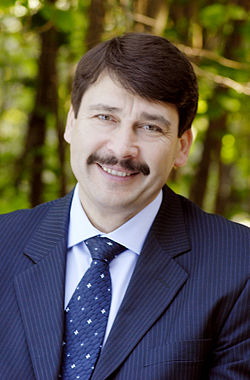 János ÁderJános Áder is a Hungarian politician and lawyer who served…Affiliated
 Annette Widmann-MauzAnnette Widmann-Mauz is a German politician of the…Affiliated
 Julia KlöcknerJulia Klöckner (born 16 December 1972 in Bad Kreuznach) is…Affiliated
 Edgar NaujokEdgar Naujok (born 25 June 1960 in Oggersheim) is a…Affiliated
 Angela MerkelAngela Merkel is a German physicist and CDU politician who…Affiliated
How the record is sourced and how the score is derived.
The score is formula-derived (Factrail formula v1, version 1.0.0), not an editorial verdict. Read the methodology.
By the Factrail desk · Method: how we source and score · Last reviewed
Dispute a fact on this pageNamed here, or represent someone who is? Request a right of reply.
People and organizations as listed in the Related section of this page; facts, drivers and the pages that name it as listed in the blocks here. Counts, not a rating.