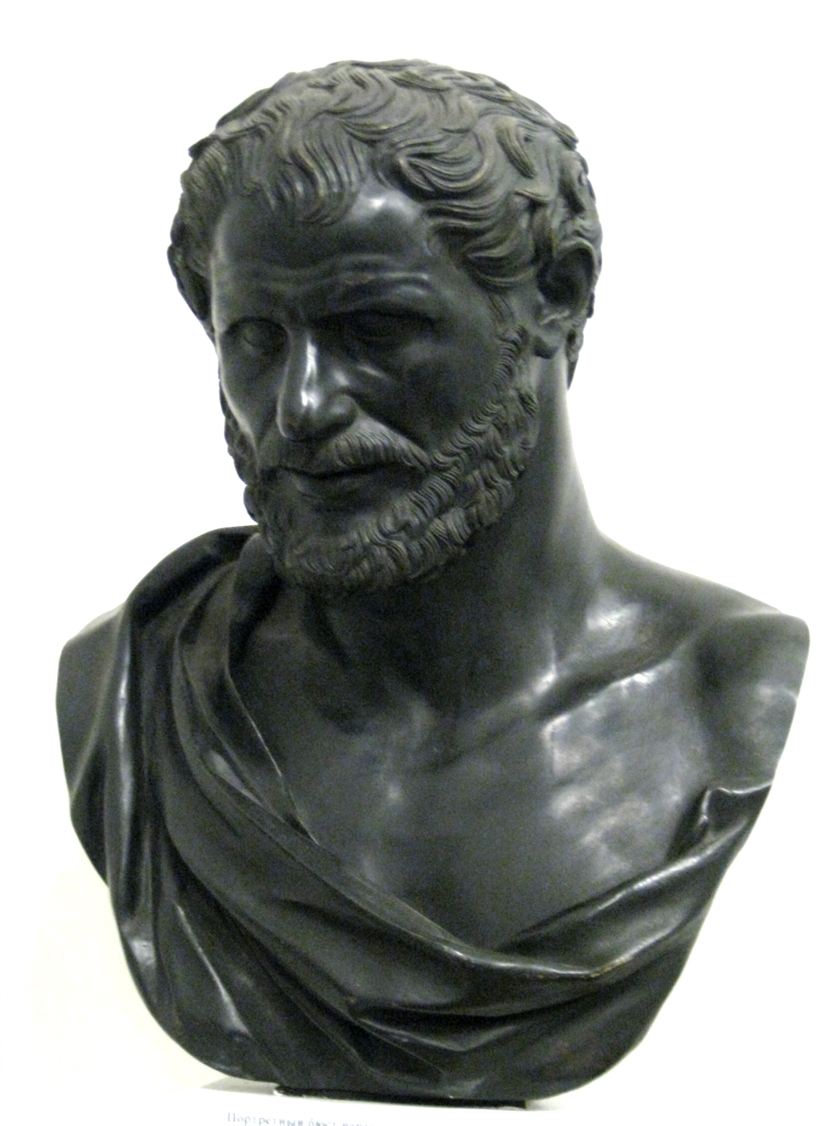
The first fact about Democritus in a public catalog is a wrecked library, not a nucleus. Diels 1903 (https://archive.org/details/diefragmenteder00dieluoft (opens in a new tab)) and Stanford (https://plato.stanford.edu/entries/democritus/ (opens in a new tab)) independently show that the ancient title-list is mostly empty boxes. Loeb Diogenes Laertius Book 9 (https://archive.org/details/livesofeminentph02dioguoft (opens in a new tab) and Perseus https://www.perseus.tufts.edu/hopper/text?doc=Perseus:text:1999.01.0258 (opens in a new tab)) is a late anecdotal Life, not a civil register. IEP at https://iep.utm.edu/democrit/ (opens in a new tab) repeats the source limit. Loeb Aristotle On Generation and Corruption (https://www.loebclassics.com/view/aristotle-on_generation_corruption/1955/pb_LCL400.1.xml (opens in a new tab)) prints a school refutation that conserved atomism as a defeated physics. DK’s joint Leucippus heading is an identity-file problem. Marx’s 1841 dissertation (https://marxists.org/archive/marx/works/1841/dr-theses/index.htm (opens in a new tab)) later made the pair a partisan ancestry. Early-modern laughing canvases and Christian captions polarised a name. Ethics fragments on euthymia, as Stanford frames them, can be read as consolation and as civic quietism. The fragment file does not abolish slave property. Popular ‘father of the atom’ pages after early nuclear models retrofit a mascot. The offsets are URLs with later dates. Laks-Most Loeb Early Greek Philosophy (https://www.hup.harvard.edu/books/9780674996892 (opens in a new tab)) re-Englished the dossier in 2016. SEP and IEP are free expert doors that flag uncertainty. Epicurus at https://plato.stanford.edu/entries/epicurus/ (opens in a new tab) kept atoms in the curriculum by revision. Lucretius in Loeb (https://www.loebclassics.com/view/LCL181/1924/volume.xml (opens in a new tab)) and the 1473 print tradition made Latin physics public. Gassendi at https://plato.stanford.edu/entries/gassendi/ (opens in a new tab) reopened speakable atomism. Cambridge’s early-Greek companion (https://www.cambridge.org/core/books/cambridge-companion-to-early-greek-philosophy/ (opens in a new tab)) is a classroom file. Museum portrait types at collections such as the Met (https://www.metmuseum.org/ (opens in a new tab)) are conventional, not death-masks. What the score must not say: that he measured a nucleus; that Book 9 is a tape; that Plato’s omitted name is a documented book-burning; that 1841 is a fifth-century party; that a Pushkin-museum bust is his face; that euthymia staffed a hospital; that Leucippus is hereby deleted or hereby proved. Complex contribution is the honest type. Confidence is high on editions and encyclopedias, medium on quietism and fear-reduction signs, low on unique modern indicator coefficients. 1903 is not 460. 1925 is not a self-blinding. 1473 is not On Nature’s first lecture. Hostile vita slander is not upgraded. Off-family indicator padding — a health series nailed to a saying without a mechanism — is refused. Related people are Leucippus, Epicurus, Aristotle, Diogenes Laertius, Lucretius, Gassendi, Marx, Thrasyllus, Plato as canon-omission counterpart, and Hippocrates only as a later Abdera pairing in legend, not as a shared clinic. The useful question is which later public pages still move knowledge, polarisation, and civic staffing under this name without inventing Abdera mornings. Keep DK, Loeb Book 9, Aristotle, and 1473 on separate dates. Later Loeb, UNESCO, and encyclopedia pages are evidence, not additional acts.
Atomism explained change without making matter appear from nothing
Democritus of Abdera, active in the fifth and early fourth centuries BCE, is associated with the atomist theory developed with or after Leucippus. The Stanford Encyclopedia of Philosophy (opens in a new tab) explains the core claim: reality consists of indivisible bodies—atoms—moving in void, while the visible qualities of ordinary objects arise from the arrangements and motions of those bodies. This was a radical solution to a problem inherited from earlier Greek philosophy. If being cannot come from non-being, change can still occur when permanent units rearrange in empty space. The theory did not rest on modern experimental evidence, and Democritus' atoms are not the particles of contemporary physics. Its importance is conceptual: it offered a material explanation of generation, destruction and perceptible qualities without requiring matter itself to be created or annihilated. The association with Abdera also became part of later caricature, including the image of Democritus as the “laughing philosopher,” but the surviving fragments point to a much wider ethical and natural-philosophical project.
Aristotle preserved atomism even while rejecting it
Much of what is known about early atomism survives because later philosophers argued against it. Aristotle criticized the atomists' account of matter, void and causation, yet his detailed objections also preserved the structure of their claims. The Stanford entry on Leucippus (opens in a new tab) discusses the uncertainty over how much of the theory belongs to Leucippus and how much to Democritus; ancient sources already disagreed on authorship. Aristotle's own natural philosophy, summarized in the Stanford Encyclopedia (opens in a new tab), rejected a void and explained change through matter, form, potentiality and actuality rather than atomic collisions alone. The later Epicurean tradition revived atomism in a modified form, and Stanford's Epicurus entry (opens in a new tab) shows how atomic physics became connected to an ethics aimed at freedom from fear. Democritus' historical influence is therefore unusually indirect: his own works survive only in fragments, while hostile critics and later adopters transmitted the theory that made his name central to the history of materialism.