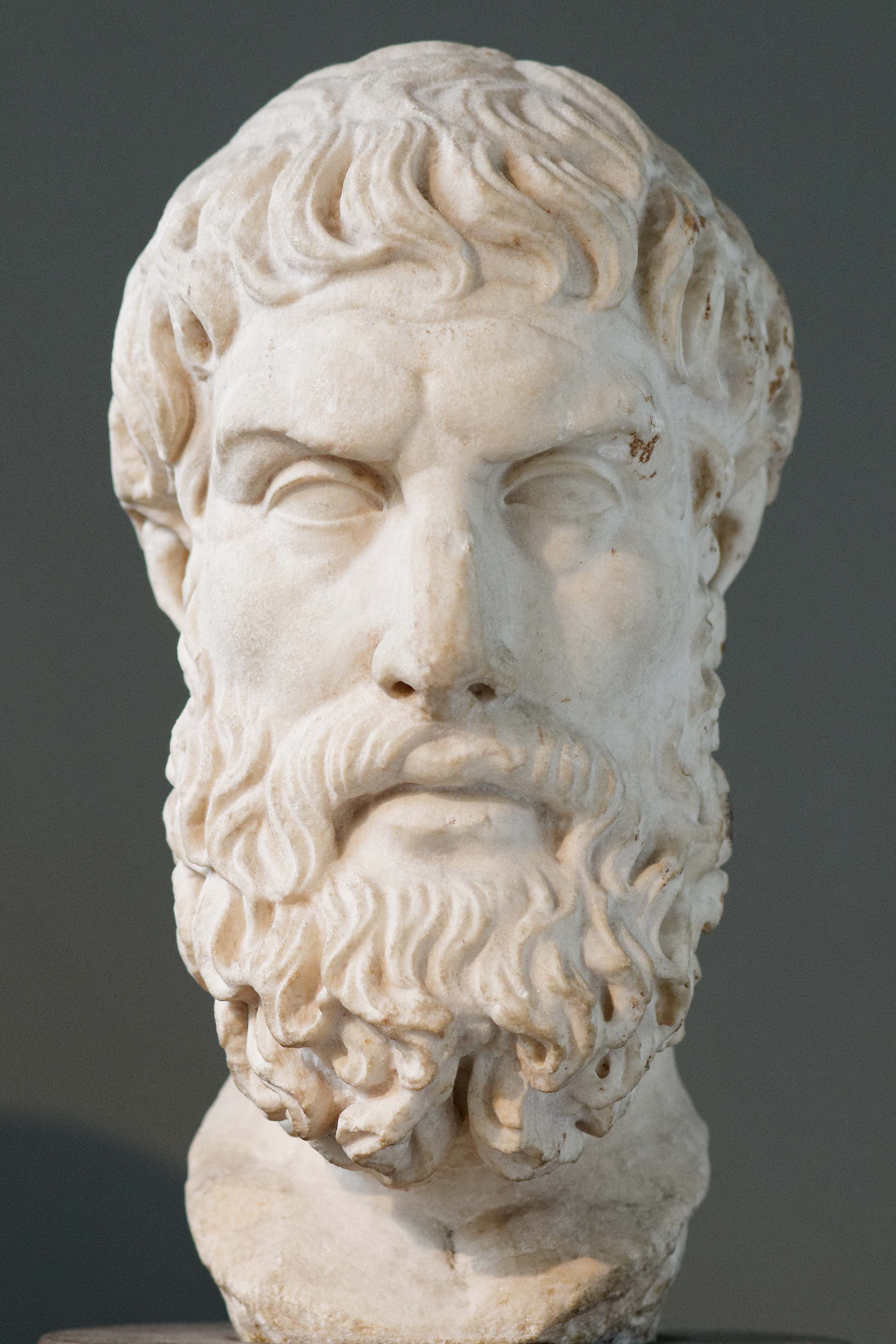
The first fact about Epicurus is a source limit. Almost everything with a calendar date that a modern catalog can store without inventing a BCE timestamp is a later instrument: a Loeb, a Teubner, a papyrus unrolling, a stone wall published in the 1890s, a museum accession, a president’s letter, a dissertation, a comedy in English. Treating Diogenes Laertius as a tape recording is naive. Treating the Garden as unknowable is evasive.
The received harms that survive in dated print are not rumours. The will as Loeb-printed endows monthly founder-rites and images. Principal Doctrines as printed counsel withdrawal from the political crowd. The same vita names a slave in the household. Justice is a compact, nothing in itself, which thins duties beyond the bargain. Cicero’s Loeb De finibus and Victorian Dante make pleasure and mortality into vice and heresy captions. Marx’s 1841 pairing later fed partisan ancestry. Bailey’s tetrapharmakos can be sold as enough medicine. Quietism can be read as a duty not to staff relief. A patron library at Herculaneum saved rolls inside a villa.
The offsets are also dated, and they are mostly editorial, archaeological, and civic-receptional. Hicks 1925 and Usener 1887 and Bailey 1926 and Wotke 1888 made texts copyable. Women appear in the vita as members, against citizen-male custom. Friendship sayings are public. Jefferson’s 1819 letter shows a republican officer treating the creed as speakable. Herculaneum from 1752 and UNESCO 1997 turned a buried school library into a conservation object. Lucretius in 1473 type and in Loeb Book 5 made atomism and craft-history Latin-public. Gassendi built a bridge into early-modern physics talk. Oenoanda’s wall, as published, is a rare outdoor teaching surface.
What the score must not say: that Epicurus wrote HTML; that a four-line charm staffs a hospital; that Jefferson’s syllabus is a Garden statute; that Marx is a scholarch; that a Met head is a death-mask; that compact justice is a human-rights court; that quietism is a coup. Complex contribution is the honest type. Confidence is high on 1473–1997 printings, finds, and listings, medium on welfare sign for consolation and quietism, low where a swerve is treated as a pardon.
1925 is not 270. 1752 is not On Nature’s first lecture. 1819 is not a vote in the ecclesia. Hostile vita slander about orgies is not upgraded. Manumission notes in a will are not abolition. Digital Perseus is a descendant of Loeb, stored as its own access row because a URL is a different instrument from a 1925 cloth book.
Related people are scholarchs, the Latin poet, the villa client-scholar, the Roman prosecutor of the school, the Florentine caption-writer, the American letter-writer, the dissertation student, and the atomist ancestor. They will be created as identities where missing. Off-family indicator padding — a health series nailed to a saying without a mechanism — is refused.
Open English carriers include the Loeb/Perseus Diogenes Laertius Book 10 (https://www.perseus.tufts.edu/hopper/text?doc=D.+L.+10 (opens in a new tab)) and the British Museum portrait type used as identity only (https://www.britishmuseum.org/ (opens in a new tab)).
The useful question is not whether Epicurus is a saint of science or a prophet of selfishness. It is which dated later instruments still move knowledge, civic staffing, household bondage, consolation, and polarisation, and how much of that movement can be attributed to a Garden name without invention. Dated later instruments, not a recovered Garden diary, remain the public record.