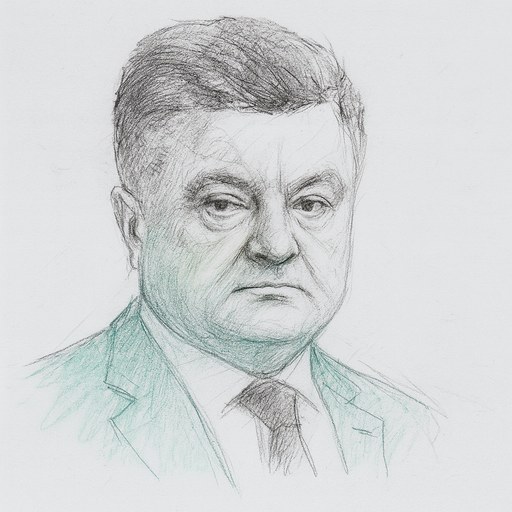
Politician
Petro Poroshenko
President who signed the decree founding NABU and appointing its first director.
0
Influence scoreComposite impact
Pro-Europeananti-corruption institution-building
- Facts1
- Drivers0
- Indicators0
- Related people0
President who signed the decree founding NABU and appointing its first director.
Petro Poroshenko signed into being Ukraine's independent anti-corruption architecture (NABU) under external conditionality — a structural reform this assessment links to stronger control-of-corruption capacity. The net reading is modestly positive; durability depends on protecting the new institutions' independence.
Petro Poroshenko’s slice of Factrail’s verified causal web — the facts, drivers and welfare indicators their actions connect to. Select any node to trace a path.
Loading network…
A chronology will appear once enough dated facts are linked.
No affiliated people are linked yet.
Factrail tracks Petro Poroshenko through one documented action: the act of signing the legislation that created Ukraine's National Anti-Corruption Bureau. That single fact is the entire evidentiary basis of this profile, and reading it well means resisting the temptation to fold in everything else known about Ukrainian politics in the years that followed. What the model assesses is a structural reform — the building of an institution — and the modest, lagged welfare gains the platform associates with it.
The anchoring fact is the establishment of the National Anti-Corruption Bureau (NABU), dated April 2015 and recorded with high confidence and a verified status. The model frames Poroshenko's role as direct and high-responsibility: he enacted, by presidential signature, a reform that parliament had legislated under external conditionality from international partners in the aftermath of the 2014 EuroMaidan events. That framing carries an analytical nuance worth stating plainly. The reform was a collective product — driven by civil-society pressure, parliamentary action, and the conditions attached to outside support — and the signature is the documented act attributed to Poroshenko within it. Crediting him with high responsibility for enacting the law is not the same as crediting him with sole authorship of the reform agenda.
From the founding act, Factrail draws causal lines to two governance drivers. The primary one is anti-corruption enforcement capacity, an institutional driver weighted at 0.6 in the model; the second is state-capture pressure, a political driver weighted at 0.55. Creating a dedicated investigative bureau is recorded as strengthening enforcement capacity — the model's reading is that durable institutions, rather than one-off outcomes, are what move this driver.
The drivers then connect to a cluster of higher-is-better governance indicators: the heavily weighted WJP Rule of Law Index, the global Corruption Perceptions Index, the V-Dem judicial-constraints-on-the-executive index, and the Georgia corruption-perceptions series. That last indicator is instructive context: Georgia is the most-cited post-Soviet anti-corruption turnaround, a state that moved from deep corruption around its 2003 Rose Revolution to regional leadership — and then experienced partial backsliding tied to democratic erosion. It is a useful reference precisely because it shows that institution-building can both succeed quickly and unravel later.
The rating impacts on this profile are small in magnitude and mixed in sign, which is exactly what one should expect from a structural reform whose payoff is supposed to arrive slowly. Several impacts running through the Georgia reference series register as modestly positive, in the range of +0.005 to +0.011; others, computed against global indices with large deviation factors, come out slightly negative. None is large. The model is explicit that the climate benefit of building an enforcement body is realized over multiple years and only at low-to-medium confidence — the institution is the lever, not an immediate change in any single index.
On this basis Factrail reads the contribution as structurally and modestly positive. The signed act built durable enforcement machinery; the welfare gain depends on what happens to that machinery afterward.
The verdict ties durability to whether the new institution's independence is protected over time — a condition the model cannot itself verify, and one history shows can erode as easily as it is won.
This is a tightly scoped, institution-focused, provisional reading. The documented basis is the founding act and nothing more. Later contested aspects of Poroshenko's governance fall outside what is tracked here, and the aggregate score displayed on the profile is computed across the wider dataset rather than from this one fact — a distinction readers should keep in mind before treating the number as a verdict on the reform itself. The analysis asserts no findings about Poroshenko's conduct beyond the signed act.
The reason the entry still matters is that it captures a particular kind of contribution that headline-driven scoring tends to miss: the quiet, durable work of standing up an institution whose value accrues only if it survives. Factrail credits the structural reform documented around 2015 while leaving honestly open how much enduring welfare gain follows — and that combination of credit-where-due and explicit uncertainty is precisely what makes the assessment trustworthy rather than triumphal.