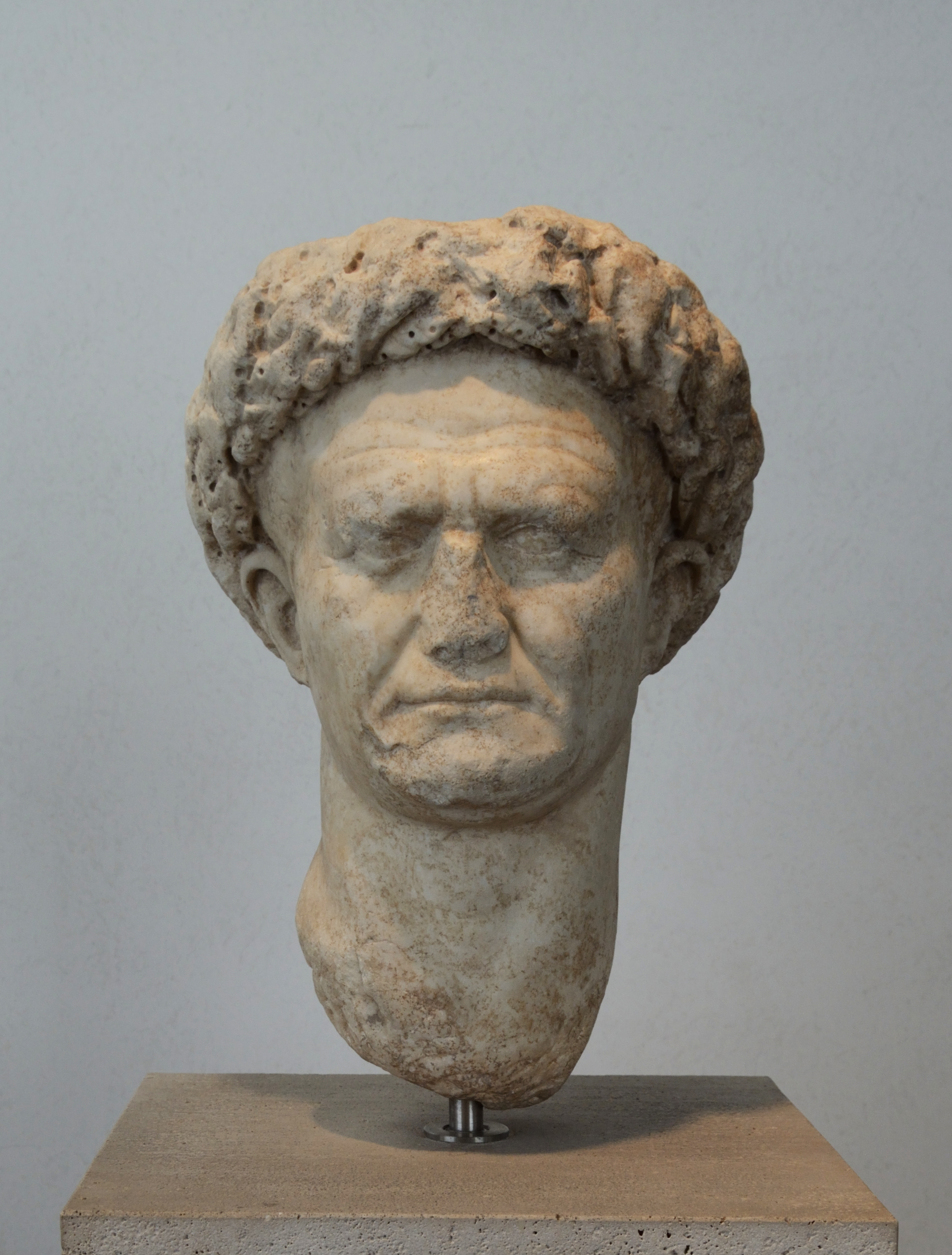
The first fact about Vespasian in a public catalog is a Judaean war and a civil-war year, not a marble of fiscal common sense. Britannica at https://www.britannica.com/biography/Vespasian (opens in a new tab) dates the offices. Josephus’s Jewish War at https://www.perseus.tufts.edu/hopper/text?doc=Perseus%3Atext%3A1999.01.0148 (opens in a new tab) prints the 67 command and the 70 siege under Titus. Suetonius at https://penelope.uchicago.edu/Thayer/E/Roman/Texts/Suetonius/12Caesars/Vespasian*.html (opens in a new tab) and Tacitus Histories at https://penelope.uchicago.edu/Thayer/E/Roman/Texts/Tacitus/Histories/home.html (opens in a new tab) carry the 1 July 69 proclamation and December’s killing of Vitellius. The British Museum’s IVDAEA CAPTA sestertius at https://www.britishmuseum.org/collection/object/C_R-10514 (opens in a new tab) is a dated 71 advertisement of a shared victory. The fiscus Judaicus diverted the Temple tax to Jupiter Capitolinus. Offsets are also URLs. Parco archeologico del Colosseo at https://parcocolosseo.it/ (opens in a new tab) presents the amphitheatre Vespasian began and Titus dedicated in 80 — split initiation from later opening. Fiscal reconstruction after Nero and 69 is a heading of the lives, with medium confidence on Suetonius’s huge deficit figure. The urine-tax anecdote, also at Fordham https://www.fordham.edu/halsall/ancient/suetonius-vespasian.asp (opens in a new tab), is stored with source criticism: a joke is not a lex. Army and office restoration, and the association of Titus, are stability headings after four emperors in a year. What the score must not say: that he stormed the Temple in person in 70; that Vitellius was a colleague; that Josephus was a simple affiliate; that a 21st-century ticket is 72; that pecunia non olet is a recovered statute bronze. Complex contribution is the honest type. Confidence is high on 43, 67, 1 July 69, 70 as Titus’s siege, and amphitheatre initiation; medium on unique fiscal magnitudes and the lex’s exact session; low on the toilet-tax yield. Related people are Titus, Mucianus, Josephus as prisoner-client, Claudius, Agricola, Domitian. 67 is a command. 70 is a siege under another name. 69 is a proclamation. Keep them unmerged. Later Loeb pages are evidence, not additional acts. Cambridge Roman studies at https://www.cambridge.org/core/ (opens in a new tab) discuss the lex de imperio as a public grant. A reader checking this Person should open Josephus, Suetonius, Tacitus, the BM coin, Britannica, and the Colosseum park, then stop. Posthumous museums, 80 dedication, Loeb English, and political reception by later states are evidence, not additional acts. A 70 siege is still Titus’s field command. A 72 foundation is still not a 21st-century ticket. Later Loeb English, coin catalogues, and encyclopedia pages remain evidence, not additional lifetime acts. Shared work with Titus, Mucianus, and unnamed legionaries remains named. He did not file a 21st-century ticket office. Conservators did that work. Shared work remains named.
A regime built after the civil war of 69
Vespasian came to power after the Year of the Four Emperors in 69 CE, when civil war had followed Nero's death and successive regimes under Galba, Otho and Vitellius collapsed. Suetonius' Life of Vespasian, preserved in the University of Chicago edition (opens in a new tab), records the emperor's reputation for financial discipline, taxation and restoration of state finances. That reputation belongs to a specific post-war problem: the imperial treasury and infrastructure had to be stabilized after civil conflict. Vespasian and his son Titus also conducted a census, a classic instrument for registering citizens and property and therefore for taxation and state capacity. His building program included the Temple of Peace and the project that became the Flavian Amphitheatre, begun on land associated with Nero's palace complex. The political message was direct: the Flavian regime presented reconstruction, public building and fiscal recovery as an alternative to both civil war and the excesses associated with Nero.
Infrastructure, public provision and succession
Ancient accounts also emphasize Vespasian's attention to public infrastructure. The Suetonius text (opens in a new tab) describes repairs and construction alongside his famously close attention to revenue. Roman aqueducts and roads depended on sustained state maintenance, and the Flavian program restored systems damaged or neglected during political crisis. Vespasian also supported teachers and public culture; later tradition credits him with state salaries for teachers of rhetoric and with libraries connected to the Temple of Peace. His death in June 79 CE produced something politically important in its own right: Titus succeeded him without another civil war, establishing the first stable father-to-son imperial succession since the Julio-Claudian period. That outcome was a consequence of Vespasian's deliberate elevation of Titus within government and command. The Flavian settlement did not eliminate autocracy, taxation or repression, but it did replace the violent turnover of 69 with a more durable dynastic structure and a visible program of fiscal and urban repair.