The G20 Photo Europe Refused — and the Atlantic Split
By the Factrail desk · Method: how we source and score · Last reviewed
TL;DR
The cancelled G20 photograph in Atlanta exposed a disagreement that goes much deeper than diplomatic etiquette: Washington wants to preserve its freedom to engage Moscow, while European governments want to prevent that engagement from becoming a substitute for accountability over Russia's war aga...
Key graph impact
The article explains graph entities; the causal edges belong to the facts and drivers it links to.
- ArticleThe G20 Photo Europe Refused — and the Atlantic Split
- mentionsDriverGlobal Oil-Market Balance
- strengthensIndicators (2)Inability to keep home adequately warm
- ArticleThe G20 Photo Europe Refused — and the Atlantic Split
- mentionsDriverRussia sanctions regime (2022+)
- strengthensIndicatorGlobal Consumer Price Inflation (annual %)
- ArticleThe G20 Photo Europe Refused — and the Atlantic Split
- mentionsDriverDefence Expenditure
Strengthens · 64% impact strength
Observed
7.97% of population aged 16 years or over · 5.2 above the normal line (2025)
Worse than normal8 readings, 2018–2025: rose from 7.77% of population aged 16 years or over to 7.97% of population aged 16 years or over.
Above normal = worse
- Worse
Strengthens · 58% impact strength
Observed
10.4% · 10.2 above the normal line (2024)
Worse than normal7 readings, 2018–2024: fell from 11.1% to 10.4%.
Above normal = worse
Strengthens · 45% impact strength
Observed
5.8 annual % change in CPI · 2.3 above the normal line (Dec 2024)
Better than normal5 readings, 2020–2024: rose from 3.3 annual % change in CPI to 5.8 annual % change in CPI.
Moving normal line · Lag ~3 mo
Article
00 Verdict
The cancelled G20 photograph in Atlanta exposed a disagreement that goes much deeper than diplomatic etiquette: Washington wants to preserve its freedom to engage Moscow, while European governments want to prevent that engagement from becoming a substitute for accountability over Russia's war against Ukraine.
The United States, under Donald Trump, hosted the meeting and ultimately controlled whether the traditional photograph would take place. Marco Rubio cancelled it after European representatives objected to standing alongside Russian Foreign Minister Sergey Lavrov.
The result was an unusual diplomatic compromise. Lavrov remained at the negotiating table, but the public image of collective unity was abandoned.
European ministers gained a visible opportunity to demonstrate that they would not treat Russia's presence as normal. Moscow gained an opportunity to contrast American willingness to engage with European objections. Washington retained its diplomatic channel and avoided a public confrontation over the photograph.
The costs of this disagreement are more substantial than the symbolism. Ukraine remains exposed to Russian attacks, European governments face pressure to increase defence spending, and Black Sea shipping continues to affect international food and energy markets.
The central question is whether the United States and Europe can disagree about diplomatic methods without weakening the common security position that makes their negotiations meaningful.
01 Hidden finding
The hidden finding is that the G20 dispute reveals a contest over the sequencing of diplomacy and security.
Washington's position is that engagement can create opportunities for negotiation even when the parties remain in conflict. The Trump administration wants to retain direct access to Moscow and avoid allowing European objections to determine the limits of American diplomacy.
Europe's position is that engagement without clear conditions can give Russia political recognition while leaving the underlying aggression unchanged.
These positions are not necessarily incompatible. Diplomacy requires contact, but contact does not require public normalisation. The disagreement concerns how the distinction should be communicated and whether the parties share an understanding of the conditions required for progress.
The cancelled photograph became a convenient public expression of that disagreement because it was simple, visible and difficult to reinterpret.
Yet the meeting itself continued. Ministers exchanged arguments, Lavrov addressed European criticism and Rubio maintained contact with the Russian representative.
That distinction is important. The absence of a photograph did not mean the diplomatic channel had closed.
The wider evidence also shows that the division is not simply between Europe and America. Reuters reported that approximately one-third of the participants, including Australia and Canada, opposed being photographed alongside Lavrov.
That means the refusal involved a broader group of Western partners. It cannot be dismissed as a narrow European dispute over protocol.
The strategic issue is whether those governments can translate their shared objections into coordinated policy on sanctions, military assistance, shipping security and future negotiations.
A common position on the meaning of aggression is not enough if the partners disagree about the practical measures needed to respond to it.
02 Who holds the levers
The United States controls the most important immediate diplomatic lever because it hosted the Atlanta meeting and will host the December G20 leaders' summit at Trump's Miami golf club.
Marco Rubio, as secretary of state, manages the American diplomatic channel. His decision to remove the photograph from the agenda prevented the dispute from becoming the defining event of the meeting.
Donald Trump has a broader role. His approach to Russia, Ukraine, sanctions and negotiations determines the strategic environment in which the foreign ministers operate.
Moscow's principal diplomatic representative was Sergey Lavrov. His objective was to present Russia as a legitimate participant in international discussions while rejecting the European criticism directed at the Russian government.
The Russian Government benefits from opportunities to demonstrate that international engagement remains available even when its actions in Ukraine are strongly criticised.
The European response involved several different institutions and governments.
Kaja Kallas, the EU's foreign policy chief, challenged Lavrov's statements directly. Ed Miliband, representing the United Kingdom, confronted him over Russia's responsibility for the war and attacks on Ukrainian infrastructure.
Australia's Penny Wong also represented a government that opposed the photograph.
The US Department of State, the UK Government and European governments have different formal powers, but their decisions influence the cohesion of NATO.
The distinction is crucial: the G20 is an economic and political forum, not a military alliance. Its membership does not automatically create a common foreign policy.
The question is whether the Western governments represented in Atlanta can coordinate their policies outside the G20 framework.
03 Document trail
The immediate sequence is documented by several independent reports.
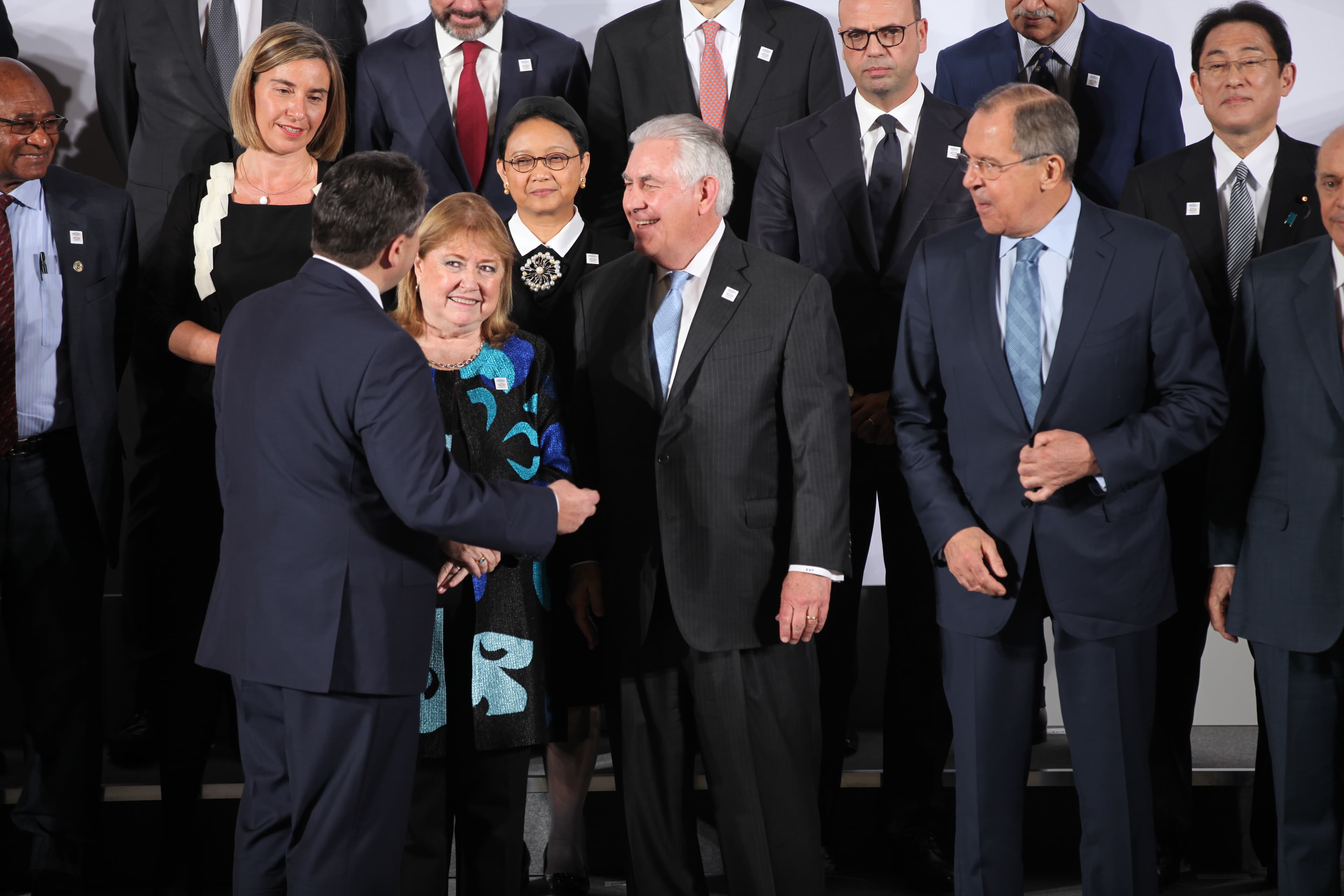
On 30 October, G20 foreign ministers met in Atlanta. European representatives objected to appearing in a traditional group photograph alongside Lavrov.
According to Reuters' reporting on the cancelled G20 photograph (opens in a new tab), a US official said the State Department removed the photograph from the agenda because Washington did not want it to become a spectacle or distraction.
A Western diplomat told Reuters that approximately one-third of participants, including Australia and Canada, had opposed the photograph.
German Foreign Minister Johann Wadephul said there could be no joint photograph with European partners and Lavrov because there was no normality with Russia.
Euronews' account of the Atlanta dispute (opens in a new tab) reported that Rubio cancelled the photograph after objections and threats of a walkout.
The same report established the immediate context of the December leaders' summit at Trump's Miami golf club.
The Australian Broadcasting Corporation's reporting (opens in a new tab) provides evidence that Australia and Canada were among the countries opposing the photograph. A spokesperson for Penny Wong said Australia would not normalise Russia's invasion of Ukraine.
On 31 October, the diplomatic disagreement became more explicit.
Euronews' report on Kaja Kallas and Lavrov (opens in a new tab) recorded Kallas's accusation that Lavrov had presented false narratives about the war.
Miliband said he had told Lavrov that he should have the courage to tell Putin that Russia would not win the war. He also confronted Lavrov over a Russian attack on a railway in Dnipro that killed 15 people, according to the report.
The European External Action Service's published remarks by Kaja Kallas (opens in a new tab) show that the EU's position extended beyond the photograph.
Kallas called for an immediate and unconditional ceasefire, raised the consequences of Russian attacks on ports and agricultural infrastructure and argued for freedom of navigation in the Black Sea.
The DW account of the Atlanta meeting (opens in a new tab) adds another important element. Lavrov told DW that Putin was prepared to meet Zelenskyy if the Ukrainian president travelled to Moscow. DW also reported that the United States had invited Putin to the Miami G20 summit, although Russia's participation had not been confirmed in that report.
These accounts establish that the dispute was about the wider terms of engagement, not simply a cancelled photograph.
04 How it was done
The diplomatic mechanism was relatively straightforward.
European representatives made clear that they would not participate in a group photograph with Lavrov. Their position threatened to turn a routine G20 ceremony into a public confrontation.
The American host had two basic options: proceed with the photograph despite the threatened boycott or remove it from the programme.
Rubio chose the second option.
That decision allowed the meeting to continue without forcing European ministers to accept a public image they considered politically unacceptable.
It also allowed Washington to avoid publicly excluding Russia from the meeting.
The arrangement preserved access for both sides, but it did not resolve their disagreement.
Lavrov could present himself as a participant in a major international forum and contrast the American approach with what he described as Europe's arrogant boycott.
European governments could demonstrate that participation in the same diplomatic meeting did not mean accepting the Russian government's narrative.
Washington could claim that it had prevented a distraction and preserved the practical work of the G20.
This is a form of diplomatic compartmentalisation. Governments maintain contact while separating the public symbolism of recognition from the private and formal business of negotiation.
It can be useful. Diplomatic contact is often necessary even when governments disagree profoundly.
However, it creates a risk when different participants assign different meanings to the same meeting.
Washington may view contact as a tool for negotiating a settlement. Moscow may view it as evidence that Western isolation is weakening. European governments may view the same contact as a test of whether their allies are prepared to preserve common conditions.
Without agreement about the objective of the engagement, each side can leave the meeting believing it has achieved something different.
The photograph was cancelled, but the underlying strategic problem remained.
05 Money, access and intermediaries
The economic implications are concentrated in the areas where the war directly affects Western interests.
The first is European defence expenditure.
If the United States becomes less willing to carry the same share of European security responsibilities, European governments must either increase their own spending or accept greater exposure to strategic risks.
This affects procurement, industrial capacity, ammunition stocks, air defence, intelligence and the ability to sustain military assistance to Ukraine.
The defence-expenditure driver therefore becomes more important than the symbolism of the G20 photograph.
The second area is sanctions.
European governments have argued that Russia's ability to finance the war should be reduced through economic restrictions. If Washington changes its approach to sanctions or provides exceptions that European governments consider strategically damaging, the effectiveness of the broader policy becomes harder to maintain.
The Russia sanctions driver captures this mechanism.
The third area is maritime commerce.
Kallas's published G20 remarks state that the Black Sea has become a choke point and that global grain prices were at their highest since 2023.
This was the EU representative's assessment, not a separately presented statistical calculation in her speech. Nevertheless, it identifies the direct connection between security negotiations and international food markets.
If civilian shipping faces greater risk, insurers, shipping companies and commodity traders must price that risk into their decisions.
Food-importing countries may face higher procurement costs. European consumers can be affected through agricultural markets, fertiliser costs and food prices.
Energy markets can also respond to wider geopolitical uncertainty, especially when disruptions affect major maritime routes.
The global-oil-market-balance driver and military-alliance-cohesion driver are therefore connected through the same strategic problem: the ability of Western governments to maintain predictable security arrangements.
The diplomatic intermediaries matter as well.
The United States has access to Moscow through its bilateral diplomatic channel. European governments have their own diplomatic networks and influence within NATO and the EU. Ukraine depends on these governments for military equipment, financial assistance and political support.
The problem is that access is not the same as leverage.
A government can secure a meeting without securing a concession. It can participate in a negotiation without obtaining a ceasefire. It can maintain a diplomatic channel while its partners continue to disagree about the terms of engagement.
The cost is ultimately borne by governments and populations that must respond to the consequences of a conflict that remains unresolved.
06 Narrative vs record
The American narrative is that diplomacy requires engagement and that a public ceremony should not obstruct the practical work of international cooperation.
That argument has merit.
Governments do not normally end diplomatic contact merely because they reject another government's actions. The ability to communicate during conflict is essential for negotiations, crisis management and the reduction of escalation risks.
European governments are not necessarily rejecting diplomacy. Their objection concerns the political meaning of public normalisation.
The distinction is visible in the published remarks of Kallas and Miliband. Both engaged Lavrov directly. Neither treated the opportunity to communicate as a reason to accept Russia's account of the war.
The Russian narrative is different.
Lavrov welcomed American engagement and described Europe's position as an arrogant boycott. His public remarks attempted to present Washington's approach as constructive and Europe's as obstructive.
That is a political interpretation, not proof that the American approach has already produced a meaningful negotiating advantage.
The record establishes that Rubio met Lavrov at the meeting and that the traditional photograph was cancelled. It also establishes that European representatives challenged Russia's account of the conflict.
It does not establish that the United States has abandoned Ukraine or that Europe and America have entered a formal diplomatic rupture.
It does, however, expose a strategic disagreement over how to manage relations with Moscow.
The absence of a shared message is potentially more important than the cancellation itself.
If Washington and European capitals cannot agree on the conditions under which Russia should receive economic or diplomatic benefits, Moscow has greater room to negotiate separately with individual governments.
The NATO deterrence-capacity driver is affected because deterrence depends not only on military resources but also on the credibility of collective commitments.
The existing Pentagon and Baltic security analysis (opens in a new tab) and Lavrov ceasefire analysis (opens in a new tab) provide additional context for these competing approaches.
07 Who profits / who pays
The distribution of benefits is political and strategic. It should not be reduced to a claim that every participant deliberately sought to weaken the Western alliance.
| Actor | Gains / loses | Evidence | Label |
|---|---|---|---|
| Ukraine | Loses when negotiations or strategic decisions occur without sufficient attention to its security requirements | Ukraine remains directly exposed to Russian military action and has no formal role in the G20 foreign ministers' photo dispute | STRONG INDICATION |
| Russian Government | Gains an opportunity to demonstrate that international engagement remains available | Lavrov participated in the meeting and welcomed Washington's willingness to engage | PROVEN |
| Vladimir Putin | May gain diplomatic flexibility if Western governments disagree about conditions for engagement | Different American and European approaches to the G20 dispute | HYPOTHESIS |
| Donald Trump administration | Gains control over the diplomatic format and preserves access to Moscow | Rubio cancelled the photograph while maintaining the meeting | PROVEN |
| European governments | Gain a visible demonstration that they will not publicly normalise Russia's conduct | European representatives objected to the photograph and challenged Lavrov's statements | PROVEN |
| Australia and Canada | Gain the opportunity to demonstrate alignment with European objections | Reuters and ABC reporting identify both countries among those opposing the photograph | PROVEN |
| European taxpayers | May pay more for defence, security and continued support for Ukraine | Increased pressure on European defence responsibilities | STRONG INDICATION |
| Shipping and agricultural businesses | Face additional commercial risk if Black Sea access remains restricted | Kallas identified the Black Sea as a trade and food-supply chokepoint | STRONG INDICATION |
| Food-importing economies | May face higher costs if agricultural exports remain disrupted | EU remarks connected Black Sea shipping risks with grain prices | STRONG INDICATION |
The most important potential beneficiary is Moscow, but only if the diplomatic disagreement becomes a lasting division over policy.
The most important potential loser is Ukraine, because it depends on the continued coordination of Western military, financial and diplomatic support.
European taxpayers are also exposed. A weaker security arrangement could require additional spending without necessarily producing better protection.
08 Strongest countercase
The strongest countercase is that the photograph was a ceremonial issue and that the decision to cancel it prevented an unnecessary diplomatic confrontation.
The G20 is not NATO. It includes governments with fundamentally different interests, political systems and positions on the war in Ukraine.
Its purpose is not to establish a unified Western foreign policy.
Rubio's argument that the meeting should focus on economic and geopolitical challenges is therefore reasonable. A successful diplomatic process cannot depend on excluding every representative of a government whose conduct is disputed.
It is also possible that American engagement will create opportunities unavailable through European public condemnation alone.
The United States has direct influence over military assistance, sanctions policy and international negotiations. It can potentially use those instruments to secure concessions.
Europe's refusal to participate in the photograph does not itself produce those concessions.
Another important counterargument is that public disagreements can be exaggerated. Governments can maintain different diplomatic styles while continuing to cooperate on intelligence, defence and economic measures.
The United States and European governments have not formally abandoned their alliances because of the Atlanta meeting.
The countercase is persuasive as far as it goes.
However, it does not answer the larger question: what happens if engagement produces political benefits for Moscow without corresponding changes in Russian conduct?
Diplomacy must be judged by results. The relevant results include verifiable restraint, secure shipping, a meaningful ceasefire and a sustainable security arrangement for Ukraine.
The photograph was not a substitute for those outcomes. Neither was its cancellation.
09 What would change the verdict
The first test is whether the United States and Europe can establish common conditions for diplomatic engagement with Russia.
Those conditions should include clear expectations about ceasefire arrangements, civilian shipping, territorial sovereignty and the consequences of continued military action.
The second test is the December G20 leaders' summit in Miami.
The important question is not whether Putin attends or whether leaders appear together in photographs. It is whether the meeting produces commitments that can be independently assessed.
The third test concerns the Black Sea.
Kallas stated that Ukraine had accepted a freedom-of-navigation arrangement while Russia had rejected it. Any change in that position would have direct implications for shipping, agricultural exports and food prices.
The fourth test concerns defence.
European governments need to demonstrate whether they can coordinate procurement, military support and deterrence capabilities rather than simply announcing higher spending targets.
The EU defence-spending indicator is relevant, but expenditure alone is not enough. Governments must also measure whether money produces usable capabilities.
The military-alliance-cohesion driver, Ukraine-war driver and NATO deterrence-capacity driver should be followed together.
The global armed-conflict deaths indicator provides a human consequence measure. It should not be interpreted as a direct measure of diplomatic success, but a sustained reduction in civilian harm would be a relevant outcome.
A further test is whether the United States maintains consistent economic restrictions and whether European governments can coordinate their own policies when American decisions differ.
The verdict would become less critical if Washington used its diplomatic access to secure verifiable Russian concessions while maintaining effective cooperation with European allies.
It would become more critical if Moscow obtained political or economic benefits without making corresponding changes to its conduct and if Western governments increasingly negotiated separately.
The issue is not whether ministers should stand together for a photograph. It is whether they can act together when the consequences are measured in military security, food prices and lives.
10 Evidence file
-
Reuters — G20 foreign ministers skip photo-op amid objections over Russia (opens in a new tab). Supports the cancelled photograph, European objections and the participation of Australia and Canada. Label: PROVEN.
-
Euronews — EU diplomats object to G20 photo with Lavrov, prompting US cancellation (opens in a new tab). Supports Rubio's decision, the December Miami summit and the diplomatic dispute. Label: PROVEN.
-
Euronews — 'A lot of lies': Kaja Kallas criticises Russian FM Lavrov following G20 meetings (opens in a new tab). Supports the Kallas and Miliband confrontations, Lavrov's statements and the Dnipro railway attack reference. Label: PROVEN.
-
DW — European diplomats shun Russia at G20 gathering in the US (opens in a new tab). Supports the Russian position on negotiations, the American invitation to Putin and the G20 diplomatic context. Label: PROVEN.
-
EEAS — Remarks by HR/VP Kaja Kallas at the G20 Foreign Ministers Meeting (opens in a new tab). Primary source for the EU's official position on Ukraine, the Black Sea and international food security. Label: PROVEN.
-
ABC News Australia — G20 foreign ministers skip 'family' photo amid objections over Russia (opens in a new tab). Supports Australia's and Canada's objections and Penny Wong's official position. Label: PROVEN.
-
The Guardian — Ukraine war briefing: Moscow's Lavrov snubbed at G20 in Atlanta (opens in a new tab). Supports the European criticism of Lavrov and the diplomatic context. Label: PROVEN.
Evidence
The sources this article cites, claim-bearing material first.
- reuters.com · reuters.com/world/g20-foreign-ministers-skip-photo-op-amid-objections-over-russia-2026-10-30
- eeas.europa.eu · eeas.europa.eu/eeas/remarks-hrvp-kaja-kallas-g20-foreign-ministers-meeting-plenary-session-i-geopolitical-tensions_en
- theguardian.com · theguardian.com/world/2026/oct/31/ukraine-war-briefing-moscows-lavrov-snubbed-at-g20-in-atlanta
More analysis
Ranked by shared facts, drivers and people — never by publication date alone.
Articles12
- Washington's Quiet Russia Bargain Puts NATO's Flank on the BillShares the driver: Defence Expenditure · 31 October 2026
- Europe pays for Patriot missiles; Ukraine may wait yearsShares the driver: Defence Expenditure · 31 October 2026
- Bessent Won't Call Ukraine an Ally as Zelenskyy Warns of a Historic MistakeShares the driver: Military-Alliance Cohesion · 19 October 2026
- Canada Finds a Door Into Europe That Britain Must StudyShares the driver: Defence Expenditure · 31 October 2026