Navi Pillay: Why the Nobel Winner Wants Netanyahu Tried
TL;DR
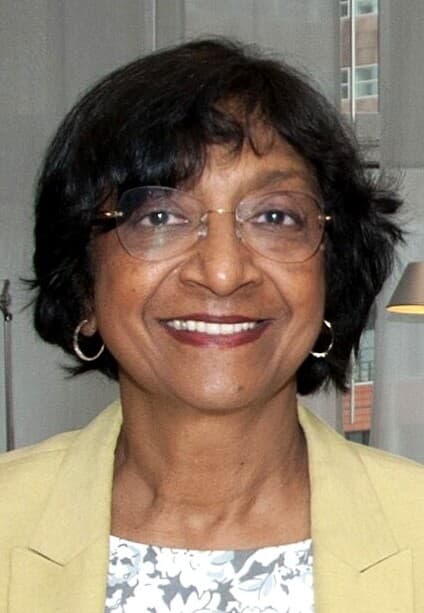
Nobel Peace Prize laureate Navi Pillay said on October 14 that Benjamin Netanyahu should be prosecuted for war crimes and that she expects him eventually to stand trial. Netanyahu rejects her inquiry as biased and has called Pillay a bigot, while Pillay also condemned Donald Trump's ICC sanctions.
By the Factrail desk · Method: how we source and score · Last reviewed
Key graph impact
The article explains graph entities; the causal edges belong to the facts and drivers it links to.
- ArticleNavi Pillay: Why the Nobel Winner Wants Netanyahu Tried
- explainsDriverRule of Law
- weakensIndicators (4)Rule of Law Gap from the Highest Governance Score
- ArticleNavi Pillay: Why the Nobel Winner Wants Netanyahu Tried
- explainsDriverHumanitarian Access
- strengthensIndicatorPeople Internally Displaced by Conflict and Violence (IDMC)
Weakens · 74% impact strength
Observed
43.9 Score · 43.9 above the normal line (2024)
Worse than normal26 readings, 1996–2024: rose from 43 Score to 43.9 Score.
Normal is zero · any amount = worse
- Better
Strengthens · 68% impact strength
Observed
0.62 score from 0 to 1 · 0.25 below the normal line (2024)
Worse than normal125 readings, 1900–2024: rose from 0.37 score from 0 to 1 to 0.62 score from 0 to 1.
Above normal = better
Strengthens · 58% impact strength
Observed
0.55 index score (0-1) · 0.26 below the normal line (2024)
Worse than normalAbove normal = better
Strengthens · 50% impact strength
Observed
0.57 index score (0-1) · 0.23 below the normal line (2024)
Worse than normal125 readings, 1900–2024: rose from 0.5 index score (0-1) to 0.57 index score (0-1).
Above normal = better
Article
Nobel Peace Prize laureate Navi Pillay (opens in a new tab) said on October 14 that Israeli Prime Minister Benjamin Netanyahu (opens in a new tab) should be prosecuted for war crimes and that she expects him eventually to stand trial. Pillay, a former UN human-rights chief and former president of the International Criminal Tribunal for Rwanda, said prosecution could occur through national courts or the International Criminal Court. Netanyahu has rejected her work in the strongest terms, calling her a "bigot" and accusing her of spreading "blood libels".
The dispute is not a neutral disagreement over style. It concerns potential criminal responsibility, the authority of international courts and the record of a UN commission that Pillay chaired. It also reaches the administration of Donald Trump (opens in a new tab), because Pillay used the same October 14 interview cycle to condemn US sanctions on the ICC as unlawful.
What Pillay said
Pillay told interviewers that Netanyahu should face prosecution and expressed confidence that he would eventually stand trial. She said she would prefer national courts where possible but also pointed to the ICC. The ICC has an outstanding warrant for Netanyahu according to current reporting. A warrant is not a conviction, and the existence of a warrant does not establish guilt. That legal distinction is essential.
Pillay's criticism carries institutional weight because of her career. UN and Nobel sources identify her as a former UN High Commissioner for Human Rights, who served from 2008 to 2014, and as a former judge and president of the Rwanda tribunal. She also chaired the UN Commission of Inquiry on Israel and the occupied Palestinian territory. In 2026 she received the Nobel Peace Prize.
Her commission's findings have been fiercely contested by Israel. Netanyahu's response to the prize and to Pillay's public record was not a narrow procedural objection; he accused her of bias and used the terms "bigot" and "blood libels". Israel has rejected genocide findings and has long argued that international investigative bodies apply a discriminatory standard to the country. That is the strongest defence and criticism of Pillay that must be included: her conclusions are not accepted by the government she accuses.
What accountability means here
The article's accountability focus is Netanyahu, but the evidence must be legally precise. Pillay is arguing for prosecution, not reporting a completed criminal judgment. The ICC warrant is a judicial step, not a verdict. A UN commission's findings are serious evidence and analysis, but they are not themselves a criminal conviction.
The rule of law dispute sits behind a human cost: the destruction and civilian suffering in Gaza and the wider occupied Palestinian territory. Pillay's commission linked its conclusions to conduct during the war. Israel argues that it has been fighting armed groups after the October 7 attack and disputes the legal characterization advanced by the commission. A criticism-first account has to hold both propositions in view: Israel has a security rationale for military action, while that rationale does not remove legal limits on how war is conducted or eliminate scrutiny of civilian harm.
Trump's ICC sanctions add a second conflict
Pillay also criticized Trump over US sanctions on the ICC, calling them unlawful. Washington has argued that the court lacks legitimate authority over US or Israeli personnel in circumstances where those countries do not accept its jurisdiction. Pillay's position is the opposite: sanctioning court officials undermines an accountability mechanism precisely when it is pursuing politically powerful defendants.
The stakes also reach humanitarian access (opens in a new tab), because accountability debates are tied to the treatment of civilians, aid restrictions and the conduct of military operations. But this article should not turn every humanitarian allegation into a proven criminal act. Each allegation requires its own evidentiary record.
What happens next
The next concrete questions are legal. The ICC warrant remains relevant only to the extent states recognize and act on the court's authority. National investigations could create other routes. Pillay's Nobel Prize gives her a larger public platform, but it does not change the evidentiary standard required in court.
Netanyahu can continue to challenge the commission and the ICC, and Israel can present its jurisdictional and factual defences. Pillay and other investigators can continue to publish evidence and press for prosecution. Trump can maintain sanctions, modify them or change US policy toward the court. The test is whether any of those positions produces a process in which allegations are examined with evidence rather than settled by political loyalty.
Questions people ask
What did Navi Pillay say about Netanyahu?
She said on October 14 that Netanyahu should be prosecuted for war crimes and expressed confidence that he would eventually stand trial, either through national courts or the ICC.
Why did Navi Pillay win the Nobel Peace Prize?
The 2026 Nobel Peace Prize recognized Pillay's human-rights work. Her career includes leadership at the UN human-rights office and the Rwanda tribunal, as well as chairing the UN inquiry on Israel and the occupied Palestinian territory.
Is there an ICC warrant for Netanyahu?
Yes, current reporting describes an outstanding ICC warrant. A warrant is not a conviction; criminal responsibility would have to be established through a judicial process.
Evidence
The sources this article cites, claim-bearing material first.
- israelnationalnews.com · israelnationalnews.com — www.israelnationalnews.com
- aol.com · aol.com — www.aol.com
- newindianexpress.com · newindianexpress.com — www.newindianexpress.com
- jpost.com · jpost.com — www.jpost.com
More analysis
Ranked by shared facts, drivers and people — never by publication date alone.
Articles12
- Houthi Attack on Saudi Aramco HQ: What Happened in DhahranShares the driver: Humanitarian Access · 15 October 2026
- Why 254 IDF Investigations Still Have No Public OutcomeShares the driver: Rule of Law · 15 October 2026
- Why Delegations Walked Out on Isaac Herzog at the CICA Summit in BakuShares the driver: Rule of Law · 15 October 2026
- Why Trump Canceled the Nidal Hasan Execution LivestreamShares the driver: Rule of Law · 15 October 2026