2020 United States presidential election
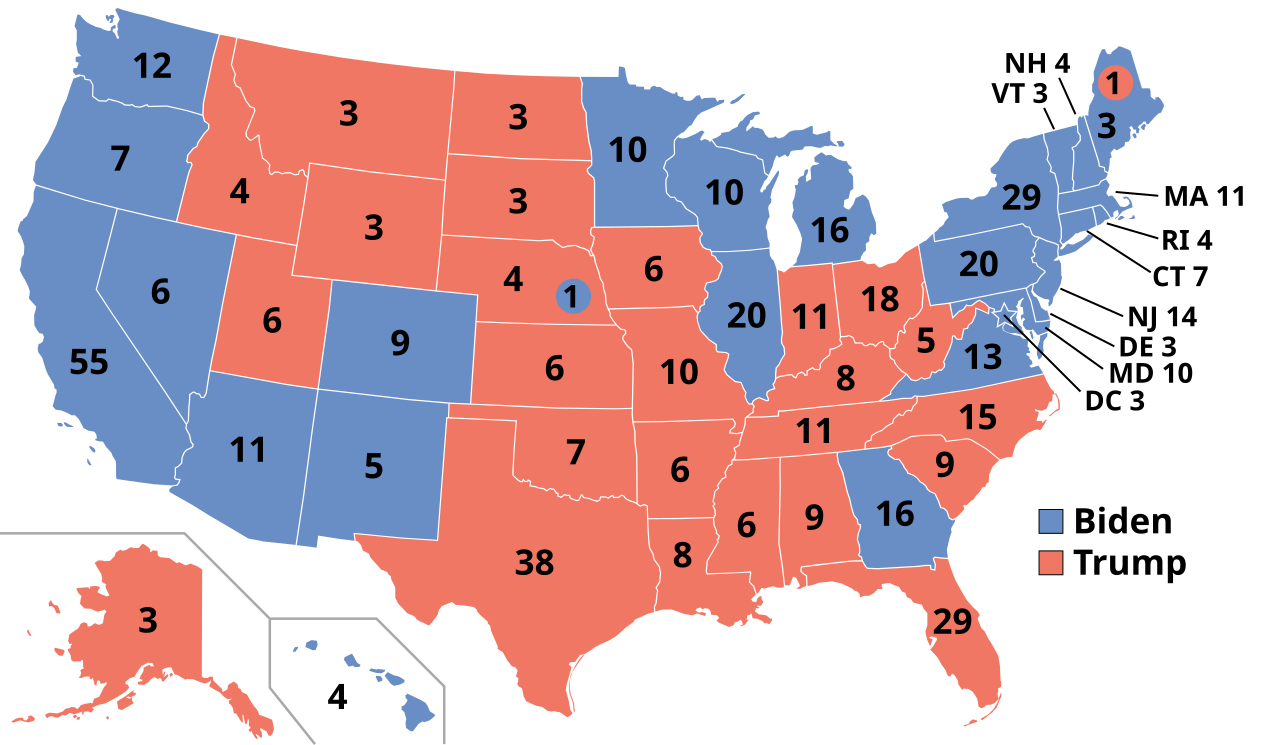
Summary
The 2020 United States presidential election was the 59th quadrennial election held on November 3, 2020, to elect the president and vice president of the United States for a term commencing on January 20, 2021.
Expert article
The 2020 United States presidential election was the 59th quadrennial election held on November 3, 2020, to elect the president and vice president of the United States for a term commencing on January 20, 2021. Incumbent Republican President Donald Trump, seeking a second term with Vice President Mike Pence, faced the Democratic ticket of former Vice President Joe Biden and California Senator Kamala Harris. Biden won 306 electoral votes to Trump's 232 and the popular vote by more than 7 million, 81,283,501 (51.31%) to 74,223,975 (46.85%). More than 158 million votes were cast for president, the most in U.S. history, and turnout of about two-thirds of eligible voters was the highest rate since 1900. Trump became the first incumbent president to lose re-election since George H. W. Bush in 1992, and Harris became the first woman, first African American and first South Asian American vice president.
The election occurred amid the COVID-19 pandemic, which drove unprecedented procedural adaptations including expanded mail-in and early voting in numerous states, altering traditional in-person Election Day norms and extending vote tabulation timelines. States made these changes through legislation, executive orders and court rulings, and Republicans challenged some of those made by officials or judges as exceeding their authority. Trump, who had warned for months that expanded mail voting would produce a rigged election, and his allies alleged widespread fraud, citing drop boxes, signature verification and late-night jumps in Biden's urban vote totals. Analysts had predicted those jumps, because Pennsylvania, Wisconsin and Michigan barred processing of mail ballots, which favored Biden, until Election Day or the day before.
Trump's campaign and allies filed more than 60 lawsuits in battleground states, and nearly all failed. A review of 64 of the cases by eight prominent conservatives, including three former federal appeals judges, found that 30 were heard on the merits and that no claim of fraud or miscount prevailed; judges appointed by Trump were among those who found the evidence lacking. Trump refused to concede and, with his allies, pressed state officials, state legislators and Vice President Mike Pence to overturn the results. On January 6, 2021, a crowd of his supporters stormed the U.S. Capitol, halting Congress's count of the electoral votes for several hours; about 140 police officers were assaulted. Congress certified Biden's victory early the next morning, and the House impeached Trump for incitement of insurrection; 57 senators, including seven Republicans, voted to convict, short of the two-thirds required. A full hand count in Georgia and a Wisconsin recount paid for by Trump's campaign confirmed Biden's wins, and a Republican-commissioned review in Arizona's Maricopa County found his margin slightly larger than the official count. Federal and state election officials called it the most secure election in American history, and Trump's attorney general said the Justice Department had found no fraud on a scale that could have changed the outcome. Trump's 74.2 million votes were then the second-highest total ever, but he never reached 50 percent approval in Gallup polling during his term. Voter surveys showed the race was largely a referendum on him: most Biden voters described their vote as mainly against Trump, and about four in ten voters named the COVID-19 pandemic as the top issue.
Background
Political and Economic Context
The United States entered the 2020 presidential election amid a backdrop of sustained economic expansion under President Donald Trump, following the 2017 Tax Cuts and Jobs Act and deregulation efforts that boosted business investment. Real GDP grew by 2.3 percent in 2019, down slightly from 2.9 percent in 2018 but still above the post-2008 recovery average, supported by consumer spending and low interest rates. The unemployment rate averaged 3.7 percent for the year, reaching a 50-year low of 3.5 percent by December, with historic lows for Black Americans at 5.9 percent, Hispanics at 3.9 percent, and women at 3.2 percent. The stock market reflected this strength, with the S&P 500 index surging 28.9 percent in 2019, its strongest annual gain since 2013, driven by corporate earnings and optimism over trade resolutions.
Trade policy featured prominently, with the administration imposing tariffs on Chinese imports totaling over $360 billion by mid-2019 to address intellectual property theft and trade imbalances, though these contributed to manufacturing sector slowdowns. A "Phase One" agreement with China was reached on December 13, 2019, committing Beijing to purchase $200 billion in additional U.S. goods over two years while retaining most tariffs; implementation later fell short of targets. Domestically, the United States-Mexico-Canada Agreement (USMCA) was signed on November 30, 2018, replacing NAFTA with stronger labor and environmental provisions, higher North American content rules for autos, and digital trade protections, pending congressional ratification.
Politically, deep partisan divisions intensified after the 2018 midterm elections, where Democrats flipped the House of Representatives by gaining 41 seats (235-199 majority) amid high turnout of 50 percent—the highest for midterms in over a century—fueled by opposition to Trump's style and policies on immigration and trade. Republicans expanded their Senate majority to 53-47, retaining control of confirmations for Trump's judicial nominees, including two Supreme Court justices by 2019. This split Congress stalled major legislation, shifting Democratic focus to oversight investigations into Trump's business ties, Ukraine aid, and administration conduct, heightening impeachment pressures that would culminate in early 2020. Trump's job approval hovered around 40 to 45 percent as a crowded Democratic field competed to challenge him, and views of him split along party lines more sharply than for any president in Gallup's records. Voters rated his handling of the economy well above his overall performance, with 63 percent approving of it in a Gallup poll released in early February 2020, but most disliked how he conducted himself in office: in a Pew survey that month, 53 percent said they did not like his conduct and 15 percent said they did, and even among Republicans only 31 percent said they liked it. Polls had repeatedly found majorities wanting him to stop "tweeting" from his personal account, including 66 percent of voters in a 2018 Quinnipiac survey.
Impeachment Proceedings Against Donald Trump
The impeachment proceedings against President Donald Trump originated from a July 25, 2019, telephone conversation with Ukrainian President Volodymyr Zelenskyy, during which Trump requested that Ukraine investigate Democratic presidential candidate Joe Biden and his son Hunter's involvement with the Ukrainian energy company Burisma, prefacing the request by stating, "I would like you to do us a favor though." At the time, approximately $391 million in U.S. military aid to Ukraine—approved by Congress to counter Russian aggression—was frozen by the Trump administration, though the call transcript summary released by the White House contained no explicit linkage between the aid and the investigations. A whistleblower complaint filed in August 2019 with the Intelligence Community Inspector General alleged that Trump solicited foreign interference in the 2020 U.S. election for personal political benefit, prompting House Speaker Nancy Pelosi to announce a formal impeachment inquiry on September 24, 2019.
The House Intelligence Committee conducted public hearings in November 2019, featuring testimony from diplomats and officials who described a shadow foreign policy effort to pressure Ukraine, including the withholding of aid and a White House meeting, though witnesses offered differing interpretations on intent and quid pro quo elements. On December 13, 2019, the House Judiciary Committee approved two articles of impeachment: Article I for abuse of power, alleging Trump solicited Ukraine for investigations to undermine the 2020 election while placing his interests above national security; and Article II for obstruction of Congress, charging him with directing defiance of subpoenas by withholding documents and witnesses. The full House passed both articles on December 18, 2019, along largely partisan lines: 230–197 for abuse of power (with two Democrats voting no) and 229–198 for obstruction of Congress (with three Democrats voting no and one voting present).
The articles were transmitted to the Senate on January 15, 2020, initiating a trial that began on January 16, presided over by Chief Justice John Roberts. House impeachment managers, led by Adam Schiff, argued over three days that Trump's actions constituted a scheme to cheat in the election, while Trump's defense team contended the requests were legitimate anti-corruption efforts without proven bribery or extortion. The Senate rejected Democratic motions to subpoena additional witnesses and documents, limiting the trial to existing evidence, following a 51–49 vote against witnesses on January 31, 2020. On February 5, 2020, the Senate acquitted Trump: 52–48 on abuse of power (with Republican Mitt Romney voting guilty, the only bipartisan vote) and 53–47 on obstruction of Congress (all Republicans voting not guilty). The proceedings, concluding shortly after the Iowa caucuses that opened the 2020 primaries, did not remove Trump from office but heightened partisan divisions amid the election campaign.
Early Impacts of the COVID-19 Pandemic
The first confirmed case of COVID-19 in the United States was reported on January 21, 2020, in Snohomish County, Washington, involving a traveler from Wuhan, China. By late February, community transmission was evident, prompting the Trump administration to declare a public health emergency on January 31 and restrict travel from China. The World Health Organization declared the outbreak a pandemic on March 11, 2020, as U.S. case counts surpassed 1,000.
These developments disrupted the ongoing Democratic primaries, which had begun with the Iowa caucuses on February 3. Ohio canceled in-person voting for its March 17 primary on March 16, while Louisiana postponed its April 4 primary and Maryland postponed its April 28 primary to June 2. To mitigate spread, numerous contests shifted to predominantly mail-in formats; for instance, Wisconsin's April 7 primary proceeded amid legal disputes, with over 60% of votes cast absentee despite Supreme Court restrictions on extended deadlines. Presidential candidates, including Joe Biden and Bernie Sanders, curtailed in-person campaigning by early March, pivoting to virtual town halls and suspending large rallies, which compressed the primary calendar and accelerated Biden's consolidation of moderate support after Super Tuesday on March 3.
Economically, the pandemic triggered a sharp recession, with U.S. stock markets experiencing their worst single-week decline since 2008 by March 16 and unemployment rising from 3.5% in February to 4.4% in March. Widespread lockdowns and business closures, initiated by state governors starting March 13 when President Trump declared a national emergency, amplified these effects, pushing unemployment to 14.8% by April— the highest since the Great Depression. In response, Congress passed the $2.2 trillion CARES Act on March 27, providing direct payments, enhanced unemployment benefits, and the Paycheck Protection Program to sustain businesses. These measures, while averting deeper immediate collapse, shifted voter attention from pre-pandemic economic growth under Trump—marked by low unemployment and wage gains—to crisis management, with early polling indicating public dissatisfaction with federal coordination on testing and supplies.
The outbreak reframed the presidential race's core dynamics, elevating public health and economic recovery as dominant issues over trade and immigration. Trump predicted in February that the virus would disappear and in March called himself a wartime president, though he told journalist Bob Woodward that month that he had wanted to play the threat down. At an April briefing he suggested researchers look into injecting disinfectant as a treatment, prompting warnings from his own administration's Environmental Protection Agency and from the maker of Lysol; he later said he had been sarcastic. Polls found most Americans thought he had been too slow to respond, and by the fall about six in ten disapproved of his handling of the outbreak. County-level data later showed COVID-19 case rates correlating with reduced Trump vote shares compared to 2016, particularly in urban areas without strict stay-at-home orders, suggesting early mishandling perceptions eroded incumbent advantages. Assessments of the federal response were divided. Critics pointed to early failures such as the CDC's first coronavirus test kits, which an internal HHS investigation found had likely been contaminated and which critics said delayed testing by several weeks; supporters credited the early travel restrictions and Operation Warp Speed. A 2023 study in The Lancet found that, after adjusting for age and health, COVID-19 death rates varied about fourfold between states.00461-0/fulltext) States with less poverty, more education, higher vaccination rates and more trust between residents fared better, and mask and distancing mandates were linked to fewer infections. States where more people voted for Trump had worse outcomes, but whether a state had a Republican or Democratic governor made no measurable difference. By spring, the pandemic's toll—over 100,000 deaths by May 28—intensified debates on reopening, influencing campaign strategies toward virtual formats and foreshadowing expanded mail voting in the general election.
Primaries and Nominations
Democratic Party Primaries and Nomination Process
The 2020 Democratic Party presidential primaries involved a large field of candidates, with more than 20 individuals announcing bids by mid-2019, including Senator Bernie Sanders, Senator Elizabeth Warren, former South Bend Mayor Pete Buttigieg, Senator Amy Klobuchar, and former New York City Mayor Michael Bloomberg. The process aimed to select 3,979 pledged delegates to the Democratic National Convention, requiring a candidate to secure 1,991 pledged delegates for nomination on the first ballot. Superdelegates were prohibited from voting on the first ballot of a contested convention. Primaries and caucuses began on February 3, 2020, in Iowa, emphasizing early-state momentum amid a contest pitting progressive insurgents against establishment moderates.
The Iowa Democratic caucuses on February 3 resulted in a narrow victory for Buttigieg with 26.2% of state delegate equivalents, followed closely by Sanders at 26.1%, while Biden finished third at 15.8%; however, the event was marred by significant delays in reporting results due to failures in a new mobile app developed by Shadow Inc., a firm with ties to Democratic operatives, leading to manual recanvassing and widespread criticism of the Iowa Democratic Party's preparation. Sanders won the popular vote in Iowa but alleged inconsistencies in final tallies, though audits confirmed the outcomes while highlighting organizational shortcomings that eroded trust in the process. In the New Hampshire primary on February 11, Sanders prevailed with 25.7% of the vote, followed by Buttigieg at 24.4% and Klobuchar's surprise third-place showing at 19.7%. Nevada's caucus on February 22 saw Sanders dominate with 46.8% of county convention delegates, bolstered by strong union support, while Biden placed second at 20.2%.
Biden achieved a decisive win in the South Carolina primary on February 29, capturing 48.5% of the vote driven by overwhelming support from Black voters, who comprised over half the electorate and propelled his campaign forward. This victory prompted endorsements from Klobuchar and Buttigieg on March 2, consolidating moderate support ahead of Super Tuesday on March 3, when 14 states allocated about one-third of delegates. Biden swept 10 contests, including Texas (228 delegates, Biden 34.6%), while Sanders won California (415 delegates, 36%) along with Colorado, Utah, and Vermont; Bloomberg, entering late, spent heavily but exited after poor performances, endorsing Biden.
Post-Super Tuesday, Biden extended his lead in subsequent races, including a strong Michigan win on March 10 that effectively ended Sanders' viability among party insiders wary of his socialist label and 2016 primary challenges. Sanders suspended his campaign on April 8, 2020, and endorsed Biden to help unify the party. Biden formally clinched the nomination on June 5, surpassing 1,991 pledged delegates. The Democratic National Convention, shifted to a virtual format due to the COVID-19 pandemic and held August 17–20 in Milwaukee, formally nominated Biden on August 18 via a roll call vote.
Republican Party Primaries and Incumbent Nomination
Incumbent President Donald Trump, having won the 2016 election, sought re-election and formally launched his campaign on June 18, 2019, with a rally in Orlando, Florida. As the Republican nominee from 2016, Trump benefited from incumbency advantages, including access to party infrastructure and donor networks, which deterred serious challengers. The Republican National Committee (RNC) rules allowed states to cancel primaries if no viable opposition emerged, leading several states and territories to forgo contests entirely by early 2020.
A small number of candidates challenged Trump, primarily criticizing his personal conduct and policy decisions, but they failed to qualify for ballots in many states or attract substantial support. Former Massachusetts Governor Bill Weld announced on April 15, 2019, and positioned himself as a traditional conservative alternative; former Illinois Congressman Joe Walsh entered on August 25, 2019, focusing on Trump's impeachment; and former South Carolina Governor Mark Sanford launched on September 8, 2019, before withdrawing on November 12, 2019, citing the impeachment inquiry. These challengers collectively garnered less than 6% of the vote in states holding primaries, with Trump securing 94.3% overall where contests occurred. Trump won the Iowa caucuses on February 3, 2020, with 97.1% of the vote, and dominated Super Tuesday on March 3, 2020, sweeping all 13 participating states.
Trump became the presumptive nominee on March 17, 2020, after surpassing the 1,276-delegate threshold required for a majority of the 2,550 total Republican delegates following victories in Florida and Illinois. Remaining challengers, including Walsh and Weld, suspended their campaigns in February and March 2020, respectively, acknowledging Trump's dominance. The process reflected strong party loyalty, with RNC endorsements and state-level cancellations underscoring the lack of organized opposition.
Official nomination occurred at the Republican National Convention, scaled down due to the COVID-19 pandemic and held across multiple sites from August 24 to 27, 2020. A roll-call vote on August 24 in Charlotte, North Carolina, confirmed Trump's selection with unanimous delegate support, alongside Vice President Mike Pence's re-nomination. Trump accepted the nomination in a speech on August 27 from the White House South Lawn, emphasizing economic achievements and criticizing Democratic policies.
Third-Party and Independent Candidacies
The Libertarian Party nominated Jo Jorgensen, a psychology lecturer at Clemson University, as its presidential candidate at its national convention on May 23, 2020, held virtually due to the COVID-19 pandemic; she defeated Jacob Hornberger with 51.1% of delegate votes on the fourth ballot, while business consultant Jeremy "Spike" Cohen was selected as her running mate. Jorgensen's platform emphasized reducing government intervention in markets, ending foreign military engagements, and reforming criminal justice, positioning the ticket as an alternative to both major-party nominees amid dissatisfaction with pandemic lockdowns and fiscal spending. The campaign secured ballot access in all 50 states and the District of Columbia through a combination of party recognition and petitions.
The Green Party selected Howie Hawkins, a union activist and former New York gubernatorial candidate, as its nominee via a series of state primaries and a national convention in July 2020; Hawkins, who announced his candidacy on May 28, 2019, focused on ecosocialist policies including a Green New Deal, Medicare for All, and opposition to U.S. military interventions. Angela Walker, a school bus driver and activist, was chosen as vice-presidential nominee. The Hawkins-Walker ticket appeared on ballots in approximately 30 states, limited by petition requirements and state laws, and received 407,068 votes nationwide, or 0.26% of the popular vote.
Independent rapper Kanye West announced his candidacy on July 4, 2020, via Twitter, running under the "Birthday Party" banner with a platform blending Christian conservatism, support for school choice, and critiques of abortion; Michelle Tidball was named his running mate after initial choices withdrew. West's late entry restricted ballot access to 12 states via paid petitions, amid legal challenges in places like Arizona where his Republican voter registration disqualified independent status. The campaign spent nearly $6 million, largely self-funded, but garnered 70,950 votes, or 0.04% nationally.
Other minor candidacies included Brian Carroll of the American Solidarity Party, a teacher advocating pro-life and distributist policies, who appeared on ballots in eight states and received 40,365 votes; and Don Blankenship of the Constitution Party, who received 60,080 votes. Collectively, third-party and independent candidates received about 1.8% of the popular vote, with Jorgensen accounting for the largest share at 1,865,535 votes (1.18%), insufficient to influence outcomes in any congressional district under ranked-choice or other systems but highlighting persistent voter frustration with the two-party dominance. No third-party candidate met the 5% threshold for automatic federal funding in future cycles.
General Election Campaign
National Party Conventions
The Democratic National Convention took place from August 17 to 20, 2020, in a predominantly virtual format necessitated by the COVID-19 pandemic, with pre-recorded videos, live remote speeches, and a limited number of in-studio segments broadcast from sites including the Wisconsin Center in Milwaukee and stages in New York City. Originally planned as an in-person event in Milwaukee for over 4,000 delegates, the shift to virtual proceedings reduced physical gatherings to comply with health guidelines, resulting in no large-scale audience attendance.
During the convention's second night on August 18, delegates participated in the first-ever fully virtual roll call vote, nominating former Vice President Joe Biden as the presidential candidate. Biden received 3,558 votes in the convention roll call. California Senator Kamala Harris was nominated as the vice-presidential candidate the following evening, becoming the first Black woman and first South Asian American to receive a major-party nomination for the office.
The Republican National Convention convened from August 24 to 27, 2020, adopting a hybrid model that combined in-person elements with remote contributions amid the ongoing pandemic, featuring the formal delegate roll call in Charlotte, North Carolina, to fulfill prior contractual commitments for approximately 336 delegates. Plans to shift subsequent nights to Jacksonville, Florida, were canceled on July 23 amid a COVID-19 surge; remaining programming was conducted remotely from Washington, D.C., and other sites. President Donald Trump was renominated for a second term, securing unanimous support from delegates, and Vice President Mike Pence was renominated without opposition; the party issued a short resolution endorsing Trump’s agenda and retained the 2016 platform rather than adopting new policy planks.
Speakers emphasized pre-pandemic economic gains, border security achievements, and contrasts with Democratic policies, including addresses by First Lady Melania Trump on compassion in leadership, Senator Tim Scott on opportunity, former UN Ambassador Nikki Haley on foreign policy, and Representatives Matt Gaetz and Jim Jordan on law enforcement support. Pence accepted his nomination on August 26, defending the administration's COVID-19 response including Operation Warp Speed vaccine development, while Trump closed the convention on August 27 with a 70-minute acceptance speech from the White House South Lawn to an audience of about 1,000, framing the election as a choice between American greatness and socialist decline. The events proceeded despite health risks, with some venues requiring masks and social distancing, though critics noted higher in-person densities compared to the Democratic gathering as evidence of differing risk assessments.
Campaign Strategies, Fundraising, and Endorsements
Donald Trump's campaign strategy emphasized large-scale rallies in battleground states to energize his base and project strength amid the COVID-19 pandemic, holding numerous events (often daily, sometimes multiple per day) from Labor Day onward despite health risks and criticism for downplaying the virus. Trump focused messaging on pre-pandemic economic achievements, accusing Biden of socialist policies and weakness on law enforcement, while portraying himself as the candidate best equipped to handle urban unrest and foreign threats. In contrast, Joe Biden's approach relied on limited in-person appearances—fewer than 40 public events post-nomination due to pandemic precautions—supplemented by virtual town halls, targeted digital advertising, and surrogates to reach voters, framing the election as a referendum on Trump's handling of COVID-19 and division. Biden's team prioritized mail-in voting promotion and suburban outreach, avoiding direct confrontations to minimize gaffes and leverage anti-Trump sentiment without overexposure.
Fundraising for Biden's principal campaign committee totaled $1.04 billion, surpassing Trump's $774 million, with Biden's haul accelerating after the August 2020 Democratic National Convention through small-dollar online donations averaging $40 per contribution. Trump's funds drew heavily from small donors—nearly half of contributions under $200—fueled by rally enthusiasm and email appeals emphasizing grievances against media and elites, though his total lagged due to fewer high-dollar events during lockdowns. Outside spending amplified both: pro-Biden super PACs like Priorities USA raised $700 million for ads attacking Trump's COVID response, while pro-Trump groups such as America First Action spent $300 million on economic messaging, contributing to the election's record $14 billion overall cost.
Newspaper endorsements favored Biden, with 47 major papers backing him and 7 backing Trump, though research suggests newspaper endorsements have limited influence on how people vote. Biden secured support from former presidents Obama and Clinton, most Democratic congressional leaders, and over 80% of Democratic governors, bolstering his primary consolidation and general election unity. Trump retained endorsements from 90% of Republican senators and representatives, including key figures like Mitch McConnell, but lost some traditional conservatives such as Mitt Romney and Liz Cheney, who cited concerns over Trump's character and election rhetoric. Celebrity backing skewed toward Biden, with endorsements from Taylor Swift and Oprah Winfrey reaching millions via social media, while Trump garnered support from figures like Jon Voight and Kid Rock, aligning with his populist appeal but carrying less sway in urban demographics.
Presidential and Vice-Presidential Debates
The Commission on Presidential Debates organized two presidential debates and one vice-presidential debate for the 2020 general election cycle. The first presidential debate occurred on September 29, 2020, at Case Western Reserve University in Cleveland, Ohio, moderated by Chris Wallace of Fox News. It featured incumbent President Donald Trump and former Vice President Joe Biden, covering topics including the COVID-19 pandemic, the economy, Supreme Court nominations, race relations, and law enforcement. The event drew widespread criticism for its chaotic format, marked by frequent interruptions primarily from Trump, leading Biden to retort, "Will you shut up, man?" during the opening segment on Supreme Court nominations. Wallace faced backlash from both sides for struggling to enforce time limits and maintain order, with some observers attributing the disorder to Trump's speaking style rather than moderation failures alone.
A second presidential debate was originally scheduled for October 15, 2020, in Miami, but Trump declined to participate after his COVID-19 diagnosis on October 2, prompting the commission to cancel it. In response to complaints about the first debate's interruptions, the commission announced format changes for a rescheduled second debate on October 22, 2020, at Belmont University in Nashville, Tennessee, moderated by Kristen Welker of NBC News. These included muting candidates' microphones during their opponent's initial two-minute responses to questions, aiming to reduce crosstalk while allowing rebuttals afterward. The debate proceeded more orderly than the first, addressing COVID-19 vaccines, climate change, national security, and election integrity, though Trump continued to challenge Biden on topics like energy policy and foreign affairs.
The vice-presidential debate took place on October 7, 2020, at the University of Utah in Salt Lake City, moderated by Susan Page of USA Today. It pitted Vice President Mike Pence against Senator Kamala Harris, focusing heavily on the Trump administration's COVID-19 handling, economic recovery, and foreign policy. The exchange was generally more subdued than the first presidential debate, with fewer interruptions, though both candidates occasionally spoke over each other and the moderator. Page received praise for her question selection but criticism for not strictly enforcing response times, particularly on issues like presidential disability succession amid Trump's illness. A notable moment involved a fly landing on Pence's head, which became a viral distraction but did not derail substantive discussions on topics such as abortion and healthcare.
Polling Trends and Predictive Models
National opinion polls throughout 2020 consistently showed Joe Biden leading Donald Trump, with margins widening in the spring amid perceptions of the incumbent's handling of the COVID-19 pandemic. By April 2020, the RealClearPolitics (RCP) national polling average indicated Biden ahead by approximately 6 points. Following the national party conventions in late August, the lead was approximately 7 to 8 points, reflecting heightened public focus on pandemic response and economic shutdowns. The average remained stable into the fall, with Biden's support hovering around 51% in late October polls from firms like Economist/YouGov, though some trackers like IBD/TIPP showed tighter races at +4 points.
In battleground states, polling trends mirrored the national picture but with narrower projected margins, often 3-6 points for Biden in Michigan, Pennsylvania, Wisconsin, Arizona, and Georgia. For instance, final aggregates in Pennsylvania showed Biden up by about 4 points, compared to his actual 1.2-point victory. Errors were more pronounced in these states, with polls underestimating Trump's performance by an average of over 5 percentage points across state-level surveys, systematically favoring Democratic margins. This pattern was evident in Wisconsin, where final polls overstated Democratic support similar to 2016, contributing to closer-than-expected outcomes in the Rust Belt.
Predictive models aggregated these polls with historical data, economic indicators, and simulations to forecast outcomes. FiveThirtyEight's model, updated daily, assigned Biden an 89% probability of winning the Electoral College as of early November, based on thousands of simulations incorporating polling averages and uncertainty adjustments for COVID-19's impact on turnout. The model correctly predicted winners in 48 of 50 states but underestimated Trump's chances in Florida (31% projected vs. actual win) and North Carolina (36% vs. win), attributing misses to correlated polling errors biased toward Democrats by roughly 5 points. Other models, such as those from The Economist and PredictIt markets, similarly favored Biden but highlighted risks in swing states due to historical Republican overperformance relative to polls.
Post-election analyses revealed systematic inaccuracies, with national polls erring by an average of 4.5 points and state polls by over 5 points, primarily through understating Trump's support by 3.3 points while overstating Biden's by 1 point. The American Association for Public Opinion Research (AAPOR) task force concluded no single methodological fix—such as weighting for education or turnout models—fully explained the failures, ruling out late deciders or early voting overrepresentation as primary causes. Instead, non-response bias emerged as a key factor, with Trump-leaning respondents, particularly non-college-educated whites in low-trust environments, less likely to participate, a pattern amplified by politicization and reluctance amid media scrutiny. This echoed 2016 errors and raised questions about polling's reliability in capturing causal drivers like economic pessimism among working-class voters, though pre-election surveys accurately predicted Biden's popular vote plurality and Electoral College win despite the margin gaps.
Major Campaign Issues
Economic Policies and Recovery
Prior to the onset of the COVID-19 pandemic, the U.S. economy under President Trump exhibited sustained growth, with real GDP increasing by 2.3 percent in 2017, 2.9 percent in 2018, and 2.2 percent in 2019, according to Bureau of Economic Analysis data. Key policies included the Tax Cuts and Jobs Act of December 2017, which reduced the corporate tax rate from 35 percent to 21 percent and lowered individual income tax rates across brackets, contributing to business investment and wage growth. Deregulatory efforts, such as rolling back portions of the Dodd-Frank Act and environmental rules, were credited by administration officials with fostering a business-friendly environment that supported median household income reaching a record $68,700 in 2019. Unemployment fell to 3.5 percent in February 2020, the lowest rate in 50 years, with notable gains among Black (5.8 percent) and Hispanic (4.4 percent) workers.
The pandemic-induced economic shutdowns caused a sharp contraction, with GDP declining at an annualized rate of 31.2 percent in Q2 2020 and unemployment surging to 14.7 percent in April 2020, per Bureau of Labor Statistics figures. In response, the CARES Act, signed March 27, 2020, provided $2.2 trillion in stimulus, including $1,200 direct payments to most adults, enhanced unemployment benefits adding $600 weekly through July 31, 2020, and a $350 billion Paycheck Protection Program for small businesses to retain payrolls. These measures facilitated a partial recovery, with unemployment dropping to 6.9 percent by October 2020 and over 12 million jobs regained since April lows. Trump campaigned on this rebound, emphasizing rapid reopening of states and additional executive actions like the August 8, 2020, memoranda authorizing lost-wages assistance of $300 per week in federal funds (up to $400 with state matching) and deferral of certain employee payroll taxes, arguing they prevented deeper recession through targeted relief rather than prolonged lockdowns.
Former Vice President Biden criticized Trump's handling as chaotic, asserting in the September 29, 2020, debate that the prior administration had left a "booming economy" that Trump "blew" due to insufficient planning, and proposed a "Build Back Better" framework focused on infrastructure investment, clean energy transitions, and manufacturing resurgence. His plan included raising the corporate tax rate to 28 percent, increasing the top individual rate to 39.6 percent for incomes over $400,000, and a 15 percent minimum tax on book income for large corporations, projected to generate $3.375 trillion in revenue over a decade while adding $5.35 trillion in spending on education, child care, and climate initiatives. Biden advocated for more direct aid to states and workers, including a $15 federal minimum wage and expanded child tax credits, positioning these as pathways to equitable recovery amid disparities exacerbated by the pandemic, though critics noted potential inflationary pressures and reduced incentives for investment from higher taxes. In debates, Trump countered that Biden's tax hikes would stifle growth, highlighting pre-pandemic wage gains averaging 3 percent annually for low-wage workers.
The economy ranked as the top voter concern, with 79 percent of registered voters deeming it very important in August 2020 Pew surveys, amid partisan divides: Trump supporters prioritized his record of deregulation and trade deals like the USMCA replacing NAFTA in July 2020, while Biden backers favored interventionist policies to address inequality. Recovery debates centered on balancing health restrictions with economic reopening, with Trump pushing for full resumption by summer 2020 to avoid permanent job losses, versus Biden's emphasis on vaccine development coordination and safety-net expansions to sustain consumer spending. Empirical data showed payroll employment rising 638,000 in October 2020 alone, underscoring momentum from federal interventions despite ongoing challenges like supply chain disruptions.
COVID-19 Response and Public Health Measures
The COVID-19 pandemic, which emerged in late 2019 and spread to the United States by January 2020, became a central issue in the 2020 presidential campaign, with candidates Donald Trump and Joe Biden offering contrasting approaches to public health measures, economic reopening, and vaccine development. By the end of 2020, the U.S. recorded approximately 385,000 COVID-19 deaths, making it the third leading cause of death that year behind heart disease and cancer. Trump, the incumbent, prioritized rapid vaccine development through Operation Warp Speed—announced on May 15, 2020—and early travel restrictions, including a January 31, 2020, proclamation suspending entry of most foreign nationals who had recently been in China (effective February 2), while opposing prolonged nationwide lockdowns due to their economic toll, which saw unemployment peak at 14.8% in April 2020.
Biden campaigned on a critique of Trump's response as inconsistent and politically motivated, pledging a "science-driven" strategy that included a national mask mandate, expanded testing infrastructure, and federal coordination of lockdowns rather than leaving decisions to states. He argued that Trump's downplaying of the virus—evident in public statements minimizing its severity—contributed to higher case rates, though empirical analyses of state-level policies showed lockdowns reduced transmission by 10-20% in early stages but at significant cost to mental health and non-COVID mortality, with no clear consensus on net lives saved versus economic harms. Biden promised no national shutdown but emphasized "build back better" through targeted measures, contrasting Trump's focus on Operation Warp Speed, which invested billions to accelerate vaccine trials and achieved emergency authorization for Pfizer-BioNTech and Moderna vaccines by December 2020, delivering initial doses ahead of typical timelines.
Debates highlighted divisions: In the September 29, 2020, first presidential debate, Trump touted Warp Speed's progress and state-led reopenings, while Biden accused the administration of chaos and insufficient PPE distribution; the October 22 final debate saw Biden cite projections of 200,000 additional deaths by year's end and advocate mask-wearing, noting models that estimated 100,000 lives could be saved. Polls showed voters trusted Biden more than Trump to handle the pandemic, by 52 percent to 39 percent in October 2020, while Trump and his supporters argued that coverage gave too little credit to measures such as the CARES Act and Operation Warp Speed. State variations in measures, such as California's strict lockdowns versus Florida's earlier reopenings, fueled campaign rhetoric, with Trump praising governors who resisted extended closures to mitigate secondary effects like increased substance abuse deaths, which rose 30% in 2020. Overall, the pandemic shifted campaign strategies toward virtual events and mail-in advocacy, influencing voter turnout patterns without altering core policy divergences on balancing health containment with economic vitality.
Foreign Policy, Trade, and Alleged Interference
During the 2020 campaign, President Donald Trump positioned his foreign policy as "America First," emphasizing unilateral actions to prioritize U.S. interests, including withdrawing from multilateral agreements like the Paris Climate Accord and the Iran nuclear deal, while brokering bilateral deals such as the Abraham Accords normalizing relations between Israel and several Arab states. Trump highlighted his administration's pressure on NATO allies to increase defense spending, which rose from 5 allies meeting the 2% GDP target in 2016 to 10 by 2020, and his tough stance on China through sanctions and export controls over human rights abuses in Xinjiang and Hong Kong. In contrast, Joe Biden advocated restoring alliances and multilateralism, pledging to rejoin the Paris Accord on his first day in office and criticizing Trump's approach as isolating the U.S., while promising a "foreign policy for the middle class" focused on diplomacy over confrontation. Biden's platform included strengthening NATO commitments and pursuing a "democracy summit" to counter authoritarian regimes, though he supported continued sanctions on China but with allied coordination rather than unilateral tariffs.
On trade, Trump touted achievements like the Phase One U.S.-China deal signed in January 2020, which committed China to purchase $200 billion in additional U.S. goods, and the replacement of NAFTA with the USMCA, which included stronger labor and environmental protections and digital trade rules. He defended his tariffs on Chinese imports—imposed on over $360 billion in goods by 2020—as leverage against intellectual property theft and unfair subsidies, arguing they protected American manufacturing jobs, with U.S. steel production rising 6% from 2017 to 2019. Biden criticized Trump's tariffs as chaotic and harmful to U.S. consumers and farmers, estimating they cost Americans $1,277 per household annually, but stated he would not immediately revoke them, instead opting to negotiate with allies for a united front against China's practices while linking trade to labor standards. Both candidates agreed on confronting China's economic dominance, but Trump favored aggressive bilateral pressure, while Biden emphasized embedding trade policy in broader foreign policy goals like climate and supply chain resilience.
Allegations of foreign interference centered on influence operations rather than direct vote manipulation, with U.S. intelligence agencies assessing that no foreign actors altered voting infrastructure or tabulation processes. A declassified March 2021 Intelligence Community Assessment found Russia conducted influence campaigns favoring Trump, including amplifying domestic divisions via state media like RT and proxies, while Iran ran anti-Trump operations such as sending spoofed emails mimicking the Proud Boys to intimidate voters in battleground states. China was assessed to prefer Biden's election due to Trump's confrontational policies but engaged in no direct election interference, focusing instead on messaging against Trump without targeting the electoral process. In 2025, FBI Director Kash Patel declassified and sent to Congress a September 2020 report from the FBI's Albany field office relaying a claim from a confidential source that China was producing fake U.S. driver's licenses to enable fraudulent mail-in votes for Biden. The report had been recalled within the FBI, and notations on it showed the bureau questioned the information. It did not say whether any such ballots were cast, and no evidence that they were has been made public.
On October 19, 2020, 51 former intelligence officials released a public statement saying the New York Post's reporting on Hunter Biden's laptop had "all the classic earmarks of a Russian information operation," while noting that they did not know whether the emails were genuine and had no evidence of Russian involvement. Michael Morell, the former CIA deputy director who organized it, later told House investigators that a call from Biden campaign adviser Antony Blinken prompted the statement and that one of his aims was to help Biden win; a 2024 House Republican report found that Morell and at least one other signatory were CIA contractors at the time. The laptop was later authenticated, with federal prosecutors confirming in 2024 that it belonged to Hunter Biden. Iranian actors were charged in 2021 for a disinformation campaign, including a fabricated video purporting to depict hacking of election systems (bearing a Proud Boys logo) and spoofed emails mimicking the Proud Boys to intimidate voters, aimed at sowing chaos and benefiting Biden. These efforts, while not altering vote counts, contributed to debates over media and platform suppression of stories. A post-election online survey of self-identified Biden voters in seven swing states, commissioned by the conservative Media Research Center, found that 17 percent said they would not have voted for him had they known of at least one of eight stories, including the laptop; respondents were told about the stories by the pollsters after the election.
Domestic Social Issues and Civil Unrest
The death of George Floyd on May 25, 2020, after Minneapolis police officer Derek Chauvin knelt on his neck during an arrest, was officially determined by the Hennepin County medical examiner to be a homicide caused by cardiopulmonary arrest complicating law enforcement subdual, restraint, and neck compression. This event catalyzed the Black Lives Matter movement's resurgence, leading to demonstrations in more than 2,000 U.S. locations over the ensuing months, with demands centered on police accountability, racial equity in law enforcement, and broader social justice reforms. While organizers and participants emphasized nonviolent action, the protests frequently intersected with the 2020 presidential campaign, amplifying debates over governance, public safety, and institutional responses to unrest.
Civil disturbances escalated in scale and intensity, particularly in Democratic-led cities such as Minneapolis, Seattle, Kenosha, and Portland, where riots, arson, vandalism, and looting occurred amid otherwise peaceful gatherings. According to data from the Major Cities Chiefs Association, approximately 7% of 8,700 tracked protest events in major cities involved violence, including clashes with law enforcement or property destruction, though these incidents were concentrated in urban hotspots and often perpetrated by small groups infiltrating larger crowds. The unrest inflicted $1-2 billion in insured property damage—exceeding the 1992 Los Angeles riots—and was associated with at least 25 fatalities from shootings, vehicle rammings, or other protest-related violence. In Portland, protests persisted for over 100 nights, featuring repeated assaults on the federal courthouse with commercial fireworks, lasers, and incendiary devices, prompting the Trump administration to deploy federal agents in July to protect government property without local cooperation.
President Trump framed the unrest as evidence of Democratic leniency toward anarchy, launching a "law and order" offensive that included executive orders to curb violence, National Guard activations in states like Wisconsin after the August 23 Jacob Blake shooting in Kenosha, and campaign rhetoric decrying "radical left" elements. He argued that unrest in cities governed by opponents like Portland Mayor Ted Wheeler exemplified failed leadership, positioning his reelection as essential to restoring stability. Biden, in contrast, condemned rioting as counterproductive to legitimate grievances, asserting it "robbed protesters of the nobility of their righteous cause," while proposing legislative reforms such as federal standards for police use of force, incentives for body cameras, and a ban on military equipment transfers to departments. His platform rejected explicit "defund the police" slogans from progressive activists, instead advocating increased funding for community policing alongside accountability measures, though critics noted associations between his supporters and groups tolerating disorder.
The issues polarized voters along partisan lines, with September 2020 polls showing 81% of Republicans viewing violence caused by protesters as a big problem compared to 25% of Democrats, while economy and COVID-19 overshadowed but did not eclipse public safety concerns. Trump ads highlighted burning storefronts to underscore chaos, prompting Biden counter-ads accusing Trump of inflaming tensions through divisive tactics. Empirical studies using weather data as a proxy for protest intensity suggested the events increased the Democratic vote share in affected counties by mobilizing sympathy for racial justice causes, though causal effects remained debated given confounding factors like pandemic restrictions and baseline polarization. Supporters of the protests pointed to data from the Armed Conflict Location & Event Data Project, which classified about 93 percent of the demonstrations as peaceful, while conservatives cited sustained unrest in cities such as Portland and Minneapolis as evidence that local officials had been too lenient.
Immigration, Law Enforcement, and Judicial Appointments
During the 2020 presidential campaign, immigration policy emerged as a key point of divergence, with President Trump emphasizing enforcement measures to curb illegal entries, including continued construction of the border wall—nearly 400 miles of new or replacement barrier completed by late October 2020, with a goal of 450 miles by year's end—and restrictions like the Migrant Protection Protocols (Remain in Mexico), implemented starting in 2019, which required asylum seekers to await hearings in Mexico and contributed to a sharp decline from the May 2019 peak of 132,887 southwest border apprehensions. Trump argued these policies protected American workers and national security, citing data from U.S. Customs and Border Protection showing apprehensions fell to a low of about 16,000 in April 2020 amid pandemic restrictions, from peaks over 130,000 earlier in his term. In contrast, Joe Biden pledged to end wall construction on his first day, reverse Trump-era asylum limits, and enact comprehensive reform granting a pathway to citizenship for an estimated 11 million undocumented immigrants, framing Trump's approach as inhumane and ineffective at addressing root causes like violence in Central America. Biden's platform included expanding legal immigration channels and rescinding travel bans on certain countries, positions criticized by Trump as open-borders policies that would incentivize surges, as evidenced by post-inauguration increases in encounters exceeding 2 million annually under Biden's early reversals.
Law enforcement became a flashpoint amid widespread protests and riots following George Floyd's death on May 25, 2020, with Trump campaigning as a "law and order" president, deploying federal agents to cities like Portland under Operation Legend to combat rising urban violence—later FBI data and city surveys showed approximately a 30% increase in homicides in 2020—and signing an executive order on June 16, 2020, promoting police accreditation and banning chokeholds except in life-threatening situations. Trump highlighted endorsements from major law enforcement organizations representing hundreds of thousands of officers and accused Democrats of fueling anarchy through rhetoric tied to "defund the police" movements, which later saw cities like Minneapolis shift $8 million from police budgets in December 2020. Biden rejected the "defund" label, proposing instead a $300 million grant program for community policing, national use-of-force standards, and a federal ban on chokeholds, while endorsing the George Floyd Justice in Policing Act to increase oversight and address racial disparities in arrests, where Black Americans comprised 13% of the population but roughly 27% of those killed by police from 2015-2020 per Mapping Police Violence data. He positioned reforms as necessary to rebuild trust eroded by incidents like Floyd's, though critics noted his campaign's association with progressive demands contributed to perceptions of leniency amid a 5.6% national increase in violent crime and nearly 30% rise in homicides in 2020.
Judicial appointments underscored ideological divides, with Trump touting his record of confirming 220 Article III judges by early November 2020, including three Supreme Court justices—Neil Gorsuch (2017), Brett Kavanaugh (2018), and Amy Coney Barrett (announced September 26, 2020, confirmed October 26, 2020)—shifting the Court to a 6-3 conservative majority and filling 53 appellate seats, one short of Barack Obama's eight-year total of 55. Trump framed these as fulfilling promises to appoint "originalists" who would uphold constitutional limits on executive power and protect Second Amendment rights, appealing to voters concerned over rulings like the overturning of Roe v. Wade precursors, with Senate Republicans expediting Barrett's process despite Democratic objections to the timing near the election. Biden criticized the Barrett nomination as a power grab subverting norms established after Justice Scalia's 2016 death, vowing to nominate judges reflecting "the diversity of America," including prioritizing a Black woman for the next Supreme Court vacancy, and to expand ethical oversight without court-packing, amid fears that Trump's young appointees (median age of 48 for circuits) would entrench conservatism for decades. His platform emphasized reversing perceived politicization, though without a Senate majority prospect, implementation hinged on electoral outcomes.
Electoral Administration and Preparations
Expansion of Mail-in and Absentee Voting
In response to the COVID-19 pandemic, which spread rapidly in the United States during March 2020, numerous states temporarily expanded mail-in and absentee voting options to minimize in-person gatherings at polling places and reduce transmission risks. These changes included eliminating or relaxing excuse requirements for absentee ballots, extending deadlines for requesting and returning ballots, waiving witness or notary signatures, and in some cases automatically mailing ballots or applications to all registered voters. Prior to 2020, 34 states plus D.C. permitted no-excuse absentee voting or all-mail elections; the pandemic spurred additional states to enact temporary facilitating measures, often via executive orders, legislation, or court rulings.
Amid the COVID-19 pandemic, states implemented significant changes to voting procedures to enable safe participation. The Brennan Center reported that 29 states and the District of Columbia passed 79 bills expanding access, including no-excuse absentee voting and early voting extensions. At least 30 states plus D.C. eased rules per contemporary reports, with Ballotpedia cataloging modifications to absentee/mail-in voting, deadlines, and other procedures across approximately 30-47 states. These often temporary measures, via legislation, executive action, or courts, led to unprecedented mail-in voting rates of 43% nationwide. The expansions resulted in a dramatic surge in mail-in participation: approximately 69.4 million voters cast ballots by mail or absentee in the 2020 presidential election, accounting for 43.1% of total votes, compared to 33.7 million (about 23%) in 2016. Five states—Colorado, Hawaii, Oregon, Utah, and Washington—already conducted primarily all-mail elections, but additional jurisdictions adopted universal mailing for 2020, including California (which mailed ballots to all active voters starting October 2020), Nevada (which sent mail ballots to all active voters after legislative approval), New Jersey (via executive order), and Vermont (to all registered voters). Other battleground states implemented targeted expansions; for instance, Pennsylvania, under a 2019 law expanded by courts amid pandemic litigation, processed over 2.6 million mail ballots, while Michigan extended absentee request deadlines and allowed ballot drop boxes.
These policy shifts varied by state political control: Democratic-led legislatures and governors in states like New Jersey and Nevada pursued broader universal-mail approaches, whereas Republican-controlled states such as Texas and Florida emphasized request-based systems with added verification like signature matching, rejecting proposals for automatic ballots to all. The Democratic National Committee and allied groups advocated for nationwide expansions through legislation like the HEROES Act, which proposed federal funding for state mail-in infrastructure, while the Trump campaign and Republican officials cautioned against universal mail due to potential administrative burdens and verification challenges. Overall, the changes facilitated record early and mail voting, with 69% of ballots cast before Election Day, though they also strained election offices, leading to extended processing times in states like Pennsylvania where statutes prohibited pre-Election Day curing of ballots.
State-Level Ballot Access and Rule Changes
In response to disruptions caused by the COVID-19 pandemic, including lockdowns and social distancing measures that impeded in-person signature collection for nominating petitions, several states enacted temporary modifications to presidential ballot access rules for the 2020 general election. These changes primarily affected third-party, minor-party, and independent (unaffiliated) candidates, who typically rely on gathering voter signatures to qualify, while major-party nominees—Donald Trump (Republican) and Joe Biden (Democratic)—secured automatic or qualified ballot access nationwide without issue due to established party recognition thresholds met in prior elections._pandemic,_2020) Such adjustments aimed to preserve electoral competition but sparked litigation in cases where candidates argued requirements remained unduly burdensome, with courts applying the Anderson-Burdick framework to balance state interests in ballot integrity against access rights.
Key modifications included extensions of petition filing deadlines and reductions in required signatures, often by 30-50%, alongside allowances for electronic or remote submission methods in select jurisdictions. For instance, Georgia postponed the petition deadline for minor-party and unaffiliated candidates to August 14, 2020, and lowered signature requirements to 70% of the standard amount._pandemic,_2020) Similarly, Virginia reduced the signature threshold for presidential candidates to 2,500. These measures enabled parties like the Libertarian (Jo Jorgensen) to achieve ballot access in all 50 states and the District of Columbia, compared to challenges in prior cycles, though the Green Party (Howie Hawkins) faced exclusions in some states like Wisconsin after failed legal challenges to unchanged rules.
| State | Key Change(s) | Date/Detail |
|---|---|---|
| Alabama | Extended petition deadline for unaffiliated candidates | August 20, 2020_pandemic,_2020) |
| Connecticut | Extended major-party filing to June 11; unaffiliated to August 7; signatures reduced by 30% | Executive order_pandemic,_2020) |
| Georgia | Extended minor/unaffiliated petition deadline; signatures to 70% of normal | August 14, 2020_pandemic,_2020) |
| Louisiana | Extended qualifying deadline; party nominee notification deadline | July 24 / August 25, 2020_pandemic,_2020) |
| Maryland | Reduced signatures for minor-party status (e.g., Green/Libertarian) and unaffiliated by 50% | 5,000 threshold for parties_pandemic,_2020) |
| New Jersey | Allowed electronic signatures; extended unaffiliated petition deadline | July 7, 2020_pandemic,_2020) |
| New York | Extended independent nominating petition filing deadline | July 30, 2020_pandemic,_2020) |
| Virginia | Reduced signatures for presidential candidates to 2,500 | ~August 21, 2020 |
Despite these accommodations, not all states altered rules—e.g., Wisconsin maintained strict in-person signature mandates, leading to third-party exclusions upheld by courts citing administrative burdens. Overall, the changes mitigated pandemic impacts without compromising core verification processes, though critics from minor parties contended that uneven state responses still disadvantaged non-major candidates relative to 2016 levels.
Pre-Election Litigation and Court Rulings
Pre-election litigation surrounding the 2020 United States presidential election encompassed over 340 lawsuits across multiple states, primarily contesting procedural changes implemented in response to the COVID-19 pandemic, such as expansions of mail-in and absentee voting, ballot receipt deadlines, drop box usage, and signature verification requirements. Republican plaintiffs, including the Trump campaign and state Republican parties, frequently argued that executive or judicial alterations to voting rules violated state statutes, separation of powers principles, or increased risks of fraud due to unverifiable ballots. Democratic plaintiffs and advocacy groups countered that restrictive rules disenfranchised voters amid health concerns, seeking broader access and cure provisions for defective ballots. Federal and state courts resolved the majority of these disputes before Election Day, with outcomes predominantly upholding expansions, though often on narrow statutory interpretations rather than constitutional grounds.
In Pennsylvania, a key battleground, the state Supreme Court ruled on October 23, 2020, that county election officials could not reject mail-in ballots based solely on signature mismatches with voter registration records, absent a process for voters to cure defects. Earlier, on September 17, 2020, the same court extended the mail-in ballot receipt deadline so that ballots postmarked by Election Day would be accepted if received by 5 p.m. on November 6, while also authorizing drop boxes; some additional requested changes, such as third-party ballot delivery, were rejected. A 4-4 U.S. Supreme Court decision on October 19, 2020, declined to stay the three-day extension, leaving it in effect.
Wisconsin's litigation included an October 6, 2020, 4-3 Wisconsin Supreme Court decision allowing Republican legislators to intervene in federal litigation over extending the absentee ballot receipt deadline. Drop boxes were used extensively in 2020 without a statewide prohibition at that time. In Michigan, the state Court of Appeals on October 16, 2020, reversed a lower-court order extending the absentee-ballot deadline and required receipt by Election Day, while a September 16 ruling by the same court upheld the secretary of state's authority to mail absentee-ballot applications to all registered voters.
A federal court in Nevada in September 2020 dismissed a Trump-campaign lawsuit challenging the state's law sending mail ballots to all active voters, which relies on signature verification. In Texas, the state Supreme Court on October 7, 2020, enjoined Harris County from mailing unsolicited mail-in ballot applications to all registered voters; subsequent rulings permitted drive-thru voting. These rulings, often issued weeks or days before November 3, reduced some administrative barriers but fueled criticisms from Republican litigants that hasty judicial interventions bypassed legislatures, potentially enabling unverifiable votes without empirical evidence of widespread fraud risks being adjudicated. The U.S. Supreme Court declined most pre-election interventions, deferring to state courts on procedural matters.
Election Security Protocols and Technology
The primary voting technologies employed in the 2020 United States presidential election consisted of optical scan systems for tabulating hand-marked paper ballots, which were used in approximately 95% of jurisdictions, alongside ballot marking devices (BMDs) for accessible voting and a small fraction of direct recording electronic (DRE) machines lacking paper trails in select areas. Major vendors included Election Systems & Software (ES&S), Dominion Voting Systems, and Hart InterCivic, with systems certified under the U.S. Election Assistance Commission's (EAC) Voluntary Voting System Guidelines (VVSG), which emphasize voter-verified paper audit trails (VVPAT) where possible to enable post-election verification. These machines were generally not connected to the internet, relying on air-gapped networks to mitigate remote cyber threats, as recommended by federal guidelines.
Security protocols mandated pre-election logic and accuracy (L&A) testing by election officials, often with bipartisan observation, to verify tabulation software against known test decks of ballots, alongside physical safeguards such as tamper-evident seals, locked storage, surveillance cameras at polling sites and central count facilities, and chain-of-custody documentation for ballots and equipment transport. The Cybersecurity and Infrastructure Security Agency (CISA), under the Department of Homeland Security, coordinated with state and local officials through its #Protect2020 initiative, providing vulnerability assessments, cybersecurity training, and information-sharing via the Elections Infrastructure Information Sharing and Analysis Center (EI-ISAC) to address foreign interference risks identified since 2016. Physical access controls, including badge systems and background checks for poll workers, were standard, with federal grants under the Help America Vote Act supporting upgrades to these measures.
Post-election verification relied on risk-limiting audits (RLAs) in states like Colorado, Georgia, and Rhode Island, where statistical sampling of paper ballots compared against machine tallies could statistically confirm results with high confidence, and routine hand counts or recounts in close races, such as Georgia's full hand recount of over 5 million ballots. Paper ballots provided the evidentiary basis for these processes in most jurisdictions, allowing for manual reconciliation if discrepancies arose from scanner errors or human input, as seen in isolated incidents like Michigan's Antrim County where a clerical programming error was detected and corrected via paper records. Procedural redundancies, including duplicate tabulation in some counties and mandatory canvassing boards comprising officials from multiple parties, aimed to detect and resolve anomalies before certification. Despite these protocols, critics noted variations in state implementation, with some jurisdictions lacking comprehensive RLAs or full paper trails, potentially complicating verification in high-stakes contests.
Election Day and Results
Voting Day Operations and Initial Reporting
In-person voting on November 3, 2020, proceeded at over 100,000 polling places nationwide, with operational hours varying by state but commonly spanning 13–14 hours from 6:00–7:00 a.m. to 7:00–8:00 p.m. local time. Election officials implemented COVID-19 mitigation measures, including masking recommendations or requirements in many states, physical distancing, plexiglass barriers, and additional cleaning, which contributed to efficient administration despite heightened voter volumes. The Election Assistance Commission's data from jurisdictions indicated that major problems—such as equipment malfunctions or staffing shortages—affected fewer than 1% of jurisdictions, consistent with voter surveys showing the large majority experienced no issues accessing polling sites.
High turnout, with the Census Bureau reporting that 66.8% of citizens age 18 and older voted and official returns showing approximately 158.4 million ballots cast, strained resources in select urban and battleground areas. Reports documented wait times exceeding two hours in parts of Georgia, Michigan, and Pennsylvania, attributed to surges in same-day registration, provisional ballot processing, and residual effects of pandemic-related consolidations of polling locations. Isolated technical glitches, including scanner delays in Antrim County, Michigan, and voter roll mismatches in Allegheny County, Pennsylvania, occurred but were resolved without widespread disenfranchisement, as verified by post-election audits. Overall, federal assessments found no systemic operational failures, with the vast majority of polling sites opening on schedule.
Initial reporting commenced as Eastern polls closed at 7:00 p.m. ET, with networks like the Associated Press, Fox News, CNN, and NBC aggregating partial returns from electronic reporting systems and applying statistical models incorporating exit polls and historical voting patterns. Trump achieved projected wins in reliably Republican states including Texas (38 electoral votes), Florida (29), and Ohio (18) overnight, with the Associated Press calling Ohio at 12:19 a.m. ET, Florida at 12:35 a.m. ET, and Texas at 1:06 a.m. ET on November 4, based on in-person vote tallies showing leads exceeding 5–10 percentage points. In battlegrounds, early counts from Election Day in-person voting favored Trump—e.g., a lead of around 550,000 votes in Pennsylvania at midnight ET—reflecting higher Republican participation in such methods.
Tabulation pauses occurred in mail-in-heavy states after midnight, adhering to laws prohibiting pre-processing until Election Day in places like Pennsylvania (where processing of absentee ballots began at 7:00 a.m. on November 3, with some counties delaying tabulation until November 4) and standard practices in Michigan and Wisconsin to verify signatures and batches. Resumed reporting revealed a "blue shift" as Democratic-leaning mail ballots were tabulated, narrowing or reversing margins; for instance, a large update from Wayne County, Michigan, around 6:00 a.m. ET included votes with approximately 67% support for Biden, consistent with urban absentee demographics. This pattern aligned with analyses showing about 65% of mail votes favoring Biden versus 33% for Trump. Media projections avoided calling Pennsylvania and Georgia until November 7, prioritizing data over incomplete counts.
Vote Tabulation and Media Projections
Vote tabulation commenced after polls closed at 7:00 p.m. local time across states on November 3, 2020, with election officials prioritizing the reporting of in-person Election Day votes before processing and announcing results from mail-in and absentee ballots in many jurisdictions. This sequencing stemmed from the unprecedented volume of mail ballots—approximately 65 million nationwide—driven by pandemic-related expansions, which required time-intensive verification steps such as signature matching and envelope opening. In battleground states like Pennsylvania, Michigan, and Wisconsin, statutory restrictions barred pre-Election Day processing of mail ballots, confining tabulation to post-7:00 p.m. starts and extending reporting into subsequent days or weeks. Initial tallies thus reflected a higher proportion of in-person votes, which favored Trump, yielding leads for him in Pennsylvania (over 600,000 votes at midnight ET), Michigan, and Wisconsin by late evening.
As urban counties reported large mail-in batches overnight and into November 4, Biden's margins expanded dramatically due to the partisan skew in mail voting—60 percent of Democrats voted by mail compared to 32 percent of Republicans—producing a "blue shift" in final tallies. Notable examples included Milwaukee County's release of roughly 170,000 votes around 4:00 a.m. ET on November 4 (Biden +80%), Wayne County's Detroit-area batches in Michigan shifting leads post-midnight, and Philadelphia's phased reporting of hundreds of thousands of mail ballots through November 6, predominantly for Biden. These updates reversed Trump's early advantages: Wisconsin's lead flipped by 6:00 a.m. ET, Michigan by 6:00 a.m., and Pennsylvania's narrowed to under 200,000 by November 5, with tabulation ongoing amid high-volume scrutiny. Georgia's statewide risk-limiting audit, completed November 19, reaffirmed Biden's lead (certified November 20); a subsequent machine recount requested by the Trump campaign produced a final official margin of 11,779 votes.
Media outlets, relying on data from the National Election Pool (via Edison Research) and proprietary models incorporating vote counts, turnout estimates, and precinct-level history, issued projections cautiously amid incomplete data. Early calls included Trump for Florida (8:30 p.m. ET), Ohio, and Texas; Biden for states like California and New York. Fox News projected Arizona for Biden at 11:20 p.m. ET on November 3, citing Maricopa County's mail results, though other networks held off until November 4. Michigan and Wisconsin followed for Biden on November 4 (AP at 2:16 p.m. ET for Wisconsin and 5:58 p.m. ET for Michigan), based on insurmountable leads post-mail reporting, while Pennsylvania, North Carolina, and Georgia remained uncalled due to tight margins and ongoing counts. The Associated Press projected Biden's national victory at 11:26 a.m. ET on November 7, after Pennsylvania's updated tallies showed a lead of 34,243 votes deemed irreversible; CNN, NBC, and others concurred within minutes.
Trump and his supporters cited the sudden shifts in the running totals as evidence of fraud. Election officials and analysts attributed them to the order in which in-person and mail ballots were counted and reported, as this section describes, and later recounts, audits and court reviews found no manipulation. After the Associated Press and the major networks projected Biden the winner on November 7, Trump said the election was "far from over," accused Biden of "rushing to falsely pose as the winner" and said his campaign would pursue its case in court. Projections are not official results: news organizations call a race only when they judge that the trailing candidate has no remaining path to victory, and the certified results later matched the networks' calls in every state.
State-by-State Outcomes and Electoral Vote Allocation
Joseph R. Biden received 306 electoral votes from 25 states, the District of Columbia, and one congressional district each in Maine and Nebraska, defeating incumbent Donald J. Trump who secured 232 electoral votes from 25 states and the remaining districts in Maine and Nebraska. Biden flipped five states from Trump's 2016 victories—Arizona (11 votes), Georgia (16), Michigan (16), Pennsylvania (20), and Wisconsin (10)—accounting for 73 electoral votes that proved decisive in reaching the 270-vote threshold. Trump retained strongholds in the South and Midwest, including Florida (29 votes), North Carolina (15), Ohio (18), and Texas (38), where margins exceeded 1% in each case.
The closest contests occurred in battleground states, with Biden prevailing by margins under 1% in Arizona (0.31 percentage points), Georgia (0.24), and Wisconsin (0.63), while Pennsylvania (1.16%) and Michigan (2.78%) were less narrow but still tight. These results were certified by state officials following recounts in Georgia and Wisconsin and audits in Arizona and Michigan, confirming Biden's wins despite subsequent legal challenges.
| State/District | Winner | Electoral Votes | Popular Vote Margin (Biden %) |
|---|---|---|---|
| Alabama | Trump | 9 | -25.46 |
| Alaska | Trump | 3 | -10.06 |
| Arizona | Biden | 11 | +0.31 |
| Arkansas | Trump | 6 | -27.62 |
| California | Biden | 55 | +29.16 |
| Colorado | Biden | 9 | +13.50 |
| Connecticut | Biden | 7 | +20.07 |
| Delaware | Biden | 3 | +18.97 |
| District of Columbia | Biden | 3 | +86.75 |
| Florida | Trump | 29 | -3.36 |
| Georgia | Biden | 16 | +0.24 |
| Hawaii | Biden | 4 | +29.46 |
| Idaho | Trump | 4 | -30.77 |
| Illinois | Biden | 20 | +16.99 |
| Indiana | Trump | 11 | -16.07 |
| Iowa | Trump | 6 | -8.20 |
| Kansas | Trump | 6 | -14.63 |
| Kentucky | Trump | 8 | -25.94 |
| Louisiana | Trump | 8 | -18.61 |
| Maine (at-large + 1st/2nd CDs) | Biden/Trump | 3-1 | +9.07 (statewide) |
| Maryland | Biden | 10 | +33.21 |
| Massachusetts | Biden | 11 | +33.46 |
| Michigan | Biden | 16 | +2.78 |
| Minnesota | Biden | 10 | +7.12 |
| Mississippi | Trump | 6 | -16.54 |
| Missouri | Trump | 10 | -15.39 |
| Montana | Trump | 3 | -16.37 |
| Nebraska (at-large + 1st/3rd CDs; 2nd CD) | Trump/Biden | 4-1 | -19.05 (statewide) |
| Nevada | Biden | 6 | +2.39 |
| New Hampshire | Biden | 4 | +7.35 |
| New Jersey | Biden | 14 | +15.93 |
| New Mexico | Biden | 5 | +10.79 |
| New York | Biden | 29 | +23.13 |
| North Carolina | Trump | 15 | -1.34 |
| North Dakota | Trump | 3 | -33.34 |
| Ohio | Trump | 18 | -8.03 |
| Oklahoma | Trump | 7 | -33.08 |
| Oregon | Biden | 7 | +16.08 |
| Pennsylvania | Biden | 20 | +1.16 |
| Rhode Island | Biden | 4 | +20.78 |
| South Carolina | Trump | 9 | -11.68 |
| South Dakota | Trump | 3 | -26.16 |
| Tennessee | Trump | 11 | -23.21 |
| Texas | Trump | 38 | -5.58 |
| Utah | Trump | 6 | -20.48 |
| Vermont | Biden | 3 | +35.42 |
| Virginia | Biden | 13 | +10.11 |
| Washington | Biden | 12 | +19.20 |
| West Virginia | Trump | 5 | -38.93 |
| Wisconsin | Biden | 10 | +0.63 |
| Wyoming | Trump | 3 | -43.39 |
Data sourced from official certifications; margins reflect Biden minus Trump percentage points, with positive indicating Biden victory.
Voter Turnout, Demographics, and Shift Analysis
The 2020 presidential election saw a record voter turnout of 66.8% among the voting-age citizen population, the highest rate since 1900, with approximately 158.4 million ballots cast. This represented an increase of about 17 million voters compared to 2016's 60.1% turnout. Joseph R. Biden received 81,283,501 votes (51.3%), while Donald J. Trump received 74,223,975 votes (46.8%), with the remainder going to third-party candidates. The surge was driven by expanded mail-in and early voting options amid the COVID-19 pandemic, with 46% of voters using nontraditional methods, up from 21% in 2016.
Turnout increased across all major demographic groups, though disparities persisted. Non-Hispanic whites had the highest rate at 71.0%, followed by Blacks at 62.6%, Asians at 59.8%, and Hispanics at 53.7%. Younger voters (ages 18-24) reached 51.4%, a sharp rise from 44.0% in 2016, while those 65 and older hit 74%. Women turned out at 68.4%, slightly above men at 65.0%. These gains reflected broader mobilization efforts and eased access, though urban and suburban areas saw disproportionate increases due to mail voting adoption.
| Demographic Group | Turnout Rate (%) | Biden Support (%) | Trump Support (%) |
|---|---|---|---|
| Non-Hispanic White | 71.0 | 41 | 57 |
| Black | 62.6 | 87 | 12 |
| Hispanic | 53.7 | 59 | 38 |
| Asian | 59.8 | 61 | 34 |
| Men | 65.0 | 45 | 53 |
| Women | 68.4 | 57 | 42 |
Vote preferences, drawn from AP VoteCast surveys of over 120,000 voters, showed Biden's strength among women, nonwhites, and college-educated voters, while Trump dominated among men, non-college whites, and rural residents. However, traditional exit polls like those from Edison Research overestimated Biden's margins among Hispanics (reporting 65-32) and underestimated Trump's gains, as later precinct-level analyses and ecological models indicated Hispanic support for Trump closer to 38-42%, particularly among working-class and male subgroups, due to sampling challenges with mail ballots.
From 2016 to 2020, Trump expanded his support among Black voters (from 8% to 12%) and Hispanics (from 28% to 32-38%), gains concentrated in urban areas like Miami-Dade County, Florida, and parts of Texas, reflecting appeals on economic and law-enforcement issues. Biden, however, consolidated high turnout among core Democratic groups and flipped key suburbs, where white college-educated voters shifted toward him by 5-10 points in battleground states, offsetting Trump's minority gains through superior mobilization and anti-Trump sentiment in affluent areas. Overall, the election highlighted a realignment, with Republicans making inroads into nonwhite working-class voters while Democrats relied on educated whites and high-propensity urban turnout.
Post-Election Disputes
Initial Irregularity Allegations and Public Reactions
On November 4, 2020, President Donald Trump delivered a White House address prematurely declaring victory in the presidential election and alleging widespread voter fraud, including claims that Democrats were attempting to steal the election through illicit ballots. He specifically called for an immediate halt to vote counting in several battleground states where early in-person returns favored him, asserting that additional ballots being tallied—primarily mail-in votes from urban areas—were fraudulent. These initial allegations centered on observed pauses in tabulation overnight from November 3 to 4 in states including Pennsylvania, Georgia, Michigan, and Wisconsin, where counting halted after polls closed due to procedural requirements, such as securing facilities and shifting to absentee ballot processing, leading to sharp Biden vote surges later that morning (often termed "vote dumps" by critics). Officials in these states, including Republican-led ones like Georgia, attributed the pauses to standard election protocols amid high mail-in volume from pandemic-related expansions, with no evidence of coordinated cessation tied to partisan leads.
Trump's claims, amplified via social media and supporters, ignited the "Stop the Steal" campaign, with domains like StoptheSteal.us registered on November 4 and social media mentions peaking on November 5 as protests formed outside counting centers in Philadelphia, Detroit, and Atlanta, decrying limited observer access and covered windows as signs of manipulation. Participants, including Trump allies like Roger Stone and Ali Alexander, argued these irregularities—such as reported exclusions of Republican poll watchers—violated transparency norms, though state officials countered that access complied with laws and pauses prevented errors in high-volume environments. Early investigations by local boards, including in Wayne County, Michigan, found no substantiation for fraud in the tabulated batches, attributing shifts to Democratic-leaning absentee returns reported en masse.
Public reactions polarized sharply along partisan lines. Among Republicans, doubt surged immediately; a November 10, 2020, poll indicated 70% viewed the election as not "free and fair," with 78% citing mail-in ballots as enabling fraud and 72% suspecting tampering. By early December, 77% of Republicans believed widespread voter fraud occurred, and only 25% accepted the outcome as final, fueling rallies and demands for audits. Democrats and independents largely rejected the allegations, with Biden urging patience and certification; a Quinnipiac survey showed 60% overall affirming Biden's legitimate win.
Mainstream media outlets, including CNN, BBC, and The New York Times, responded by fact-checking Trump's assertions in real-time, labeling them unsubstantiated and interrupting his November 5 briefing to note ongoing counts. Networks like ABC and Fox News aired explanations of the "blue shift" phenomenon—expected Democratic gains from late-reported mail votes—while social platforms began adding warning labels to related posts, amid concerns over incitement. Conservative voices, including some on Fox, echoed skepticism but increasingly faced internal pushback, as later revealed in network communications doubting fraud privately while covering it publicly. These reactions underscored a credibility divide, with empirical reviews by agencies like the Cybersecurity and Infrastructure Security Agency later affirming no widespread irregularities sufficient to alter results, though public distrust persisted among Trump's base.
Specific Claims of Fraud and Manipulation
Various witnesses in Pennsylvania submitted affidavits alleging irregularities in mail-in ballot processing, including claims that signatures were not adequately verified and that ballots were backdated or cured without legal authority. The Trump campaign said it had collected more than 1,000 affidavits, many describing poll watchers kept too far away to observe counting in Philadelphia and Pittsburgh; on November 17, 2020, the Pennsylvania Supreme Court ruled that Philadelphia's arrangements for observers complied with state law, reversing a lower-court order that had allowed them within six feet. Jesse Morgan, a truck driver for a Postal Service contractor, said in an affidavit that he had carried what he believed to be thousands of completed ballots from Bethpage, New York, to Harrisburg, Pennsylvania, on October 21, 2020; associates later put the figure at about 288,000. A joint investigation by the FBI, the U.S. Postal Inspection Service and the Postal Service's inspector general interviewed 20 witnesses, could not corroborate the claim, and found that the trailer's contents were mostly packages rather than letters or ballots.
In Georgia, Trump's legal team presented clips of surveillance video from State Farm Arena in Fulton County, recorded on the night of November 3–4, 2020, alleging that election workers pulled "suitcases" of ballots from under a table after observers left and counted them without supervision. Investigators from the FBI, the Georgia Bureau of Investigation and the secretary of state's office reviewed the full, unedited footage and found no evidence of fraud. The containers were standard ballot carriers, a state investigator and an independent monitor observed the counting until it ended for the night, and Georgia's statewide hand count found no discrepancy suggesting ballot stuffing. In 2023, a federal jury ordered Rudy Giuliani to pay $148 million to Ruby Freeman and Shaye Moss, two of the election workers shown in the video, for defaming them with the ballot-stuffing claim.
Michigan saw claims centered on Antrim County, where initial unofficial results on November 3, 2020, erroneously showed Biden leading Trump by over 3,000 votes in a heavily Republican area; these were later corrected to a Trump win after a clerical error in which the county clerk failed to update the election-management software following last-minute ballot-style changes, causing mismatched candidate identifiers when unofficial results from multiple precincts were aggregated. A report by Allied Security Operations Group, commissioned by plaintiffs, alleged that Dominion software contained exploitable vulnerabilities and had altered tabulations; a hand count of Antrim County's paper ballots confirmed the machine totals, and an independent review by University of Michigan computer scientist J. Alex Halderman attributed the error to human mistakes, as described in the next section. Republican challengers at Detroit's TCF Center said they had been outnumbered and restricted and that late-arriving ballots lacked chain-of-custody records; on November 13, 2020, Wayne County Chief Judge Timothy Kenny called their account "incorrect and not credible," and in June 2021 the Republican-led Michigan Senate Oversight Committee found no evidence of fraud that affected the result.
Some commentators also circulated statistical claims, applying Benford's Law to precinct-level vote counts in Georgia, Wisconsin and other states and pointing to turnout patterns and overnight jumps in Biden's totals in Milwaukee and Detroit as signs of fraud or algorithmic manipulation. Election researchers and fact-checkers rejected these claims. Benford's Law is an unreliable test for fraud in precinct vote counts, which often deviate from it in clean elections, and the overnight jumps came when cities that counted absentee ballots centrally reported large batches at once, after state laws delayed their processing. Wisconsin's Republican Senate leader, Devin LeMahieu, gave the same explanation for the Milwaukee batch.
Role of Voting Machines and Software Vendors
Various electronic voting systems, including optical scanners, direct recording electronic (DRE) machines, and ballot-marking devices, were employed across the United States in the 2020 presidential election, with Dominion Voting Systems providing equipment in 28 states, including battleground jurisdictions such as Georgia, Michigan, and Pennsylvania. Election Systems & Software (ES&S) and Hart InterCivic supplied systems in other states, while Smartmatic's technology was limited to Los Angeles County, California. These vendors' software facilitated vote tabulation, but post-election scrutiny focused on allegations of malfunctions, remote access vulnerabilities, and vote manipulation, particularly targeting Dominion.
In Antrim County, Michigan, an initial unofficial tabulation on November 3, 2020, erroneously reported 5,963 votes for Joe Biden and 3,975 for Donald Trump, reversing the expected Republican lean; the corrected count showed Trump leading by over 3,000 votes after a hand recount confirmed the machines' paper ballot totals. State officials and Dominion attributed the discrepancy to human error in failing to update the election management software and properly verify results before public reporting, not a systemic software flaw or intentional manipulation. A subsequent forensic audit by Allied Security Operations Group claimed potential vulnerabilities but was disputed by Michigan officials and independent reviews, which found no evidence of altered outcomes or broader Dominion software issues affecting the election.
Georgia's statewide hand recount of over 5 million ballots, completed on November 19, 2020, using Dominion's ImageCast X systems, yielded results consistent with machine tabulations, with discrepancies totaling less than 0.01%—primarily from unreadable or damaged ballots, not software errors. Isolated incidents, such as a 37-vote shift in Ware County during a machine recount, were traced to human entry errors in reconciling scanner tapes, not automated flipping by the software. The Cybersecurity and Infrastructure Security Agency (CISA) later identified software vulnerabilities in Dominion systems, including potential remote access risks, but stated on June 3, 2022, that no evidence existed of exploitation during the 2020 election. Claims linking Dominion or Smartmatic software to foreign interference or vote-switching, amplified by some Republican figures, lacked substantiation in court reviews and official inquiries, which emphasized procedural safeguards like paper trails in most jurisdictions.
Federal and state assessments, including CISA's November 12, 2020, joint statement with election officials, affirmed that voting equipment operated without compromise, attributing rare glitches to user errors or outdated protocols rather than inherent software defects altering results. ES&S systems, used in states like Texas and Florida, faced fewer public allegations, though general concerns about electronic tabulation persisted; audits there confirmed accuracy via paper backups. While no verified instances demonstrated machines changing voter intent on a scale to impact the national outcome, the controversies prompted vendors like Dominion to pursue defamation suits against media outlets for unsubstantiated fraud narratives and spurred calls for enhanced auditing in future elections.
Media Coverage and Narrative Formation
Major media outlets projected Joe Biden as the winner of the 2020 presidential election on November 7, 2020, four days after polls closed, following the Associated Press's declaration at 11:26 a.m. ET based on updated vote tallies in Pennsylvania and other battleground states. As in previous elections, the projection came before counting was complete and weeks before states certified their results, and it rested on vote counts showing that Biden's lead in Pennsylvania could not be overcome.
Post-election reporting predominantly dismissed Trump's allegations of widespread fraud as unsubstantiated, with the Associated Press conducting a review (as reported by PBS) that identified fewer than 475 potential instances of voter fraud in six battleground states out of more than 25 million votes cast—insufficient to alter outcomes. Mainstream coverage relied heavily on statements from election officials and cybersecurity agencies affirming the process's integrity, portraying legal challenges and affidavits from poll watchers as lacking evidentiary weight. Critics of the coverage, including Trump's supporters, said outlets dismissed the allegations without investigating them. The specific claims were, however, examined by courts, election officials, recounts and audits, including reviews commissioned by Republicans, and none found fraud that would have changed the outcome. Fox News, which had aired claims that Dominion's machines altered votes, paid $787.5 million in 2023 to settle the company's defamation suit.
Before the election, Twitter blocked sharing of the New York Post's October 14, 2020, report on Hunter Biden's laptop, citing its policy on hacked materials, and Facebook reduced the story's distribution while it was fact-checked. Twitter later called the block a mistake, and Meta chief executive Mark Zuckerberg said Facebook had acted after general FBI warnings about possible Russian "hack-and-leak" operations; the laptop was later authenticated. The letter from 51 former intelligence officials, described in the Foreign Policy section, was widely reported at the time.
Social media platforms labeled many of Trump's fraud claims as disputed and removed some posts, moderation that critics called censorship and that studies linked to reduced belief in the labeled claims. The claims nonetheless spread widely. Courts weighed much of the witness testimony and statistical evidence offered for them and found it insufficient, but belief in fraud persisted along partisan lines: polls since 2020 have found that roughly a third of Americans, including about two-thirds of Republicans, say Biden's win was not legitimate.
Legal Challenges and Investigations
Federal and State Lawsuits
Following the November 3, 2020, presidential election, the Donald Trump presidential campaign, Republican National Committee, and allied parties filed more than 60 lawsuits in federal and state courts across Arizona, Georgia, Michigan, Nevada, Pennsylvania, and Wisconsin, seeking to challenge vote tabulation processes, decertify electors, or invalidate ballots on allegations of statutory violations, unequal treatment of voters, deficient ballot verification, and statistical improbabilities indicative of fraud. These claims centered on expanded mail-in voting rules adopted amid the COVID-19 pandemic, including deadlines for ballot receipt, signature matching standards, and observer access during counts, arguing they deviated from state legislatures' intent under Article II of the U.S. Constitution.
Federal lawsuits invoked constitutional provisions such as the Electors Clause, Due Process Clause, and Equal Protection Clause, alongside federal statutes like 3 U.S.C. § 5, which requires controversies over electors to be resolved by December 8. A prominent example was Texas v. Pennsylvania (No. 20A82), filed on December 7, 2020, by Texas Attorney General Ken Paxton, which sought to nullify approximately 5.5 million votes in Georgia, Michigan, Pennsylvania, and Wisconsin due to alleged inconsistent election procedures; the U.S. Supreme Court denied the motion for leave to file the bill of complaint on December 11, 2020, holding that Texas lacked Article III standing to challenge the sovereignty of other states in conducting their elections. In Pennsylvania, Donald J. Trump for President, Inc. v. Boockvar (No. 2:20-cv-02078) alleged that county-level extensions for curing mail-in ballot defects violated uniform state law, but U.S. District Judge Matthew Brann dismissed the case on November 21, 2020, ruling plaintiffs failed to demonstrate redressable injury or evidence of disparate treatment affecting outcomes. In Georgia, U.S. District Judge Steven D. Grimberg, a Trump appointee, denied emergency relief to block certification in Wood v. Raffensperger on November 20, 2020, finding the plaintiff lacked standing; the Eleventh Circuit affirmed on December 5. Other federal district courts similarly rejected suits for mootness post-certification, laches due to delayed filings after Election Day, or insufficient proof beyond affidavits lacking corroboration.
State court actions yielded comparable results, with judges in battleground jurisdictions—many appointed by Republicans—dismissing claims after evidentiary hearings revealed no widespread irregularities sufficient to alter certified margins exceeding 10,000–80,000 votes per state. In Michigan, Wayne County Chief Judge Timothy Kenny denied a bid to halt certification and audit Detroit's results in Costantino v. Detroit (No. 20-014780-AW) on November 13, 2020, calling the challengers' account "incorrect and not credible"; Biden's statewide lead was about 154,000 votes, and the Michigan Supreme Court declined to intervene. Wisconsin's Supreme Court in Trump v. Biden (No. 2020AP1938-OA) split 4–3 on December 14, 2020, upholding indefinitely confined voter ballots but rejecting broader fraud assertions for want of proof that disallowed votes would have favored Trump by more than Biden's 20,682-vote edge. A rare initial success occurred on November 5, 2020, when Pennsylvania's Commonwealth Court, in In re: Canvassing Observation, ordered that campaign observers in Philadelphia be permitted to stand within six feet of ballot counting; the Pennsylvania Supreme Court reversed the order on November 17, 2020, ruling that the city's arrangements complied with state law.
Overall, fewer than 10% of cases resulted in any relief, typically limited to procedural clarifications for future elections rather than retroactive changes to 2020 outcomes, with courts emphasizing that free-floating suspicions or outlier affidavits did not meet evidentiary thresholds for extraordinary remedies like vote nullification. Some of the lawyers who brought the claims were later disciplined: Rudy Giuliani was disbarred in New York in 2024 after a court found he had made false and misleading statements to courts, lawmakers and the public about the election.
Evidence Presentation in Courts and Hearings
In federal and state courts across battleground jurisdictions, plaintiffs aligned with the Trump campaign presented evidence primarily through affidavits from poll watchers and election workers, statistical analyses, and expert declarations alleging procedural irregularities, observer exclusions, and potential ballot manipulation. For instance, in Pennsylvania's Trump v. Boockvar federal lawsuit filed November 9, 2020, numerous affidavits claimed poll watchers were positioned too far to observe counting in Philadelphia and other counties, with specific testimony from observers like Gregory Stenstrom describing limited GOP access in Delaware County precincts. Courts, including the Pennsylvania Supreme Court, reviewed these but rejected challenges, ruling that observer distances complied with law and affidavits lacked corroboration sufficient to invalidate ballots or halt certification.
In Georgia's Pearson v. Kemp federal case, attorneys including Sidney Powell presented declarations and video analyses during a November 30, 2020, hearing, asserting Dominion Voting Systems software applied undisclosed algorithms inflating Biden votes by a 1.22 factor and tied to foreign interference via Hugo Chávez-linked code. U.S. District Judge Timothy Batten characterized the submissions as supported by "precious little proof," granting a temporary freeze on machines in three counties for potential forensic review but ultimately dismissing the suit for failing to demonstrate widespread fraud or standing to alter results.
Michigan's Court of Claims in Trump v. Benson considered an affidavit alleging poll workers backdated thousands of absentee ballots in Wayne County, but deemed it hearsay and speculative without supporting documentation, denying an injunction as claims became moot post-counting. Similarly, Arizona's Ward v. Jackson state superior court case involved forensic examinations of sampled mail-in and duplicate ballots, revealing nine errors in 1,626 duplicates (0.55% rate) but no systemic forgery or misconduct, with the court affirming election integrity.
Legislative hearings provided broader platforms for witness testimony. Michigan's Senate Oversight Committee hearing on December 1, 2020, featured accounts from TCF Center workers like Mellissa Carone, who alleged prohibited duplicate scanning and unsecured ballots transported in vehicles without observers present. Additional testimonies described late-night ballot arrivals and altered envelopes, prompting calls for audits; however, the committee's June 2021 report concluded no evidence of outcome-determinative fraud, attributing issues to procedural variances rather than intentional manipulation. Arizona Senate hearings in late 2020 and early 2021 similarly aired claims of signature mismatches and machine vulnerabilities, informing subsequent audits but yielding no judicial reversals.
Across proceedings, courts emphasized that while isolated errors or lapses occurred—such as clerical miscounts or observer disputes—affidavits often relied on hearsay or conjecture without chain-of-custody proof, failing to meet evidentiary standards for overturning certified tallies. Judges appointed by Trump were among those who rejected the claims. Writing for a unanimous Third Circuit panel, Judge Stephanos Bibas said the campaign's charges required specific allegations and proof, and that it had offered neither: "calling an election unfair does not make it so."
Recounts, Audits, and Forensic Examinations
In Georgia, a full hand recount of approximately 5 million presidential ballots was conducted as a risk-limiting audit required by state law, initiated on November 11, 2020, after the initial machine tabulation showed Biden leading by about 13,500 votes (0.3% margin). The recount, completed by November 19, showed Biden with 2,475,141 votes to Trump's 2,462,857 (margin of 12,284 votes), uncovering previously uncounted ballots in some counties that slightly reduced Biden's lead, though these did not alter the outcome. A subsequent machine recount requested by the Trump campaign, completed in early December, led to recertification by Secretary of State Brad Raffensperger on December 7 with Biden receiving 2,473,633 votes to Trump's 2,461,854 (margin of 11,779 votes), with no evidence of widespread fraud sufficient to overturn the results.
In Wisconsin, Trump requested a partial recount on November 18, 2020, in Democratic-leaning Dane and Milwaukee counties, which together cast approximately 800,000 votes and accounted for much of Biden's statewide margin of 20,682 votes. The recount, costing Trump $3 million and completed by November 29, resulted in a net gain of 87 votes for Biden (Biden +132 in Milwaukee, Trump +45 in Dane), confirming his victory with only minor adjustments from observer challenges and discarded envelopes. Statewide certification proceeded without changes to the winner, as the recount identified no systemic irregularities impacting the presidential tally.
Arizona's Maricopa County, where Biden won by 45,109 votes, underwent a partisan review ordered by the Republican-led state Senate on April 22, 2021, conducted by Cyber Ninjas, a firm lacking prior election auditing experience. The September 2021 report hand-counted ballots, tested machines, and reviewed procedures, finding no proof of ballot stuffing or intentional fraud but noting discrepancies like 57,000 potentially unaccounted ballots and issues with duplicate tabulations; however, it ultimately increased Biden's margin to approximately 360 votes more than the official count in the hand recount subset, while criticizing chain-of-custody lapses. County officials and subsequent reviews, including by the Arizona Attorney General, rebutted many claims as unsubstantiated or methodologically flawed, affirming the original results' integrity.
In Michigan's Antrim County, an initial November 2020 reporting error briefly showed Biden leading by thousands in a Republican-leaning county before correction to Trump's 3,788-vote win, prompting a forensic examination of Dominion systems by Allied Security Operations Group (ASOG). The ASOG report alleged software vulnerabilities and tabulation errors potentially affecting 68% of votes, but independent analyses, including by University of Michigan professor J. Alex Halderman, attributed the glitch to human error in updating results files, with no evidence of manipulation or outcome-altering flaws after verification against paper ballots and logs. Statewide post-election audits of 250 jurisdictions confirmed machine accuracy within expected margins.
Other states, such as Texas, conducted forensic audits of equipment and procedures in select counties, finding isolated procedural weaknesses but no evidence of fraud impacting presidential results. Across examined jurisdictions, recounts and audits yielded negligible net vote shifts (under 0.01% statewide where comprehensive), with no certified changes to electoral outcomes despite identified non-systemic issues like observer access disputes and minor ballot handling variances. Proponents of deeper scrutiny, including Trump allies, argued these processes revealed vulnerabilities exploitable for fraud, though courts and officials consistently ruled insufficient evidence existed to decertify results.
Key Findings from Official Inquiries
The Cybersecurity and Infrastructure Security Agency (CISA), in coordination with election security partners, issued a joint statement on November 12, 2020, declaring the November 3 election "the most secure in American history," with safeguards ensuring that voting machines were not compromised and that any potential cyber threats were mitigated without altering outcomes. Similarly, a March 2021 joint assessment by the Department of Justice, Department of Homeland Security, Federal Bureau of Investigation, and Office of the Director of National Intelligence found no evidence of foreign actors compromising election infrastructure or changing vote tallies, though influence operations aimed to sow doubt about the process.
State-level inquiries largely affirmed the integrity of certified results while identifying isolated procedural lapses. In Arizona's Maricopa County, a January 2021 forensic audit of tabulation equipment by Pro V&V, an accredited testing laboratory, confirmed the machines accurately counted ballots with no signs of unauthorized access, hacking, or software manipulation. The subsequent Arizona Senate-commissioned review, despite noting chain-of-custody documentation gaps and unrecorded ballot handling for thousands of votes, concluded in September 2021 that discrepancies did not indicate fraud and slightly widened Joe Biden's certified margin by 360 votes.
In Georgia, the State Election Board's June 2023 investigation into Fulton County's ballot processing—prompted by video footage of ballots being scanned after observers left—determined the procedures were routine and compliant with state law, finding no evidence of fraud or illicit ballots. A separate May 2024 review of the presidential recount, following a complaint alleging irregularities involving 17,852 ballots, revealed procedural errors including duplicate ballot images and improper batch management, attributed to human mistakes rather than intentional misconduct, with no impact on the final tallies.
In Wisconsin, a review by the nonpartisan Legislative Audit Bureau, ordered by Republican lawmakers, found no widespread fraud in October 2021 while making 48 recommendations, and a 10-month review by the conservative Wisconsin Institute for Law & Liberty, including a hand count of about 20,000 ballots, found no evidence of fraudulent ballots or widespread fraud, though it argued that some practices, such as unstaffed drop boxes, did not comply with state law. A 2022 report by Michael Gableman, a special counsel hired by the Republican-led Assembly, alleged statutory violations in absentee voting but did not quantify fraud that changed the result, and courts rejected challenges based on it. Across inquiries, no systemic fraud was substantiated sufficient to reverse results, though procedural weaknesses in mail-in and audit processes were flagged for future safeguards.
Certification and Transition
Electoral College Proceedings
States finalized certification of their presidential election results by December 11, 2020, determining the slates of electors bound to vote for the candidates who received the plurality of popular votes in each jurisdiction. Federal law mandates that electors meet in their respective states on the first Monday after the second Wednesday in December, which fell on December 14, 2020, to cast votes for president and vice president. This "safe harbor" deadline of December 8 ensured that certified slates would be conclusive in resolving any controversies, though several battleground states faced lawsuits alleging irregularities that did not succeed in altering certifications.
On December 14, electors convened separately in 50 states and the District of Columbia, with enhanced security measures in some locations due to threats and public tensions surrounding fraud allegations. The Democratic electors pledged to Joe Biden and Kamala Harris cast 306 votes, while Republican electors pledged to Donald Trump and Mike Pence cast 232 votes, mirroring the certified popular vote outcomes. No electors deviated from their certified pledges in a way that impacted the final tally, as states enforced pledges through replacement of any non-compliant individuals prior to voting.
In Arizona, Georgia, Michigan, Nevada, New Mexico, Pennsylvania, and Wisconsin (several of which Biden won by narrow margins), groups of Republican activists met on the same date and submitted alternate certificates claiming to represent legitimate electors for Trump and Pence. These documents, totaling 84 purported votes across the seven states, were forwarded to the National Archives but classified as unofficial, as they lacked certification from state executives or legislatures and contradicted the officially ascertained results. Organizers said the slates were contingent, to be used if courts reversed the state results; no reversals occurred, and the documents had no legal standing under the Electoral Count Act. Several of the alternate electors and organizers were later charged under state law in Arizona, Georgia, Michigan, Nevada and Wisconsin. The Michigan charges were dismissed in September 2025 and the Georgia case in November 2025. In November 2025, Trump pardoned 77 people involved in the effort, including Rudy Giuliani, Mark Meadows, John Eastman and Sidney Powell; the pardons were largely symbolic, since none had been charged federally and presidential pardons do not cover state charges.
Certificates of vote from the official state meetings, signed by electors and state officials, were transmitted by December 23, 2020, to the President of the Senate (Vice President Mike Pence), the Archivist of the United States, and the chief judge of the relevant federal district court. The National Archives preserved these documents, confirming Biden's electoral majority of 306 votes, exceeding the 270 required. The proceedings unfolded without disruption to the constitutional timeline, despite parallel efforts to challenge state outcomes through litigation and political pressure, which courts uniformly rejected for lack of evidence sufficient to overturn results.
Congressional Certification and January 6 Events
The joint session of Congress to certify the 2020 presidential electoral votes convened at 1:00 p.m. on January 6, 2021, in the House chamber, presided over by Vice President Mike Pence pursuant to Article II, Section 1 and the 12th Amendment of the U.S. Constitution, as implemented by the Electoral Count Act of 1887. Under the Act, each state's electors' certificates were read aloud alphabetically, with provisions for written objections supported by at least one senator and one representative, triggering separate debates in each chamber limited to two hours per objection. Pence's role was ministerial, lacking unilateral authority to reject or return votes to state legislatures, a position affirmed by his prepared script and longstanding precedent.
Prior to the session, over 140 House Republicans and more than a dozen senators, including Ted Cruz and Josh Hawley, announced intentions to object to electors from states including Arizona and Pennsylvania, citing alleged voting irregularities and procedural flaws not remedied by prior state certifications or court rulings. Counting proceeded without incident through several states until Arizona's 11 electoral votes were tallied at approximately 1:15 p.m., prompting the first objection by Arizona Representative Paul Gosar and Cruz, alleging violations of state election law in mail-in ballot processing. Debate ensued, but was interrupted around 2:00 p.m. when Trump supporters, who had gathered for a "Save America" rally near the White House where President Trump spoke earlier urging a march to the Capitol to "peacefully and patriotically make your voices heard" while also stating to "fight like hell," began breaching perimeter barriers.
The breach escalated rapidly, with crowds overpowering U.S. Capitol Police lines, breaking windows and doors, and entering the building by 2:13 p.m., leading to evacuation of lawmakers and Pence to secure locations amid reports of violence including assaults on officers with makeshift weapons. One rioter, Ashli Babbitt, was fatally shot by Capitol Police while attempting to breach a barricaded Speaker's Lobby door; another, Rosanne Boyland, died of acute amphetamine intoxication during the crowd surge, with initial reports attributing it to trampling. Approximately 140 officers sustained injuries, including concussions and chemical burns, as rioters roamed interiors for over three hours, some reaching the Senate chamber and chanting threats against Pence. The National Guard deployment, requested by Capitol Police chief but delayed by Pentagon approvals, arrived after 5:00 p.m., aiding clearance by evening.
Proceedings resumed at 8:10 p.m. after the Capitol was secured, with Pence declaring the session's continuation to fulfill constitutional duty. The Arizona objection was rejected by the Senate 93-6 and House 303-121; a subsequent Pennsylvania objection (20 votes), raised by Senator Josh Hawley and Representative Scott Perry alleging unconstitutional changes to voting rules, failed 92-7 in the Senate and 282-138 in the House. Remaining states were certified without further objections, concluding at 3:41 a.m. on January 7 with Biden at 306 votes and Trump at 232, as previously reported by the National Archives. About 1,580 people were charged with federal crimes related to the attack, roughly 600 of them with assaulting, resisting or impeding police; about 1,000 pleaded guilty and about 200 were convicted at trial, including 10 for seditious conspiracy. On January 20, 2025, his first day back in office, Trump pardoned about 1,500 of those charged and commuted the sentences of 14 others, members of the Proud Boys and Oath Keepers. Trump himself was indicted in August 2023 on federal charges of conspiring to overturn the election and, with 18 others, under Georgia's racketeering law; four Georgia co-defendants, including Sidney Powell and Jenna Ellis, pleaded guilty. The federal case was dismissed in November 2024 after his re-election, under the Justice Department's policy against prosecuting a sitting president, and the Georgia case was dropped in November 2025.
Presidential Transition Delays and Government Actions
The formal presidential transition from President Donald Trump to President-elect Joe Biden was delayed by actions within the Trump administration, primarily due to unresolved legal challenges contesting election results in key states. Under the Presidential Transition Act of 1963, the Administrator of the General Services Administration (GSA) determines when to ascertain the apparent winner and authorize federal support for the incoming administration. GSA Administrator Emily Murphy, appointed by Trump, withheld this ascertainment until November 23, 2020—three weeks after the November 3 election and two weeks after major media outlets projected Biden's victory—reducing the effective transition period from approximately 78 days to 57 days. Murphy cited the absence of a "clear winner" under constitutional processes, drawing precedent from the 2000 election's delays resolved by the Supreme Court in December, and emphasized caution amid ongoing litigation.
This delay blocked Biden's transition team from accessing statutorily mandated resources, including up to $9.9 million in federal funding, office space at federal agencies, secure information technology systems, and personnel for coordination. Prior to ascertainment, Trump's White House, led by Chief of Staff Mark Meadows, refused formal engagement, though Biden's team conducted informal meetings with some private-sector and former officials to mitigate gaps. The Office of Management and Budget (OMB) also limited cooperation, restricting access to budget data and COVID-19 response details, which hindered planning for ongoing public health and fiscal challenges.
Access to national security information faced particular obstructions, with Biden denied the President's Daily Brief—a classified intelligence summary provided to sitting presidents and vice presidents—until November 24, 2020, the day after GSA ascertainment. While some agencies, including the Department of Defense and elements of the intelligence community, initiated limited briefings as early as November 10, 2020, the Pentagon later suspended transition meetings from December 18, 2020, to early January 2021, citing a holiday pause disputed by Biden officials; this affected coordination on intelligence operations and military readiness. Political appointees in various agencies monitored transition discussions and selectively limited information sharing, exacerbating risks to continuity in foreign policy and crisis response.
Following the November 23 ascertainment—prompted in part by Trump's reported recommendation to Murphy—the formal transition advanced, enabling GSA to provide office space and IT support under coordinator Mary Gibert. However, residual delays persisted, such as mid-January 2021 access to vaccine distribution software (Tiberius) and incomplete briefings on certain programs, attributed to uncooperative holdovers. These government actions, tied to Trump's non-concession and emphasis on electoral disputes, drew criticism from national security experts for potential vulnerabilities in governance continuity, while Murphy said she had been waiting for a clear winner to emerge from the recounts and legal challenges.
Long-Term Reforms and Public Trust Implications
In response to procedural concerns raised during the 2020 election, particularly regarding expanded mail-in voting and ballot verification, multiple states implemented reforms to strengthen election integrity. Georgia's Senate Bill 202, enacted March 25, 2021, required photo identification for absentee ballot requests, limited drop boxes to one per 100,000 voters during the early voting period, and barred unsolicited absentee ballot applications from being mailed by elections officials. Texas Senate Bill 1, signed September 7, 2021, prohibited 24-hour polling and drive-thru voting, mandated earlier deadlines for mail ballots, and expanded poll watcher access to enhance oversight. Florida Senate Bill 90, effective May 6, 2021, imposed voter ID requirements for mail-in voting, restricted drop box hours to match early voting times, and banned private funding for election operations to mitigate potential influence. These measures, concentrated in Republican-led legislatures, focused on tightening chain-of-custody protocols and verification amid reports of inconsistent signature matching and ballot handling in 2020, though federal courts had previously rejected widespread fraud claims.
Federally, the Electoral Count Reform Act of 2022, incorporated into the Consolidated Appropriations Act signed December 29, 2022, reformed certification processes by elevating the objection threshold for electoral votes to one-fifth of each congressional chamber and affirming the vice president's non-decisive role, addressing ambiguities exploited in January 6, 2021, objections. Eight additional states adopted or strengthened voter ID laws since 2020, bringing the total to 36 with some form of identification requirement, aiming to verify eligibility more rigorously following expansions in no-excuse absentee voting. Proponents, including state officials, argued these changes addressed verifiable lapses like unsecured drop boxes and unmonitored counting, while critics, often from Democratic-aligned groups, maintained they imposed undue burdens without causal links to prior irregularities.
The reforms coincided with a pronounced erosion in public trust, particularly among Republicans, who cited 2020's rapid rule changes and limited audits as undermining confidence. A Gallup poll conducted September 3-15, 2024, revealed 28% of Republicans versus 84% of Democrats expressed high confidence in vote count accuracy for the 2024 election, marking a record 56-point partisan gap linked to unresolved 2020 perceptions. Pre-election surveys in 2020 already showed overall confidence at 59 percent, and Republican confidence fell below 30 percent in later surveys. Pew Research in October 2024 found that 89% of voters said it is important that people who are not legally qualified to vote are prevented from doing so, yet overall institutional mistrust persists, with only 22% trusting federal government actions "most of the time" as of May 2024.
The dispute had lasting effects on public confidence in elections, which became closely tied to partisanship and to which side won. In AP-NORC polling, the share of Republicans confident that votes would be counted accurately nationwide rose from 24 percent before the 2024 election to 64 percent after Trump won it. Republicans and some commentators have argued that distrust also reflected concern about the speed and manner of the 2020 pandemic-era rule changes, while researchers have pointed to the influence of partisan cues, since the recounts, audits and court cases described in this article found no fraud that affected the result. In January 2026, FBI agents seized 2020 ballots and other election records from Fulton County, Georgia, as part of an investigation of the 2020 election. On April 19, 2026, FBI Director Kash Patel said on Fox News' Sunday Morning Futures that the bureau had "all the information we need" to support Trump's claim that the 2020 election was rigged and that arrests were "coming soon." Pressed by host Maria Bartiromo, he did not identify any targets or describe the evidence, citing an ongoing investigation, and days later said arrests would be announced when a grand jury returned indictments. As of November 2026, no charges related to alleged widespread rigging of the 2020 presidential election had been filed.
References
Since the article uses inline citations, the above links serve as references. For completeness, the sources are:
- Fox News interview with Maria Bartiromo, Sunday Morning Futures, April 19, 2026.
- democracydocket.com (opens in a new tab)
- usaherald.com (opens in a new tab)
Who was responsible
Contribution type and responsibility level for each recorded actor — not sole-author shorthand.
No public contributors are listed for this fact.
What changed
Fact → Driver → Indicator. Relationship strength orders the paths; it is not the observed indicator movement.
No public driver impacts are listed for this fact.
Causal path
How this event connects to drivers and indicators in the graph.
No causal path is recorded: this fact is not linked to a driver.
Cite this page
Factrail. (2026). 2020 United States presidential election. Factrail. https://factrail.ai/facts/2020-united-states-presidential-election
https://factrail.ai/facts/2020-united-states-presidential-election
Accessed 6 November 2026.
By the Factrail desk · Method: how we source and score · Last reviewed
Dispute this factNamed here, or represent someone who is? Request a right of reply.