
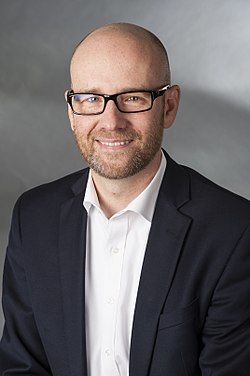
Erik Marquardt
Erik Marquardt (born 20 October 1987 in Neubrandenburg) is a German politician of Alliance 90/The Greens and a photojournalist who has sat…
- Facts0
- Drivers0
- Indicators0
Erik Marquardt (born 20 October 1987 in Neubrandenburg) is a German politician of Alliance 90/The Greens and a photojournalist who has sat…
Erik Marquardt (born 20 October 1987 in Neubrandenburg) is a German politician of Alliance 90/The Greens and a photojournalist who has sat in the European Parliament since 2019. He was elected in the 2019 European Parliament election, when the German Greens took 20.5 percent of the vote and 21 of Germany’s seats, and was returned at the 2024 European Parliament election from eighth place on the party’s common federal list. He is a member of the Greens–European Free Alliance. In July 2024, after the Greens’ vote fell to 11.9 percent and their German delegation shrank from 21 seats to 12, he became leader of that delegation, with Hannah Neumann and Alexandra Geese as deputies, succeeding Rasmus Andresen.
A 2017 profile of his candidacy in Berlin-Treptow–Köpenick described him as spokesperson of the Green Youth in 2014–2015 and, immediately afterwards, a member of the Greens’ federal party council. The same interview presented him as having grown up in Wilhelmshagen and as then living in Berlin-Weißensee, and it identified him as the Greens’ direct candidate for the 2017 Bundestag election in constituency 84, where the party was seeking second votes rather than the constituency seat. Official results for that constituency gave the Greens 5.0 percent of first votes (7,755) and 7.8 percent of second votes (12,168).
Before he entered the European Parliament he worked as a freelance photojournalist on flight routes. In a first-person report for Der Tagesspiegel he described the informal camp at Idomeni, on the Greek border with what was then referred to as Macedonia, where several thousand people were living in tents. In the summer of 2017 he sailed with the volunteer rescue ship Sea-Eye; the same newspaper reported that the crew came upon four disabled rubber boats carrying about 500 people. Der Spiegel later wrote that this reporting, together with travel to Afghanistan and the Balkan route and rescues in the Mediterranean Sea, was the background he brought into parliamentary work.
In the Parliament his public profile has centred on asylum and the European Union’s external border. An October 2020 interview identified him as migration-policy spokesperson of the Greens/EFA group and quoted his view that the European Commission’s New Pact on Migration and Asylum would turn the model of the Greek island camps into legislation. Der Spiegel’s April 2020 portrait found him on Lesbos at the start of a “Leave No One Behind” campaign about the Moria camp during the COVID-19 pandemic, and it recorded that some figures he used in public, including the camp’s population, differed from counts given by authorities and United Nations agencies.
Erik Marquardt was born on 20 October 1987 in Neubrandenburg, in Mecklenburg-Vorpommern, according to the European Parliament’s member record; the federal returning officer lists the birth year 1987.
He grew up in Wilhelmshagen, in Berlin’s borough of Treptow-Köpenick. In a July 2017 Maulbeerblatt interview, given while he was the Alliance 90/The Greens candidate in that Bundestag constituency, he said he had grown up there and spent most of his life in the district, recalling friends and evenings at the Müggelsee; the introduction said he was then living in Berlin-Weißensee. Those accounts do not name a school.
By January 2010 Marquardt was a student in Faculty II of the Technische Universität Berlin. At its meeting on 26 January 2010, the university’s Commission for Teaching and Studies recorded that he had put himself forward for a vacant student seat and recommended that the students in the academic senate appoint him until 31 March 2011. On a profile of the national student union freier zusammenschluss von studentInnenschaften (fzs), archived in October 2014, he described himself as studying chemistry and politics in Berlin and at the FernUniversität in Hagen. He wrote that, from his first semester, he had worked in AStA departments at TU Berlin, the teaching commission, the Kuratorium (board of trustees), the student parliament, Campusgrün, the education strike, local politics, and the action alliance against tuition fees.
In October 2023, asked on Abgeordnetenwatch whether he had finished any of his programmes with a bachelor’s or master’s degree, he did not name a completed degree. He wrote that he had worked full-time in committees and offices since 2010 and, from 2014, as a freelance photographer and photojournalist, and that a bachelor’s course begun alongside that work could be completed only after he left the European Parliament, because he could not take several consecutive months for a thesis.
Minutes of the TU Berlin Kuratorium list “Herr Marquardt” among the internal university representatives at the sittings of 24 January 2012 and 25 July 2014. On 24 May 2013 the fzs published his open letter to university president Jörg Steinbach, signed as a board member and Kuratorium member. He wrote that Steinbach, as first-instance legal supervisor, meant to object to a new basic statute giving the four status groups equal seats (Viertelparität) in the extended academic senate, a plan science senator Sandra Scheeres had also questioned legally, and argued that supervision should not overturn that decision.
The fzs members’ assembly in Würzburg, held from 5 to 7 August 2011, elected Salome Adam, Marquardt, Christin Eisenbrandt and Torsten Rekewitz to the board, with the term starting on 1 September 2011. On 1 September 2012 the union said he was beginning a second term, with Katharina Mahrt and Dorothea Hutterer. He named as priorities the abolition of tuition fees before the 2013 state elections in Lower Saxony and Bavaria, and more study places. Its list of former boards records another election for 2013/14 and a resignation soon afterward, with Jan Cloppenburg chosen at a later assembly. On the archived profile he said he covered several Länder and the committees on study reform, constituted student bodies and the political mandate, and women’s and gender policy.
On 25 January 2012 he was an invited expert for the fzs at a public hearing of the Bundestag Committee on Education, Research and Technology Assessment, chaired by Ulla Burchardt (SPD), on whether tuition fees changed the willingness to study. The Bundestag’s account says he sided with the Deutsches Studentenwerk in calling fees a deterrent and socially selective, and in treating education as a human right the state had to secure. Der Spiegel reported that he was the only student among the experts, spoke without reading a text, and said “Menschenrechte kauft man nicht, die muss der Staat sicherstellen,” prompting murmuring until Burchardt told the room to let the opening statement finish. The magazine wrote that, once he had finished, no one returned to the point.
From 2013 to 2015 Marquardt held federal office in the Green Youth (Grüne Jugend), the youth organization of Alliance 90/The Greens. In a later party-council application he listed himself as political managing director (politischer Geschäftsführer) for 2013–2014 and as a federal spokesperson for 2014–2015, alongside Theresa Kalmer. On 13 November 2014 taz described him as having led the organization for about a month. He was still named as spokesperson in early October 2015; at the party congress the next month, Jamila Schäfer spoke for the Green Youth.
In February 2014, while he was political director, the Green Youth pressed the parent party on the planned Transatlantic Trade and Investment Partnership. At the European delegates’ conference in Dresden it demanded that the talks be stopped; Kalmer said only that line would be credible in the European election. Delegates instead backed a compromise, promoted by co-chair Simone Peter and Bundestag group leader Anton Hofreiter, to suspend the talks and seek a new mandate.
At the April 2015 congress in Bremen, coverage reported that solo moves such as that of Winfried Kretschmann, Green minister-president of Baden-Württemberg, were unwelcome. The year before he had agreed in the Bundesrat to a CDU–SPD asylum reform, and a delegate said such compromises had to be carried by the membership. Marquardt, then 27, said he saw no sharp divide between “Realos” and idealists; he and Kalmer wanted the federal party to accept controversy and stand by its demands. The exchange with co-chairs Cem Özdemir and Peter was described as tame.
On 6 January 2015, after Gregor Gysi of Die Linke proposed talks on a federal red-red-green government, Marquardt and Kalmer criticized Özdemir for rejecting the offer. Marquardt said the Greens should name negotiators from both wings, while noting differences with the Left on foreign policy and a limited overlap with the CDU and CSU.
On the evening of 3 October 2015, the 25th anniversary of German reunification, the Green Youth tweeted: “Am 3. Oktober wurde ein Land aufgelöst und viele freuen sich 25 Jahre danach. Warum sollte das nicht noch einmal mit Deutschland gelingen?” Der Tagesspiegel treated it as a provocation disliked in parts of the Greens’ own camp. Bundestag member Dieter Janecek suggested the youth wing use fewer drugs, and CDU general secretary Peter Tauber called the post nonsense and demanded a distancing. Michael Kellner, the party’s political director, said the Greens did not want to dissolve Germany; a wiser tweet, he said, would have asked why unification should not succeed again at European level. Marquardt called Unity Day a day of warning: if a European state without secured external borders could no longer be discussed aloud, borders in people’s minds had not been overcome.
Asylum dominated the Greens’ delegates’ conference in Halle (Saale) from 20 to 22 November 2015. The lead motion, “Ja, so schaffen wir das!”, kept the line that not everyone who applies for asylum in Germany can stay, while calling for safe routes, including humanitarian visas, and for decent accommodation. Delegates rejected Green Youth amendments to delete that sentence and to let refugees choose their country in the European Union. Schäfer said the youth wing would not accept the party being “blackmailed” by the federal government; Robert Habeck and Kretschmann defended a more pragmatic course. A later study, using archives and an interview with Marquardt, says the youth board had lobbied left-wing specialists and counted those visa and shelter lines as partial gains. The same weekend he was elected to the 16-member party council (Parteirat), with the co-chairs and Kellner ex officio and Habeck, Hofreiter, Katrin Göring-Eckardt and Ska Keller among those chosen.
On 11 May 2016 the Institut Solidarische Moderne, a cross-party workshop whose board also included Left and SPD politicians such as Katja Kipping and Hilde Mattheis, listed him on its executive after a reorganization it dated to April. The appeal “Mit der Demokratie neu beginnen” proposed local forums, across parties, for a left social-ecological project, with the 2017 election as a first deadline rather than a contest of candidates. It named no coalition, but it sat beside the case he had made in January 2015 for testing red-red-green talks.
On 25 March 2017 the Berlin Greens placed him sixth on their Bundestag list. He was also the direct candidate in constituency 84, Berlin-Treptow–Köpenick; the federal returning officer listed him as a photographer born in 1987. He received 7,755 first votes (5.0 percent). The Greens took 12,168 second votes there (7.8 percent), and Gysi won the seat for the Left with 39.9 percent. Berlin returned three Green list members and one direct mandate; Marquardt was not among them.
In January, as a party-council member just back from two weeks in Kabul and around Mazar-i-Sharif, he told taz there was no safe place in Afghanistan: the Taliban held whole districts, and UNHCR plus the foreign ministry’s travel warning contradicted an interior-ministry view that Kabul was safe enough for deportation. He called a paper by Green ministers from ten Länder, which treated returns as possible in principle, a “sham debate,” and said the party should attack the federal government rather than ask it to look again.
By 2015, while a federal spokesperson of the Green Youth, Marquardt was working in Berlin as a freelance photojournalist. From July to September he and the Berlin journalist Björn Kietzmann traveled more than once from Lesbos through the Balkans toward Germany. In October their pictures were shown as "seeking human rights" at the library of the Technical University of Berlin. Marquardt said the show should raise, without answering, how much suffering people in flight had to bear.
Der Tagesspiegel reported that in August 2015 about 1,000 people a day were landing on Lesbos's north coast, many from Syria, Afghanistan and Iraq, after paying smugglers about 1,000 euros for often overcrowded inflatable boats. Marquardt, there with Kietzmann, described short moments in which "some cry with happiness, others laugh." Captions on a January 2016 photo essay from the Heinrich Böll Foundation place him at Skala Sykamineas again in November and cite International Organization for Migration figures that more than 500 people died on the crossing that year, though the Turkish coast was often under 10 kilometres away.
The same captions follow the route inland. At Moria, which his August 2015 text calls a former deportation site then used as a European Union "hotspot" for faster registration, he wrote that the grounds looked "like a large prison." In October he wrote that supplies were at times so poor that hundreds waited days in the rain to register, and that some slept in discarded refrigerators. In Gevgelija, in present-day North Macedonia, August captions describe police overwhelmed by crowds, violence on the border with Greece, waits of a week or longer, and a rule letting through only people from Syria, Iraq and Afghanistan. In Belgrade he photographed an exhausted family and people sleeping at the bus station, writing that few hostels would take them.
Der Spiegel used his photographs on 29 October 2015 from Idomeni, including Katrin Göring-Eckardt with a young Afghan mother, when it reported 5,000 to 9,000 arrivals a day. On 1 April 2016 Tagesspiegel published his account of the informal camp. He wrote that he had come to help and to show people "with dreams, wishes and hopes," not "a sad mass," and put the number in tents for more than a month at 8,000 to 15,000. He described dancing, offers of tea, and military camps closed to aid groups and journalists, where people told him medical care was scarce, while German centres stood empty and people in Greece "have to live in the mud." Those Moria captions predate the EU–Turkey statement of 18 March 2016, which provided for the return to Turkey of new irregular arrivals on the Greek islands from 20 March; the Idomeni report concerns people already stopped at the land border.
In January 2017 Marquardt spent two weeks in Kabul and around Mazar-i-Sharif. He told taz on 23 January that cross-country travel was impossible, that the Taliban held whole districts, and that the cities he saw were militarized, with checkpoints and houses behind high walls: "I had the feeling of being in a war zone." He said nowhere was safe, citing a recent statement by the United Nations High Commissioner for Refugees, embassy staff who had not left their compound for months, and the Federal Foreign Office travel warning, against the Interior Ministry's view that places such as Kabul were safe enough for deportation.
Organized returns had just begun. On 5 October 2016 tagesschau reported an EU arrangement with Afghanistan, published before a Brussels donor conference, under which Kabul would take back people who had entered Europe, alongside European financial support. On 13 December Der Spiegel reported that the first charter of rejected Afghan asylum seekers, planned for about 50 people, was to fly from Frankfurt to Kabul. Marquardt called a paper by ministers of Alliance 90/The Greens in ten states, which treated such deportations as possible in principle, a "domestic sham debate" with "nothing to do with reality," and said: "There are no safe areas in Afghanistan. I convinced myself of that personally."
At a photo lecture in Wertingen, reported by the Augsburger Allgemeine on 18 March 2017, he described children carrying rubbish sacks larger than themselves, adults searching gutters or working as day labourers, and a "zombie bridge" where, he said, men smoked opium and people froze to death daily. "The state does not take care of them," the paper quoted him, calling the lecture a document of despair.
The Böll essay of 12 January 2016 published the route pictures, including Hungary and Serbia. From the week of 7 April 2016, 24 photographs made between August 2015 and January 2016 were shown in Potsdam as "Die Balkanroute – Grenzen überwinden," organized by the Greens. Tagesspiegel said they showed "terrible and also beautiful moments," notably a widely shared picture of a boy dressing on a beach; the opening included Marquardt, Annalena Baerbock, and a young man who had come by that route.
More than 60 people, including Afghan refugees, heard the Wertingen lecture; the paper said one woman cried. On 5 May 2017 the foundation's Brandenburg office hosted "Afghanistan – Sicheres Herkunftsland?" in Potsdam, followed by a discussion with the Green MEP Ska Keller and the asylum lawyer Rolf Stahmann. From 28 May to 24 June 2018 the Technical University showed "Flucht nach Europa," grouped as Afghanistan, the Balkan route, and—separately from that land-route record—civilian rescue at sea. In the university notice he wrote that he wanted to point "factually and humanly" to individual cases when flight rarely filled front pages.
In 2017 Marquardt sailed as a volunteer with the Regensburg organization Sea-Eye in the central Mediterranean Sea, off Libya. A Tagesspiegel report of 2 July 2017 described the third day of that voyage: the ship closed on four disabled, overcrowded inflatable boats carrying about 500 people. The paper put deaths on the crossing that year at about 1,800. On 18 July Der Spiegel reported Interior Minister Thomas de Maizière telling the Funke newspapers that Italian investigators were examining claims some rescue ships hid their position and used searchlights in Libyan waters to signal smugglers. Marquardt, then on the party council of Alliance 90/The Greens, wrote that this joined a campaign of lies without facts. Sea-Watch called the claims baseless; Ärzte ohne Grenzen said they lacked evidence and distracted from states' own failure to rescue. Spiegel cited more than 93,000 arrivals in Italy that year and 2,207 deaths recorded by the International Organization for Migration.
In 2018 he crewed Sea-Eye's Seefuchs, about 26 metres long. In late May it took 138 people from a rubber boat. He told Tagesspiegel they spent days unsheltered on deck and that the missing help looked like Italian harassment. Sea-Eye said Rome ordered the ship about 200 kilometres toward Augusta and would not move the passengers while it listed. A patrol took 24 people; the rest, 126 including the crew, reached Porto Empedocle on 29 May, then headed for Valletta. In a Tagesspiegel essay on 20 June he wrote that five weeks on the Seefuchs and Sea-Watch 3 had seen hundreds rescued and dozens drowned, that crews acted only with the official centre, and that he was ashamed governments would rather let people die than rescue them, while backing what he called a violent Libyan coast-guard militia.
On 7 July 2018, days after Malta seized Lifeline, presenter Klaas Heufer-Umlauf asked viewers to fund charters under #Civilfleet and promised the money would be used as intended. In ten days 7,428 people gave 297,036 euros. Civilfleet-Support was formed to hold it, with Marquardt as chairman and Sea-Watch co-founder Ruben Neugebauer as treasurer. They chartered the Golfo Azzurro, a 1987 trawler already used by other groups, then under Panama's flag.
It never sailed for them. Marquardt told Die Welt that other ships, including the Aquarius, had lost Panamanian registration, presumably under Italian pressure, so the group and the owner tried to reflag to Vanuatu. Citing Addendum, Welt reported that about 206,675 euros, more than two-thirds of the donations, went into reflagging, a loan, a sickbay, life jackets, a reinforced tank and charter fees during the refit. The plan was abandoned in August 2019. Addendum and Welt treated the outcome as a failure of the voyage and of candour: donors went months without a public update, and the 2018 accounts were unfinished. Marquardt could not confirm the figures. He said gear, fuel and a loan might still be recovered, and that the gifts had also paid for a Sea-Eye mission rescuing 17 people and a speedboat on Sea-Watch 3, including 53 people saved with Carola Rackete's crew. Civilfleet admitted the silence, said it had answered individual donors, and argued that quitting at the first flag problem would have been easier but wrong while almost no civilian rescue ship was at sea.
In early 2020 Marquardt was on Lesbos. He told taz that far-right checkpoints had been set up and that journalists, aid workers and refugees were being attacked; he had heard of beatings with steel chains. A child drowned that Monday after 48 people got into distress, which he said the Greek coast guard confirmed. About 20,000 people in the Moria refugee camp were left without help because staff stayed away and roads were blocked. Police, he said, often watched and were also overwhelmed. Islanders' anger at being left alone by the European Union was understandable, he added, but not a licence for violence, and Greece's announced suspension of asylum was unlawful.
With COVID-19 spreading, he wrote for the Heinrich Böll Foundation that Moria, built for about 3,000 people, held far more, with one tap for about 1,300 residents, and that an outbreak would be unstoppable; an aid post had been burned. Tagesspiegel, after four weeks on the island, headlined his warning that the virus in the camp would be hell. He said he had co-created Leave No One Behind to demand evacuation and solidarity with refugees, homeless people, the old and the sick. On 18 March 2020 Spiegel reported the petition, naming presenter Joko Winterscheidt among the first signatories, with more than 20,000 signatures. The petition's early-signatory list also included actor Lars Eidinger, Rackete and Marquardt. Ärzte ohne Grenzen told Spiegel that health care did not exist in Moria.
After the Taliban took Kabul in August 2021, Marquardt helped organize a donated evacuation. On 25 August the Frankfurter Rundschau reported that dozens of groups, including Leave No One Behind, Sea-Watch and Seebrücke, had chartered an aircraft. Marquardt said it had been organized in consultation with the government, and that a reckoning with what he called the government's failure could wait. The alliance kept evacuation lists, planned to use spare money for aid, and withheld operational detail.
The Neue Zürcher Zeitung reconstructed the flight. With journalist Theresa Breuer and Neugebauer, Marquardt chartered an Airbus A320 after a smaller plane was barred from landing. Backing from the Federal Foreign Office brought a military designation and landing clearance, which the paper called the start of Kabul Luftbrücke. Nearly 200 people were expected; the aircraft left with 18 Afghans on a Portuguese list, not the airlift's. On the night of 29 August, 189 people were flown out on a United States Air Force plane. By late October the NZZ put the total at 579 people in two months, only German citizens or holders of a written admission promise: former local staff, judges, artists and journalists among them. Neugebauer said civilians were doing the ministry's job — eleven of those taken out were German citizens — and called that shameful. The Foreign Office rejected the charge and said more than 1,300 people had left Afghanistan with federal support since the end of August. The government put former local staff still eligible to leave at more than 40,000, or up to 70,000 including others judged especially vulnerable.
In the 2019 European Parliament election, held in Germany on 26 May 2019, Erik Marquardt stood eighth on the federal list of Alliance 90/The Greens. The Greens received 7,677,071 votes (20.5 percent) and 21 of Germany's seats, ten more than in 2014, so eighth place was enough for a mandate. In his November 2018 application for a winnable place he asked to be sent to the European Parliament to press an asylum and migration policy centred on dignity, criticised EU financing of a Libyan coast-guard militia, and cited deaths in the Mediterranean and right-wing populism as reasons for standing. Reporting at the time described him as a Berlin photographer and former federal spokesperson of the Green Youth who entered Parliament at the first attempt.
He took office on 2 July 2019 as a member of the Greens–European Free Alliance for Bündnis 90/Die Grünen, and the ninth-term mandate ran until 15 July 2024. A Greens/EFA press release of 18 July 2019, as EU interior ministers discussed sea rescue and relocation, named him the group's spokesperson on flight and migration.
On 10 July 2019 the Committee on Development elected him fourth vice-chair for the first half of the term; he had been an ordinary member only from 2 to 9 July. Parliament's open-data record lists a Development vice-chair mandate from 10 July 2019 to 19 January 2022 and another from 20 January 2022 to 15 July 2024. He was a substitute on the Committee on Civil Liberties, Justice and Home Affairs from 2 July 2019 and a full member from 9 November 2022 until the end of the term, and from 6 April 2022 a substitute on the Committee on Foreign Affairs.
He was a member of the delegation for relations with the Mashreq countries from 2 July 2019 and its vice-chair from 26 September 2019 to 15 July 2024. For the whole term he sat on the delegation for relations with Afghanistan and was a substitute in the delegation to the Parliamentary Assembly of the Union for the Mediterranean; he was a substitute for relations with Iraq until 16 February 2022.
On 27 September 2021 the Development committee adopted an opinion, dated 11 October 2021, for the Civil Liberties committee on legal migration policy and law (procedure 2020/2255(INL), document DEVE-AD-695032). Pierrette Herzberger-Fofana, also Greens/EFA, was rapporteur; Marquardt attended the final vote and voted in favour. The roll call was 14 in favour, 11 against and one abstention; committee chair Tomas Tobé and several other European People's Party members voted against. The opinion treated the New Pact on Migration and Asylum as an attempt to address asylum, integration and borders, called for work on conflict, poverty and climate as drivers of movement, and asked for an impact assessment focused on developing countries. It favoured a solidarity mechanism over the first-country-of-arrival rule, free movement in the Schengen Area for people granted international protection, and wider legal pathways, including for low- and medium-skilled work. It said EU talent partnerships should not be tied to returns or border control, and that official development assistance should not be used to manage migration or to externalise control. In a minority opinion, Bernhard Zimniok called the pact an attempt to legalise irregular migration and argued for returns and a stop to migration.
Priority question P-9-2021-004779, published by Marquardt as a joint question from several members, concerned a Naples ruling that had sentenced an Italian ship captain to one year in prison for returning 101 rescued people to Libya with the Libyan coast guard. The signatories asked how the European Commission would monitor cooperation with Libya and withdraw support that led to forced returns; how it and the Frontex management board would stop the agency contributing to such returns by involving that coast guard; and in how many cases Frontex alerts had been followed by a return to Libya. Ylva Johansson answered on 21 December 2021 that EU priorities included rights-compliant rescue, an end to arbitrary detention, and support for IOM returns and UNHCR evacuations. She wrote that notifying the competent rescue centre, including the recognised Libyan centre, was required by international law; that Frontex plans required non-refoulement; that no Frontex ship had disembarked people in Libya; and that Frontex had been asked for the figures.
After the 2021 German federal election, Marquardt was one of four Green members of the working group on flight, migration and integration in the talks among the Social Democratic Party of Germany, the Greens and the Free Democratic Party (Germany). Business Insider's list of 23 October 2021 named Luise Amtsberg, Marquardt, Dirk Adams and Filiz Polat for the Greens; Boris Pistorius, Frank Schwabe, Nancy Faeser and Aydan Özoguz for the SPD; and Joachim Stamp, Hans-Ulrich Rülke, Linda Teuteberg and Stephan Thomae for the FDP.
On 29 October 2021 Der Spiegel reported that the FDP and the Greens were disputing refugee policy while Alexander Lukashenko had thousands of people taken to the EU border, and presented that situation, involving Belarus, as a severe test for the coalition talks.
In the 2024 European Parliament election in Germany, held on 9 June 2024, Marquardt was re-elected to the European Parliament from place 8 on the nationwide list of Alliance 90/The Greens (Bündnis 90/Die Grünen). The Federal Returning Officer recorded the party at 11.9 percent of the vote, down from 20.5 percent in 2019, and at 12 of Germany’s 96 seats, down from 21. He took his seat for the tenth parliamentary term on 16 July 2024 as a member of the Greens–European Free Alliance.
The reduced German delegation reorganized its leadership the same week. Marquardt told the Deutsche Presse-Agentur that he would lead the twelve German Green members, with Hannah Neumann and Alexandra Geese as deputies, succeeding Rasmus Andresen; the Tagesspiegel reported the arrangement on 16 July 2024. He described the post as that of Delegationsleiter and said he wanted Germany’s dependence on Europe to figure more clearly in public debate and inside the party. The office is the leadership of the national delegation within the Greens/EFA group, not the presidency of that group.
From 19 July 2024 he has been a full member of the Committee on Civil Liberties, Justice and Home Affairs (LIBE) and a substitute on the committees on Development (DEVE), Budgetary Control (CONT) and Culture and Education (CULT). From 19 September 2024 he has been a full member of the Delegation to the EU–Türkiye Joint Parliamentary Committee and a substitute on the delegation for relations with the People’s Republic of China.
CONT appointed him on 23 September 2024 as rapporteur for the 2023 discharge of the EU agencies, procedure 2024/2030(DEC).&l=en) Report A10-0065/2025 was tabled on 14 April 2025, and on 7 May Parliament adopted the resolution by 503 votes to 121, with 26 abstentions: discharge was granted for the agencies covered except the European Union Agency for Asylum, whose discharge was postponed and sent back to committee.&l=en) A second report, A10-0169/2025, tabled on 29 September, led on 22 October to discharge for the agency’s executive director and closure of the 2023 accounts, by 476 votes to 99, with 72 abstentions, after the European Court of Auditors had given reasonable assurance on the accounts.&l=en) Marquardt voted for both, and the final act was published on 13 January 2026.&l=en)
In LIBE he was Greens/EFA shadow rapporteur for two amendments to the Asylum Procedures Regulation: the “safe third country” concept, 2025/0132(COD), rapporteur Lena Düpont (European People’s Party), and an EU list of safe countries of origin, 2025/0101(COD), rapporteur Alessandro Ciriani (European Conservatives and Reformists).&l=en)&l=en) On 17 December 2025 the plenary confirmed negotiations on the safe-third-country file by 384 votes to 237, with 31 abstentions. Greens/EFA members overwhelmingly voted against; Marquardt did not vote in that roll-call. In a group statement that day he said the centre-right was “teaming up with far-right groups to weaken the EU’s Migration & Asylum Pact before it even enters into force” by widening safe-country rules, shifting the burden of proof onto applicants and easing outsourcing.
On 21 January 2026 Parliament adopted, by 334 votes to 324, with 11 abstentions, resolution B10-0060/2026, asking the Court of Justice of the European Union whether the proposed EU–Mercosur Partnership Agreement and the interim trade agreement were compatible with the treaties. It was not a ratification vote. Marquardt voted in favour, as did eight of the twelve German Green members; Daniel Freund and Sergey Lagodinsky voted against, Martin Häusling abstained, and Michael Bloss did not vote. The majority drew on 36 Greens/EFA members, all 38 voting members of The Left, 72 members of Patriots for Europe, 24 members of Europe of Sovereign Nations, and minorities of the European People’s Party (43) and the Socialists and Democrats (35).
In a watson interview published on 22 January 2026, Marquardt said his side had not voted on the substance of the deal and wanted provisional application while the court examined climate effects and a rebalancing mechanism that, he said, could require the EU to pay compensation if its rules blocked imports. Of the majority, he said a result that depended on far-right votes could not be explained away: “Das ist ein bedauerlicher Fehler, zu dem auch ich beigetragen habe. Das ist kein gutes Signal.” He noted that more conservatives than Greens had voted yes, and said the Greens would not back far-right motions or negotiate with the far right. A Frankfurter Allgemeine Zeitung commentary on 24 January, “Gegen Mercosur: Die grünen Trumpisten”, argued that the German Greens were not supporting Europe’s effort to rely less on the United States and were aiding populism, and named Marquardt among those who had sent the agreement to the court.
On 23 September 2020 the European Commission tabled the New Pact on Migration and Asylum. President Ursula von der Leyen, Vice-President Margaritis Schinas and Home Affairs Commissioner Ylva Johansson presented it as a balance of responsibility and solidarity: faster border procedures, returns deals with countries outside the European Union, more legal pathways, and an intact right to seek asylum. The draft joined compulsory pre-entry screening to an asylum border procedure and replaced the Dublin Regulation with "flexible solidarity"—relocation, "return sponsorship", money or staff.
Marquardt, migration spokesperson for the Greens–European Free Alliance, rejected that reading in an October 2020 interview with the Heinrich Böll Foundation, a body close to the German Greens. "Migration management", he said, was a euphemism for repelling refugees, and the draft would legislate camps on the model of Moria on Lesbos. Five-day screening and detention of up to twelve weeks would not produce fair decisions and were meant to deter; return sponsorship was "a contender for misnomer of the year"; and Greece and the other southern states would carry more, not less. Concessions had still not won Viktor Orbán or Poland, so he argued for a coalition of willing states and cities.
The Council of the European Union and the European Parliament agreed the core texts on 20 December 2023: a mandatory border procedure, without authorisation to enter, for security cases, misleading applicants and nationalities with a recognition rate under 20 percent, and compulsory but flexible solidarity—relocation, money or staff—benchmarked at 30,000 relocations and €600 million a year, with no duty to relocate. On 10 April 2024 the asylum-procedures regulation passed 301–269, with 51 abstentions, and the management regulation 322–266, with 31 abstentions, on votes of the European People's Party, the Socialists and Democrats and Renew Europe.
Greens/EFA opposed most files, including those two, and backed only the reception-conditions recast and the resettlement framework. The argument split Alliance 90/The Greens. After the June 2023 Council line, backed by Interior Minister Nancy Faeser and Foreign Minister Annalena Baerbock, Marquardt called it a sweep for right-wing positions. He told taz that wider safe-third-country rules could reject Syrian and Afghan claims without a merits hearing, and that a party text he supported criticised the tightening without ordering Green ministers to block it.
In 2020 he said the Pact created no EU rescue operation in the Mediterranean Sea, only a non-binding suggestion not to criminalise rescuers and rules that would sideline small NGO ships, with rescued people held in closed border camps. In July 2021 he told RedaktionsNetzwerk Deutschland, on the 70th anniversary of the Convention Relating to the Status of Refugees, that the EU was breaching the Convention on a large scale by outsourcing asylum policy.
A UN fact-finding mission reported in March 2023 reasonable grounds to believe crimes against humanity had been committed against migrants in Libya, and asked states to stop supporting the Libyan actors involved, including the coast guard. His question E-000847/2024 asked about a March incident in which a patrol boat described as EU-donated fired near the rescue ship Humanity 1. Johansson replied that Frontex could not assign a place of disembarkation and that the support was capacity-building presented as consistent with international law. The 18 March 2016 EU–Turkey statement had already paired returns from the Greek islands with one Syrian resettled per Syrian returned and up to €6 billion for refugees in Turkey. In November 2023 he told Ippen.Media that the July memorandum with Tunisia, negotiated by von der Leyen, Giorgia Meloni and Mark Rutte with President Kais Saied, had failed: announcing a closed route raised departures, and money for an autocrat let Saied raise the price.
In July 2022 Der Spiegel, Le Monde and Lighthouse Reports described a classified inquiry by the European Anti-Fraud Office: Frontex had known Greek forces were abandoning people in the Aegean, covered the incidents up and co-financed some of the vessels. Greece denied any breach. Director Fabrice Leggeri resigned on 28 April 2022, and Parliament refused the 2020 discharge on 18 October. On 7 January 2025 the European Court of Human Rights, in A.R.E. v. Greece, found strong indications of systematic Evros pushbacks to Turkey and awarded €20,000 for breaches of the bans on ill-treatment and of the rights to a remedy and to liberty. Greece had denied the case and the practice.
On the Belarus border he told Deutschlandfunk on 25 September 2021 that Alexander Lukashenko's use of people as leverage, and Poland's refusal to register asylum claims, were both outrageous.
The Development Committee's opinion on legal migration, rapporteur Pierrette Herzberger-Fofana of Greens/EFA, passed on 27 September 2021 by 14 votes to 11, with one abstention. It called safe and legal channels fundamental, treated legal migration as useful to development in countries of origin and of destination, and asked for an impact assessment of the Pact on developing countries rather than spending those funds only on returns and control. Marquardt voted with his group. The opinion fed Parliament's resolution of 25 November 2021 on new routes for legal labour migration, the line behind the group's later yes to the Pact's resettlement regulation and no to its border-procedure files. In November 2023 he told Ippen.Media that Germany needed more, not less, migration for its economy, that the deportation rhetoric of Chancellor Olaf Scholz would help only the radical right, and that deals failed when they offered partners nothing but returns.
In July 2021 Rowohlt published his paperback Europa schafft sich ab. Wie die Werte der EU verraten werden und was wir dagegen tun können (240 pages, €14). The title inverts Thilo Sarrazin's Deutschland schafft sich ab. In taz on 23 September 2021, Christian Jakob wrote that the thesis reversed Sarrazin: not immigration or "moralism", but the dropping of Europe's own values. The review describes reporting from the Balkan route, Lesbos, rescue ships and Aegean pushbacks, set against colonialism, the Nazi-era turning back of Jews at the Swiss border, the Refugee Convention and Dublin. Marquardt did not discard the Union; Jakob noted his argument that separate nation-states would not treat refugees better, and that the lever was civil society and cities offering to receive people.
German reporting has often cast Marquardt as an activist using a parliamentary seat. In the 2 April 2020 Der Spiegel profile “Der Parlamentsaktivist,” Valerie Höhne described a new MEP who spent weeks on Lesbos, posting videos and promoting Leave No One Behind, and who said he was unsure where practical politics ended and activism began. The piece also noted imprecise figures: he spoke of 25,000 people in the Moria camp when official counts were about 20,000, and Spiegel corrected a Mediterranean-arrival statistic.
His 2021 Rowohlt book Europa schafft sich ab inverted the title of Thilo Sarrazin’s Deutschland schafft sich ab. In die tageszeitung, Christian Jakob called the title unoriginal but wrote that the reversal was the point: not immigration, but departure from the European Union’s legal standards, was the danger. He treated it as firsthand reporting from Lesbos, the Balkans and the Mediterranean, and noted that Marquardt still defended the Union against a return to separate nation-states.
On 3 October 2015, the anniversary of German reunification, the Grüne Jugend posted: “Am 3. Oktober wurde ein Land aufgelöst und viele freuen sich 25 Jahre danach. Warum sollte das nicht noch einmal mit Deutschland gelingen?” Read as a wish to dissolve the Federal Republic, the line was attacked by CDU general secretary Peter Tauber, who called it “unglaublichen Stuss,” and by Erika Steinbach, who said the Greens should not be a coalition partner if the leadership agreed. Bundestag member Dieter Janecek mocked the wording, and political director Michael Kellner said the party did not want to dissolve Germany. Marquardt, then a youth-wing spokesperson, called it a provocation for a European state without secured external borders, writing that “borders in people’s minds” had not been overcome. In May 2019 Correctiv rated as false a claim, revived in the AfD magazine AfD Kompakt, that the Greens planned to abolish Germany. The tweet was the background; the 2019 European programme proposed debating models such as a United States of Europe, not dissolving the state.
In 2018 presenter Klaas Heufer-Umlauf raised €297,036 from 7,428 donors for civilian rescue in the Mediterranean. Civilfleet, chaired by Marquardt, chartered the Golfo Azzurro, which never sailed for the group. Addendum, in “Kein Schiff wird kommen,” reported that about €206,675 had gone into the project. Die Welt reported reflagging costs, a loan to the owner and a Dutch foundation tied to a Panama company; Marquardt called that normal in shipping and said the 2018 accounts were not finished, so he could not confirm the sum. Welt corrected a headline that nobody had been rescued after he cited support for a Sea-Eye mission that saved 17 people and a boat on Sea-Watch 3 used by Carola Rackete’s crew. In Die Zeit he blamed Matteo Salvini’s pressure on Panama and a failed switch to a Vanuatu flag—“Bei unserem Projekt haben die Seenotrettungsgegner gewonnen”—and said publicity had been limited because it brought further obstacles, though donors who asked were answered. Heufer-Umlauf said the money was spent in good faith and that he would do it again.
On 21 January 2026 the European Parliament voted 334 to 324, with 11 abstentions, to ask the Court of Justice of the European Union to review the newly signed EU–Mercosur agreement. Marquardt, leader of the German Green delegation, voted for the referral with a Green majority, the Left and most of the far right; conservatives, Social Democrats and liberals were mostly opposed. The Frankfurter Allgemeine Zeitung answered with “Gegen Mercosur: Die grünen Trumpisten.” Felix Banaszak and other Green leaders criticized the result, and Foreign Minister Johann Wadephul said anyone who spoke of a firewall had to meet that standard. Marquardt told Bayern 2 the signal was wrong, a majority only with the far right was a mistake, and “das haben wir versemmelt,” while calling the vote a legal check, not a blockade. A Zeit interview was headlined “Im Nachhinein war das ein Fehler.” On Deutschlandfunk he said common cause with the far right must not recur, and accused European People's Party Group chair Manfred Weber of rejecting compromise.
Ranked by shared high-impact facts, then explicit ties, then shared drivers.
 Ursula von der LeyenUrsula von der Leyen is a German CDU politician and…Affiliated
 Margaritis SchinasMargaritis Schinas is a Greek politician and former civil…Affiliated
 Viktor OrbánViktor Orbán is a former Hungarian prime minister…Affiliated
 Winfried KretschmannWinfried Kretschmann (born 17 May 1948) is a German…Affiliated
 Katrin Göring-EckardtKatrin Dagmar Göring-Eckardt is a German politician of the…Affiliated
 Peter TauberPeter Michael Tauber (born 22 August 1974) is a German…Affiliated
How the record is sourced and how the score is derived.
The score is formula-derived (Factrail formula v1, version 1.0.0), not an editorial verdict. Read the methodology.
By the Factrail desk · Method: how we source and score · Last reviewed
Dispute a fact on this pageNamed here, or represent someone who is? Request a right of reply.
Linked because the text names them, not because anything was measured.
Built from the indicator links of the drivers this text names. A profile of coverage, not a score.