The offices he actually held
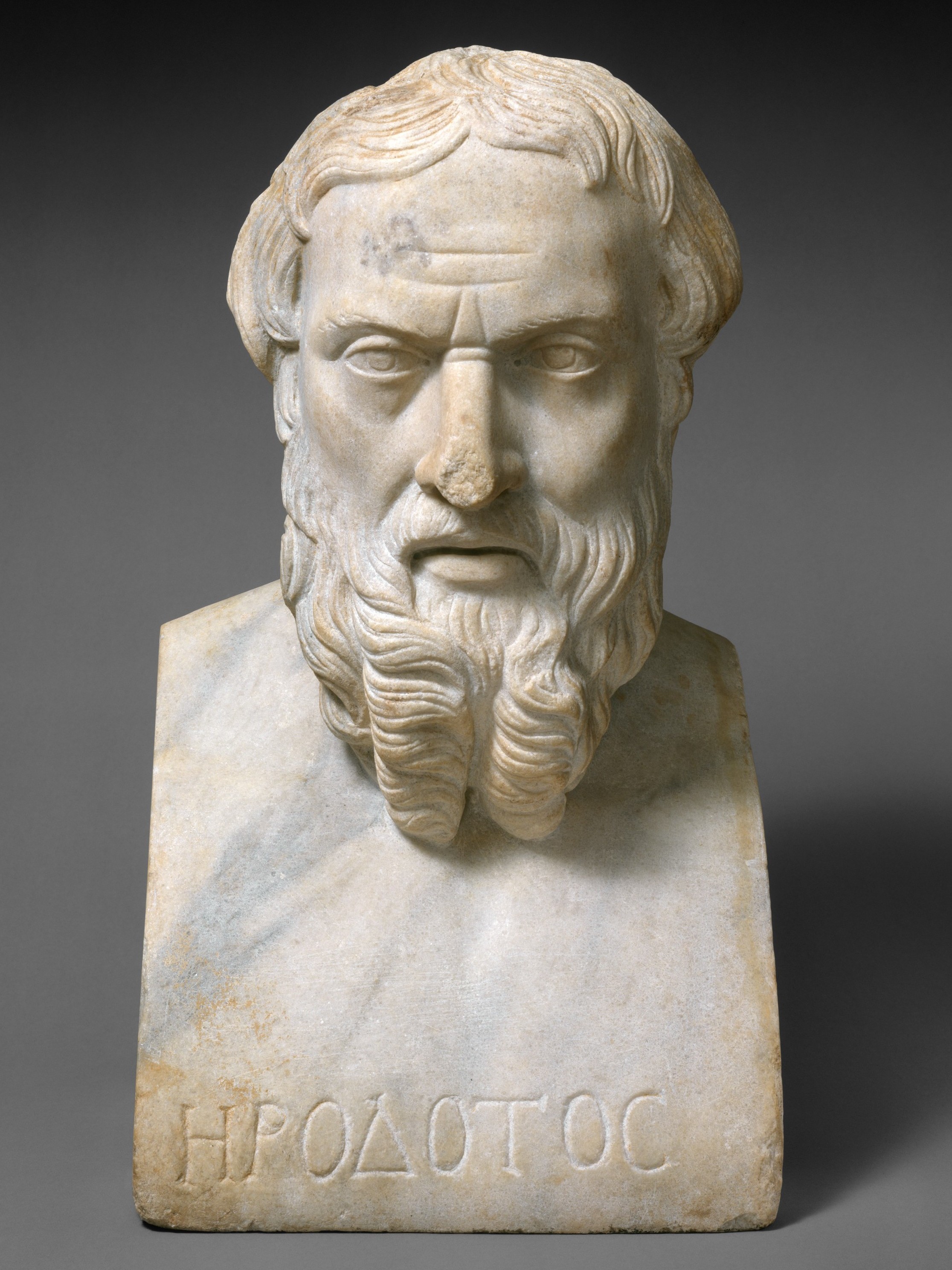
Herodotus is an inquirer, not a magistrate of a recovered Halicarnassus archive. Britannica at https://www.britannica.com/biography/Herodotus-Greek-historian (opens in a new tab), Stanford at https://plato.stanford.edu/entries/herodotus/ (opens in a new tab), IEP at https://iep.utm.edu/herodotus/ (opens in a new tab), and the Cambridge Companion at https://www.cambridge.org/core/books/cambridge-companion-to-herodotus/ (opens in a new tab) are independent public files. Perseus Godley English at https://www.perseus.tufts.edu/hopper/text?doc=Perseus:text:1999.01.0126 (opens in a new tab) is a later carrier used to locate logoi, not a 1920 act of his hand. Livius at https://www.livius.org/articles/person/herodotus/ (opens in a new tab) marks the vita as thin. The Met bust at https://www.metmuseum.org/art/collection/search/247002 (opens in a new tab) is a Roman copy.
The first fact about his power is a book. The second is a set of logoi inside that book — Egyptian types, war, speeches — that still move classrooms. The third is a later marble that must not be upgraded to a face.
What went wrong
Later lives put him in a tyranny's city. The Egyptian logos types a people. Barbaros works as othering. Palace anecdotes school wives as plot. Tribute and captives are the machine. Miletus is sacked in the Ionian logos. Thermopylae becomes a poster. Athens burns. Marathon is a killing-field logos. Helots appear as furniture. There is no autograph. Olympia recitation is a later claim. Pyramid labour is a mass-work story. Cambyses is a mad-king file of low confidence.
What improved
The proem of historié. Otanes' isonomia speech, which is not Herodotus' vote. Both-sides orations. Opsis, akoē, gnōmē. Nomos as king. Nile theories compared. Names of peoples. Artemisia as commander. Croesus as a cause-question. Inscriptions cited. Thurii as a later panhellenic notice. A medical remark. A road-file. A marked refusal to vouch.
Related people: Thucydides as later counterpart; Xerxes and Darius as kings of the logoi; Leonidas at the pass; Aeschylus of Persians; Plutarch as later critic; Homer as poetic neighbour; Pericles as neighbouring Athens; Solon in the Croesus logos; Cyrus in Book 1.
The live Person UUID is the production identity. A Roman copy is not a sitting. Nine books are not nine mornings. Later Loeb, UNESCO, and encyclopedia pages are evidence, not additional acts. Related 2024–2025 news about COP, NATO, or a chancellorship is not a relation. Shared work remains named. What would change the reading is a contradictory original with a different date or signatory. Shared work remains named. Shared work remains named. Shared work remains named.