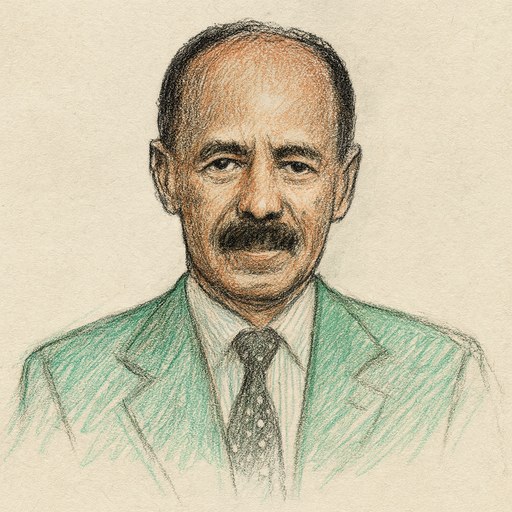
Isaias Afwerki
Eritrean head of state and co-signatory of the 2018 declaration.
- Partial1
- Facts1
- Drivers1
- Indicators5
- Related people0
Eritrean head of state and co-signatory of the 2018 declaration.
Factrail analysis (scoped / needs review): recorded here only for his role in the 2018 Eritrea–Ethiopia peace declaration, which the model logs as a positive contribution on that specific event. This is not a broader assessment of his governance, which is documented and contested elsewhere.
Isaias Afwerki’s slice of Factrail’s verified causal web — the facts, drivers and welfare indicators their actions connect to. Select any node to trace a path.
Loading network…
Projected scenarios from the Factrail model. These describe what may happen under stated assumptions — they are not confirmed facts and may change as new data arrives.
Horizon: Jun 9, 2026 – Dec 31, 2027
Under a baseline in which global immunization investment only partially recovers and vaccine hesitancy stays elevated, MCV1 coverage holds near its 83-84% plateau and the global under-five mortality rate continues to fall but more slowly, remaining above the SDG 3.2 normal line of 25 per 1,000 through 2027.
Assumptions
Assumes no major new donor surge or pandemic-scale disruption; immunization-investment intensity stays near its partially recovered ~0.75 level; vaccine hesitancy remains elevated relative to pre-2017; ~14.5 million zero-dose children are only gradually reduced. A baseline, not a worst case.
This is a projected scenario, not a confirmed fact.
Updated
Horizon: Dec 31, 2026 – Dec 31, 2027
Assuming the recent cadence of mediated settlements continues and no new great-power war erupts, Factrail projects global conflict deaths to remain well below the 2022 peak of ~401,500 yet stubbornly above the ~50,000 normal-line baseline, with the conflict-displacement stock easing only marginally given its stickiness.
Assumptions
Assumes (1) the Pretoria ceasefire and comparable settlements hold; (2) armed-conflict intensity stays near its 2023 estimated level (~0.85) rather than re-spiking; (3) no new large interstate war begins; (4) displacement remains a slow-moving stock that eases only with a long lag. A re-escalation in any major theatre would invalidate the baseline.
This is a projected scenario, not a confirmed fact.
Updated
Horizon: Jul 1, 2026 – Dec 31, 2028
Factrail's baseline projection is a slow, partial rise in the V-Dem judicial constraints index through 2028 as sustained EU accountability pressure and Poland's restoration work against court capture, but with the global rule-of-law recession capping the gain. The recovery is modest and lagged, not decisive.
Assumptions
Assumes EU enforcement tools (penalties, conditionality, post-Article 7 monitoring) remain active; Poland's restoration is not reversed by cohabitation; Hungary does not regress sharply enough to offset gains; and the broad global rule-of-law recession continues, limiting any upside. Impact strengths and lags follow the dossier's driver-indicator links (~540-day lag for accountability pressure).
This is a projected scenario, not a confirmed fact.
Updated
| Promise | Status | Deadline |
|---|---|---|
End the state of war with Ethiopia and reopen bilateral links | Partially fulfilled | — |
A chronology will appear once enough dated facts are linked.
No affiliated people are linked yet.
A scoped record is not a biography, and the distinction governs everything in this profile. Factrail tracks Isaias Afwerki for exactly one documented action: his role as co-signatory, alongside Ethiopian Prime Minister Abiy Ahmed, of the Joint Declaration of Peace and Friendship signed in Asmara on 9 July 2018. The aggregate here reflects that declaration and nothing wider. It is not a verdict on his governance, which is documented and contested elsewhere and is deliberately not weighed in this dataset.
The anchoring fact is the 2018 Joint Declaration of Peace and Friendship between Eritrea and Ethiopia, recorded as a July 2018 policy event with high confidence and verified status. Its significance is concrete: the declaration formally ended a roughly two-decade interstate state of war between the two countries and reopened diplomatic, transport and trade links that had been severed for a generation. As a co-signatory, Afwerki shares authorship of that act with the Ethiopian side, and the model assigns responsibility accordingly rather than to one signatory alone.
The dataset flags the entry as scoped and as needing review. That flag is not a doubt about whether the declaration was signed; it is an instruction about how far any inference should travel from this single event.
Factrail reads the declaration as strengthening the peacebuilding and mediation efforts driver, the documented channel most directly attached to Afwerki's profile. From there the chain reaches a set of welfare indicators, but it does so with a deliberate time-lag and at medium confidence. This is the crucial interpretive point: effective interstate settlements tend to ease conflict-related harms over time, but the linkage is a tendency, not a measured outcome attributable to any one signature.
That cautious framing is built into the structure of the estimates. The model is not claiming that this declaration produced a specific number of saved lives; it is claiming that a verified peacebuilding act plausibly pushes a family of conflict-sensitive indicators in a favourable direction, and it discounts that claim for confidence and indirectness.
Four of the five connected indicators register favourably in the model's accounting. The two most direct are the global deaths in armed conflicts series compiled from UCDP data and the stock of people internally displaced by conflict and violence tracked by the IDMC, both indicators where lower values mean a more peaceful, less uprooted world. The chain also reaches the global under-five mortality rate and the primary-school out-of-school rate, reflecting the well-understood pattern that easing armed conflict tends to improve child survival and access to schooling.
The fifth connection runs the other way and is worth naming for balance. The estimate against the WJP Rule of Law Index is small and negative in this accounting. Its magnitude is near zero, so it neither overturns the favourable picture nor should be ignored; reporting it is part of keeping positive and negative estimates visible in the same frame rather than presenting only the supportive side.
The honest boundaries here are unusually clean. Responsibility and influence for the event are shared with the Ethiopian side. The durability of the rapprochement the declaration promised lies outside what these facts capture, and subsequent regional developments are not part of this scoped record. Everything the indicators suggest is a modelled tendency with a built-in lag, not a confirmed consequence.
The entry should be read as event-specific and as needing review before any wider inference is drawn.
This profile is a clear example of what a deliberately narrow, evidence-anchored record looks like. It isolates one verified act, traces a plausible but indirect chain to indicators that effective settlements tend to ease, and refuses to let that chain become a general character assessment. The value of such scoping is precision: it lets a single peacebuilding signature be weighed for what it documentably is, while explicitly fencing off the broader and far more contested questions that this dataset does not attempt to answer.