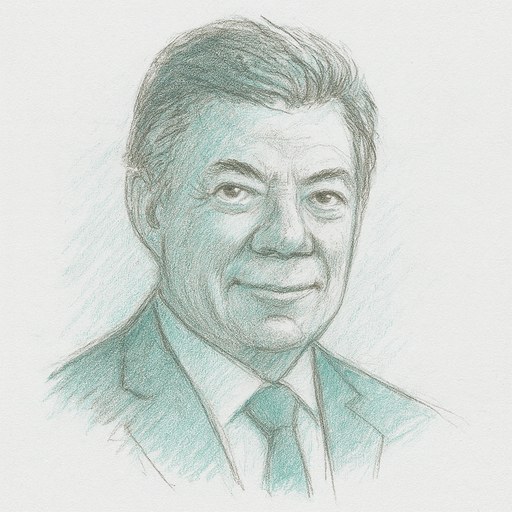
Juan Manuel Santos enters the Factrail dataset for one reason, and it is a consequential one: as President of Colombia, he carried four years of negotiations in Havana to a signed conclusion, producing the 2016 Final Peace Agreement between the government and the FARC-EP. That single tracked event is the entire basis of his profile here, and everything the model says about him flows from it. This is not a biography of a presidency; it is a scoped reading of how one peacebuilding action propagates through Factrail's causal graph toward measurable welfare outcomes.
Who he is in this context
Santos is recorded in the dataset specifically as the head of state who concluded a formal settlement to one of the longest-running internal armed conflicts of the modern era. The agreement was reached in November 2016, after an earlier version of the text was narrowly rejected in the October plebiscite and then renegotiated. It formally ended more than five decades of fighting and was recognized internationally with the Nobel Peace Prize. The dataset classifies his contribution as direct and positive in welfare direction, with a high-influence responsibility weighting, on the grounds that his government drove the process to a signed accord.
Crucially, the model does not treat him as the sole author of the outcome. Responsibility is framed as shared across the signatory parties — the Government of Colombia and the demobilizing FARC-EP — rather than attributed to one individual. This matters for how the score should be read: it is a measure of one person's documented role in a multi-party achievement, not a verdict on a single actor's heroism.
The causal chain
Factrail reads the peace agreement as an input to two related drivers. The first and most heavily weighted is armed-conflict intensity, a conflict-dynamics driver carrying a high weight in the model. The second is peacebuilding and mediation efforts, a peace-process driver of more moderate weight. Together these channels translate the act of signing into pressure on a set of welfare indicators.
The strongest positive linkages run toward security indicators where lower values are better. The agreement is associated with downward pressure on global deaths in armed conflicts, the highest-importance security indicator in this set, and on people internally displaced by conflict and violence, which tracks the stock of those still uprooted by insecurity. The model also extends the chain into adjacent human-development measures — under-five mortality and the out-of-school rate for primary-age children — on the analytical premise that reduced violence tends, over time, to relieve the conditions that drive child mortality and educational exclusion. These secondary links should be read as the model's interpretation of how peace propagates, not as directly observed Colombian outcomes.
Positive and negative impacts, honestly weighed
In the rating-impact records, the largest individual contributions are positive. The single strongest is the link through the armed-conflict-intensity driver to global conflict deaths, followed closely by the link to internal displacement. The contributions through the peacebuilding driver and toward child mortality and schooling are also positive, if smaller. On the net indicator picture, the displacement and conflict-deaths indicators carry the heaviest positive readings, consistent with the model treating de-escalation as the primary mechanism at work.
The picture is not uniformly positive, and the dataset does not pretend otherwise. The contributions toward the WJP Rule of Law Index register as slightly negative in the rating impacts. The honest reading of this is not that the agreement weakened the rule of law, but that the model's wiring between a conflict-resolution action and a governance-quality index is weak and ambiguous in sign — a reminder that not every welfare dimension responds the same way to the same event, and that small negative values here reflect modelling tension rather than a documented harm.
The benefits of a peace accord are inseparable from its implementation, and on that front the record is uneven.
Uncertainty and limitations
The most important caveat is structural. A signed agreement is a moment; its welfare payoff depends on years of follow-through. Implementation in Colombia has been uneven, and violence has persisted in some regions despite the formal settlement. The model's reading captures the documented direction of one tracked action, not a comprehensive verdict on the full presidency, on contested aspects of the peace process, or on the security situation that followed. The extensions into child health and education are analytical inferences about how reduced conflict ought to propagate, carried at modest magnitude, and they should be treated as hypotheses the dataset is willing to state rather than findings it can confirm.
Why it matters
What makes this profile worth reading is precisely its narrowness. Factrail is not adjudicating whether Santos was a good president; it is tracing how a specific, verifiable act of ending an armed conflict registers across a structured set of welfare indicators. The exercise shows both the promise and the limits of causal attribution: the direction of effect is clear and well-grounded in the conflict-dynamics literature, while the magnitude remains contingent on factors no single signature can guarantee. Read as a scoped, evidence-anchored signal — not a final judgement — the entry argues that concluding a fifty-year war is the kind of action whose welfare logic the model can credibly map, even as the durability of those gains stays an open question.