A Gaza City apartment strike tests what a ceasefire means on the ground
TL;DR
Reports of four or five deaths in a residential strike matter not only as a casualty count but as a test of whether negotiated restraint constrains the use of force in densely populated areas. An Israeli air attack on a residential building in western Gaza City early on October 3 killed civilians according to Palestinian medical reporting.
By the Factrail desk · Method: how we source and score · Last reviewed
Key graph impact
The article explains graph entities; the causal edges belong to the facts and drivers it links to.
- ArticleA Gaza City apartment strike tests what a ceasefire means on the ground
- mentionsDriverIsrael–Gaza war (Oct 2023+)
- strengthensIndicators (6)Global deaths from organized violence (UCDP)
Strengthens · 85% impact strength
Observed
245k deaths per year · 195k above the normal line (2025)
Worse than normalAbove normal = worse
Strengthens · 85% impact strength
Observed
69M people (stock, end-of-year) · 28M above the normal line (2025)
Worse than normal3 readings, 2023–2025: rose from 68M people (stock, end-of-year) to 69M people (stock, end-of-year).
Above normal = worse · Lag ~7 d
Strengthens · 40% impact strength
Observed
11% of primary-school-age children · 11 above the normal line (2023)
Worse than normalAbove normal = worse
Strengthens · 40% impact strength
Observed
27.9% · 19.9 above the normal line (2024)
Worse than normal7 readings, 2018–2024: rose from 21.5% to 27.9%.
Above normal = worse
Article
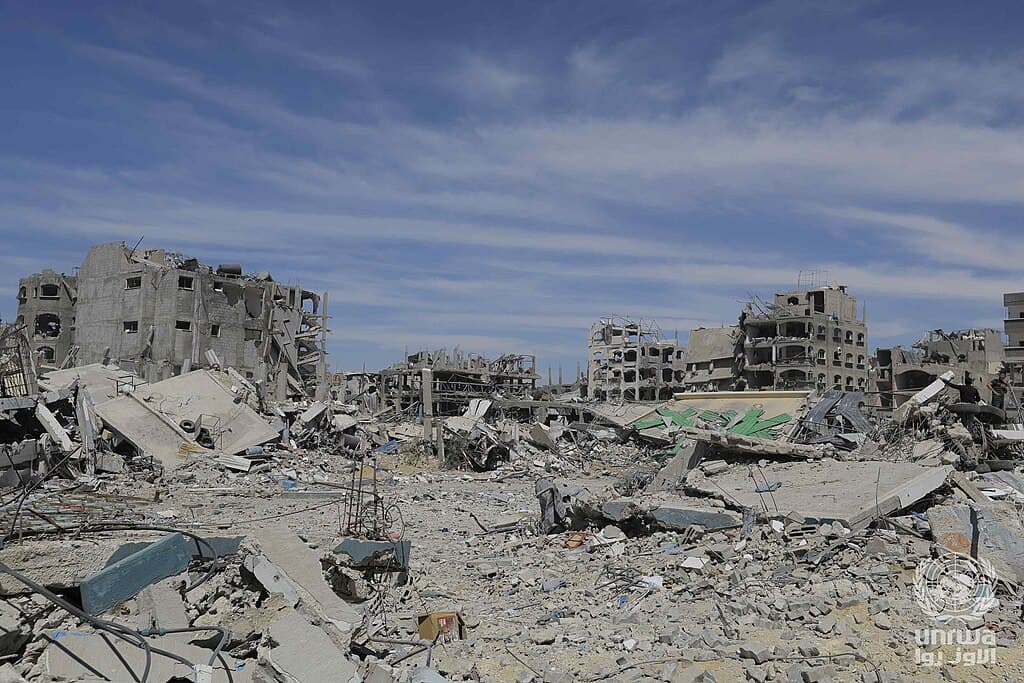
An Israeli air attack on a residential building in western Gaza City early on October 3 killed civilians according to Palestinian medical reporting. Al Jazeera, citing al-Shifa Hospital, reported at least five deaths, including four women, and at least six wounded. A separate wire-derived report gave a death toll of four. Until the discrepancy is resolved, Factrail should preserve the disagreement rather than convert either number into false precision.
The larger issue is not simply whether the final count is four or five. It is what civilian protection looks like after diplomatic agreements have repeatedly been described as steps toward ending the Israel–Gaza war (opens in a new tab).
Factrail records that the October 2025 Gaza ceasefire took effect (opens in a new tab), that a second phase of a Gaza ceasefire plan was launched in January 2026 (opens in a new tab), and that Israel had previously resumed major Gaza strikes in March 2025 (opens in a new tab). Those facts establish a history of negotiated restraint, renewed force and subsequent diplomacy. They do not by themselves determine whether the October 3 attack violated the current agreement or international humanitarian law.
That question depends on facts not yet available publicly: the intended target, the intelligence used to identify it, the expected military advantage, the anticipated civilian harm, feasible precautions and the precise rules still governing military operations under the current arrangements.
What is already observable is the welfare mechanism. The reported strike hit an apartment in the Remal area during the night. Residential buildings compress military decisions and civilian exposure into the same physical space. Where civilians are sleeping, even a geographically limited strike can affect multiple floors, start fires and force rescuers to operate under continuing aerial activity.
That makes targeting discipline a central accountability lever. A ceasefire has practical value only insofar as it changes behaviour. Diplomatic language can reduce violence if it produces enforceable limits, monitoring, communication channels and consequences for violations. If civilians remain exposed to repeated lethal force while negotiators argue over implementation, the institutional promise of a ceasefire and the lived reality of a ceasefire diverge.
Benjamin Netanyahu (opens in a new tab) heads the Israeli government responsible for national policy and the conduct of the war at the political level. That does not make him personally responsible for every tactical targeting decision. Nor does linking Mahmoud Abbas (opens in a new tab) supply responsibility for Hamas actions; his relevance is to the wider Palestinian political system, not command over Hamas operations in Gaza.
The distinction is important because accountability deteriorates when every actor is assigned every consequence. Factrail’s causal standard should remain narrower: identify who controls the policy lever being discussed.
For this incident, those levers include Israeli rules governing air operations, the quality of target verification, the protection of civilians and the diplomatic mechanisms designed to constrain renewed escalation. The disputed casualty number should remain disputed. The structural question is clearer: after multiple ceasefire milestones, civilians in Gaza still face lethal exposure, and the credibility of those agreements depends on whether they materially restrict the use of force rather than simply describe political intent.
Evidence
The sources this article cites, claim-bearing material first.
- International Criminal Court · ICC — Pre-Trial Chamber I rejects Israel's jurisdiction challenges and issues arrest warrants for Benjamin Netanyahu and Yoav Gallant, 21 November 2024 · 21 Nov 2024
More analysis
Ranked by shared facts, drivers and people — never by publication date alone.
Articles12
- A named Hamas target does not erase the civilian bill from an Israeli strikeShares the driver: Israel–Gaza war (Oct 2023+) · 4 October 2026
- Israel turns remembrance into a border shutdown — and Gaza aid absorbs the security decisionShares the driver: Israel–Gaza war (Oct 2023+) · 4 October 2026
- The October 7 Accountability Fight Is About Who Knew What — and WhenShares the driver: Israel–Gaza war (Oct 2023+) · 4 October 2026
- Benjamin Netanyahu’s ‘Ceasefire’ Still Has a Rising Death Toll in GazaShares the driver: Israel–Gaza war (Oct 2023+) · 5 October 2026