Sudan's war is making the road to food part of the battlefield.
TL;DR
An air attack on clearly marked WFP trucks killed a driver on the Dilling-Kadugli route. In a hunger crisis, destroying access to aid multiplies harm beyond the immediate strike.
By the Factrail desk · Method: how we source and score · Last reviewed
Key graph impact
The article explains graph entities; the causal edges belong to the facts and drivers it links to.
- ArticleSudan's war is making the road to food part of the battlefield.
- mentionsDriverSudan civil war (SAF↔RSF 2023+)
- strengthensIndicators (6)People Internally Displaced by Conflict and Violence (IDMC)
Strengthens · 90% impact strength
Observed
69M people (stock, end-of-year) · 28M above the normal line (2025)
Worse than normal3 readings, 2023–2025: rose from 68M people (stock, end-of-year) to 69M people (stock, end-of-year).
Above normal = worse · Lag ~7 d
Strengthens · 85% impact strength
Observed
245k deaths per year · 195k above the normal line (2025)
Worse than normalAbove normal = worse
Strengthens · 40% impact strength
Observed
11% of primary-school-age children · 11 above the normal line (2023)
Worse than normalAbove normal = worse
- Worse
Strengthens · 40% impact strength
Observed
27.9% · 19.9 above the normal line (2024)
Worse than normal7 readings, 2018–2024: rose from 21.5% to 27.9%.
Above normal = worse
Article
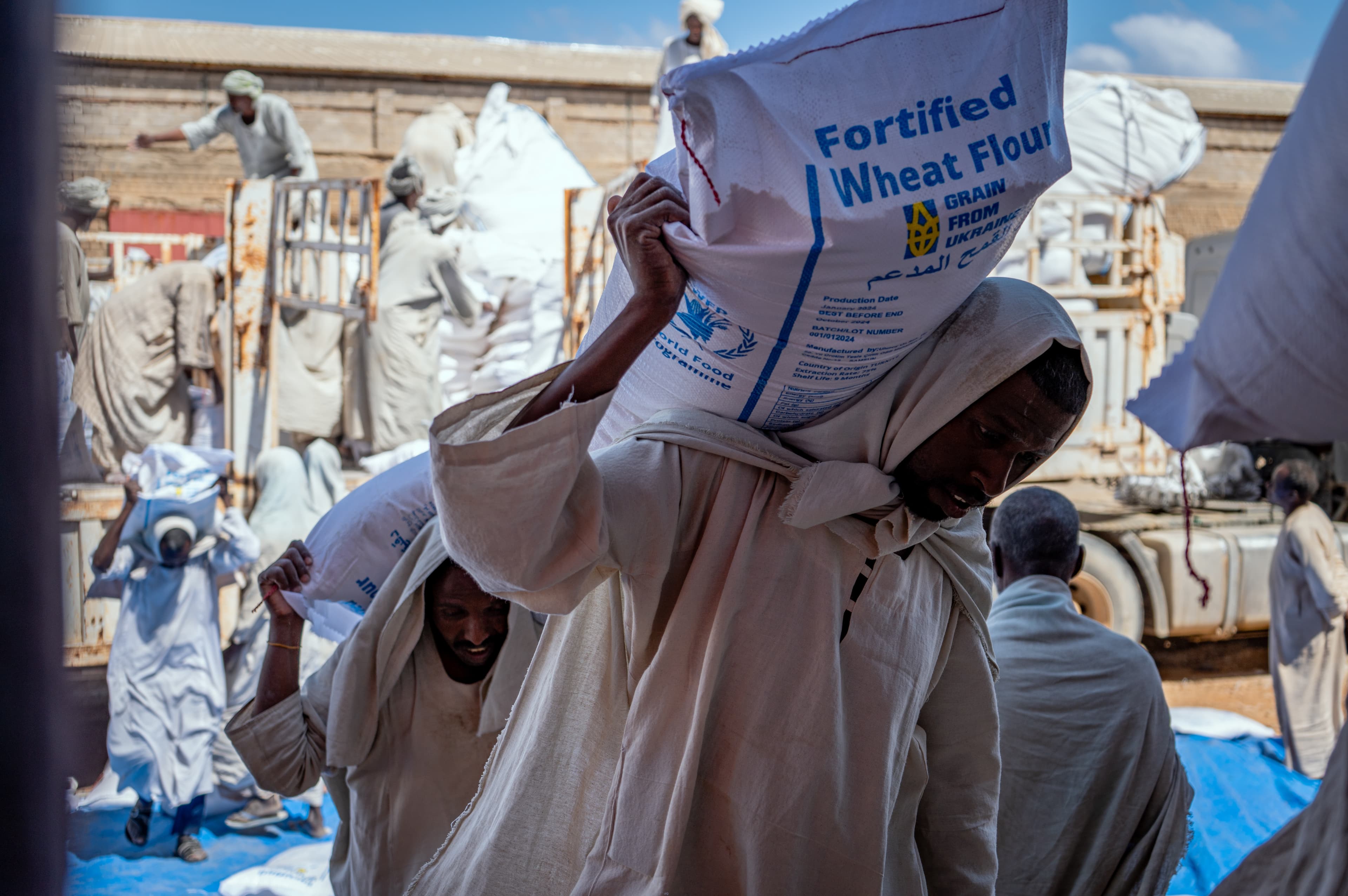
Two trucks contracted by the World Food Programme were carrying food from Dilling toward Kadugli in South Kordofan when an aerial attack struck them in the early hours of October 3. One driver was killed. WFP says the vehicles were clearly marked as humanitarian trucks and has demanded a prompt, impartial investigation.
The attack is more than another violent incident inside the Sudan civil war (opens in a new tab). In a conflict producing extreme hunger and obstructing humanitarian access, the ability to move food is itself part of the welfare system being destroyed.
That causal distinction matters. The immediate harm is the death of a driver and damage associated with the strike. The secondary harm can be much larger: greater danger for aid workers, interrupted deliveries, higher logistical costs, delayed food and fewer routes that humanitarian organizations can use with acceptable risk.
WFP has not publicly assigned responsibility in its statement. That restraint matters. The Sudan Doctors Network blamed drones belonging to the Rapid Support Forces, but an allegation by a medical organization is not equivalent to the impartial investigation WFP is demanding. Factrail should preserve that difference rather than converting accusation into established attribution.
If responsibility is established, however, the accountability chain should reach the command structure behind the attack rather than stopping with the weapon. The RSF is led by Hemedti (opens in a new tab); the opposing Sudanese Armed Forces are led by Abdel Fattah al-Burhan (opens in a new tab). Their forces have driven a war whose open SAF-RSF phase began in April 2023, represented on Factrail by the live fact SAF-RSF open fighting begins (opens in a new tab).
The broader accountability point does not depend on prematurely assigning this specific strike. Both military systems operate inside a conflict in which civilians and humanitarian operations bear enormous downstream costs. Commanders are responsible not only for territorial objectives but for whether forces under their authority comply with obligations to protect civilians and humanitarian relief.
The timing makes the convoy attack particularly serious. WFP said it occurred just one day after another WFP truck struck an explosive device in Dilling after delivering food assistance. Taken together, the incidents show a delivery environment where simply moving food can expose drivers to lethal risk.
That creates a feedback loop. Conflict produces displacement and hunger. Hunger increases dependence on humanitarian delivery. Insecurity then makes delivery more dangerous and expensive. Reduced access deepens the original hunger produced by the conflict.
A truck therefore has analytical importance far beyond the vehicle itself. It is the physical link between stored food and a household that needs it. Destroy or deter enough of those links and food can exist in the humanitarian system while remaining inaccessible to the people for whom it was procured.
The legal demand is straightforward: humanitarian personnel and cargo must be protected, and WFP has called for those responsible for violations to be held accountable. The evidentiary demand should be equally strict. Investigators need to establish what platform carried out the attack, who operated it, what command chain authorized or failed to prevent it, and whether the clearly humanitarian character of the vehicles was visible to the attacker.
Until that attribution is established, the responsible actor for this particular strike should not be presented as settled fact.
What is already established is the welfare consequence. Sudan's war has made hunger worse, and the systems attempting to relieve that hunger are themselves operating under attack. When the road carrying food becomes another front line, military violence does not stop at the point of impact.
Sources: World Food Programme (opens in a new tab), UN News (opens in a new tab), Middle East Monitor (opens in a new tab).
Evidence
The sources this article cites, claim-bearing material first.
- en.wikipedia.org · Hemedti — English-language biographical orientation
More analysis
Ranked by shared facts, drivers and people — never by publication date alone.
Articles6
- Sudan's War Is Now Making Food Delivery a Lethal Job.Shares the driver: Sudan civil war (SAF↔RSF 2023+) · 5 October 2026
- Sudan’s army is gaining ground — but territorial momentum is not a civilian victoryShares the driver: Sudan civil war (SAF↔RSF 2023+) · 4 October 2026
- Umm Badr execution footage puts RSF field-command responsibility at the centre of Sudan's warShares the driver: Sudan civil war (SAF↔RSF 2023+) · 4 October 2026
- Sudan’s Arms Embargo Has a Geography ProblemShares the driver: Sudan civil war (SAF↔RSF 2023+) · 4 October 2026