Sudan's War Is Now Making Food Delivery a Lethal Job.
TL;DR
A clearly marked WFP convoy was hit between Dilling and Kadugli, killing a driver. The immediate perpetrator still requires investigation, but the larger accountability failure is already visible: Sudan's belligerents have made humanitarian access part of the battlefield.
By the Factrail desk · Method: how we source and score · Last reviewed
Key graph impact
The article explains graph entities; the causal edges belong to the facts and drivers it links to.
- ArticleSudan's War Is Now Making Food Delivery a Lethal Job.
- mentionsDriverSudan civil war (SAF↔RSF 2023+)
- strengthensIndicators (6)People Internally Displaced by Conflict and Violence (IDMC)
Strengthens · 90% impact strength
Observed
69M people (stock, end-of-year) · 28M above the normal line (2025)
Worse than normal3 readings, 2023–2025: rose from 68M people (stock, end-of-year) to 69M people (stock, end-of-year).
Above normal = worse · Lag ~7 d
Strengthens · 85% impact strength
Observed
245k deaths per year · 195k above the normal line (2025)
Worse than normalAbove normal = worse
Strengthens · 40% impact strength
Observed
11% of primary-school-age children · 11 above the normal line (2023)
Worse than normalAbove normal = worse
- Worse
Strengthens · 40% impact strength
Observed
27.9% · 19.9 above the normal line (2024)
Worse than normal7 readings, 2018–2024: rose from 21.5% to 27.9%.
Above normal = worse
Article
A truck carrying food is not supposed to be a front line. In Sudan, that distinction is collapsing.
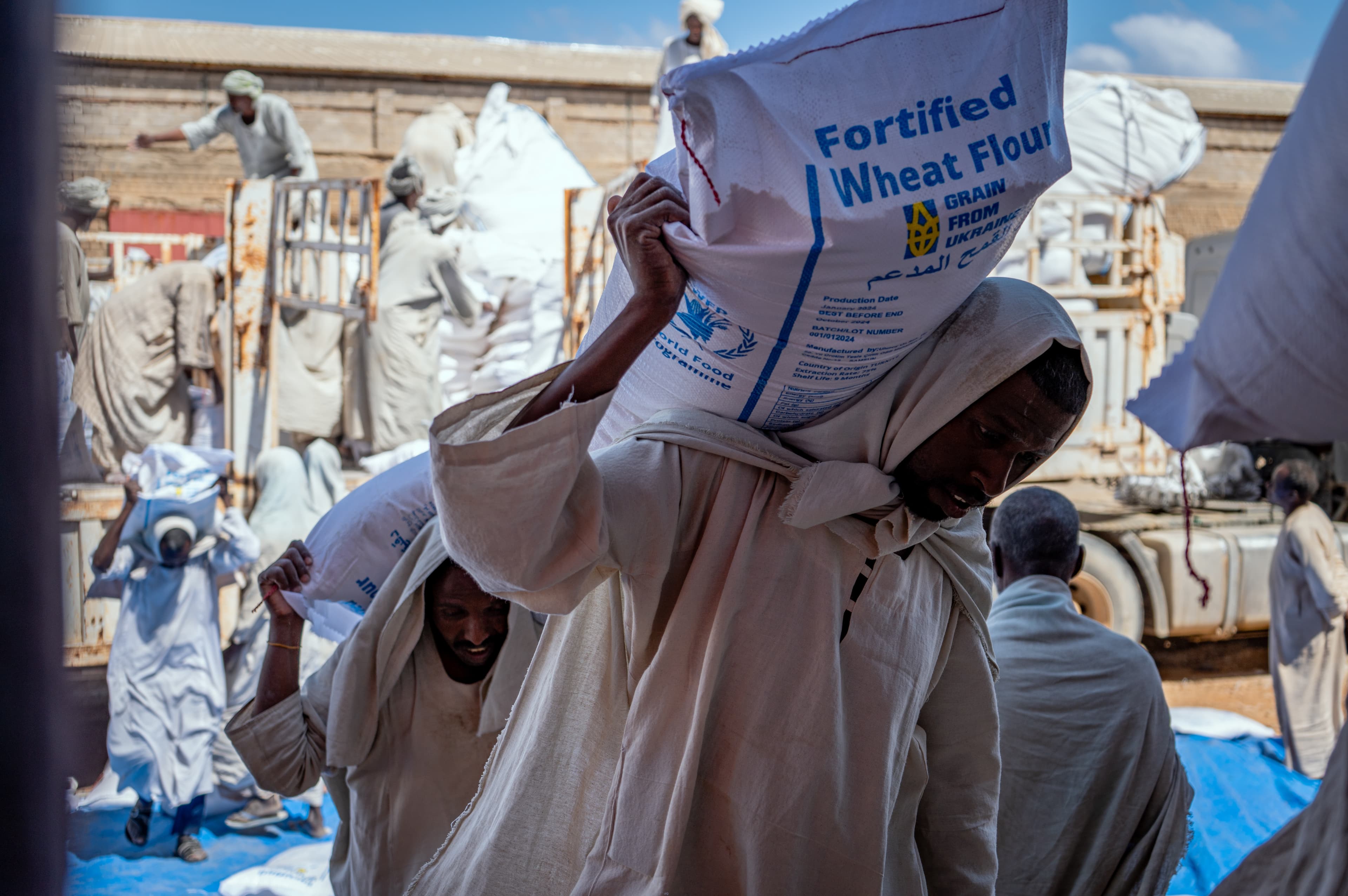
In the early hours of October 3, two contracted World Food Programme trucks carrying food from Dilling toward Kadugli in South Kordofan were hit in an aerial attack. One driver was killed. WFP says the vehicles were clearly marked as humanitarian transport and has called for a prompt and impartial investigation into what happened and who was responsible. (World Food Programme (opens in a new tab))
The agency has not publicly assigned responsibility for this particular strike. That uncertainty matters. Accountability reporting should not convert suspicion into attribution simply because Sudan's war (opens in a new tab) already has familiar perpetrators.
But uncertainty over the aircraft does not mean uncertainty over the system that made the attack possible.
Sudan's war between forces commanded by Abdel Fattah al-Burhan (opens in a new tab) and Mohamed Hamdan Dagalo, widely known as Hemedti (opens in a new tab), has converted basic civilian survival into a military-access problem. Food must cross front lines. Relief agencies must negotiate routes through territory shaped by armed control. Drivers become exposed to air attacks, drones, shelling, mines and unexploded ordnance while carrying supplies to people whose need was itself intensified by the war.
The October 3 attack was not even the first emergency on that route that weekend. WFP said that a day earlier another truck struck an explosive device in Dilling after delivering food assistance. (World Food Programme (opens in a new tab))
Sudan Tribune described the airstrike as the ninth documented attack affecting WFP operations in Sudan this year. (Sudan Tribune (opens in a new tab)) A month earlier, another aerial attack outside Dilling destroyed WFP food intended for Kadugli. The repetition changes the accountability question. It is no longer enough to describe humanitarian access as "difficult." A delivery system on which civilians depend is repeatedly being exposed to lethal violence.
That has a direct welfare consequence. Every destroyed truck, killed driver or suspended route increases the cost and danger of moving food into places already facing severe insecurity. The victims are not only aid workers. They include families who may never see the cargo.
The political lever sits with armed actors able to permit, obstruct or endanger humanitarian movement. The Sudanese Armed Forces and Rapid Support Forces cannot outsource responsibility for the humanitarian environment created by their war. Even when investigators cannot yet identify which side carried out a specific strike, commanders remain accountable for respecting humanitarian law, protecting civilian relief operations and ensuring that forces under their authority distinguish humanitarian vehicles from military targets.
WFP's demand for an impartial investigation therefore matters for more than assigning blame for a single death. Without attribution, evidence preservation and consequences, attacks on humanitarian logistics become background noise in a war already saturated with atrocities.
That normalization is itself a form of institutional failure.
Sudan's civilians are being asked to survive a conflict in which even the infrastructure designed to keep them alive can be attacked. A food truck should be one of the clearest protected objects in a war zone. When a clearly marked convoy can be struck on a known humanitarian route, the question is not merely whether aid can still get through.
It is whether Sudan's belligerents are being made to pay any political or legal cost when it does not.
Evidence
The sources this article cites, claim-bearing material first.
- en.wikipedia.org · Hemedti — English-language biographical orientation
More analysis
Ranked by shared facts, drivers and people — never by publication date alone.
Articles6
- Sudan's war is making the road to food part of the battlefield.Shares the driver: Sudan civil war (SAF↔RSF 2023+) · 5 October 2026
- Sudan’s army is gaining ground — but territorial momentum is not a civilian victoryShares the driver: Sudan civil war (SAF↔RSF 2023+) · 4 October 2026
- Umm Badr execution footage puts RSF field-command responsibility at the centre of Sudan's warShares the driver: Sudan civil war (SAF↔RSF 2023+) · 4 October 2026
- Sudan’s Arms Embargo Has a Geography ProblemShares the driver: Sudan civil war (SAF↔RSF 2023+) · 4 October 2026